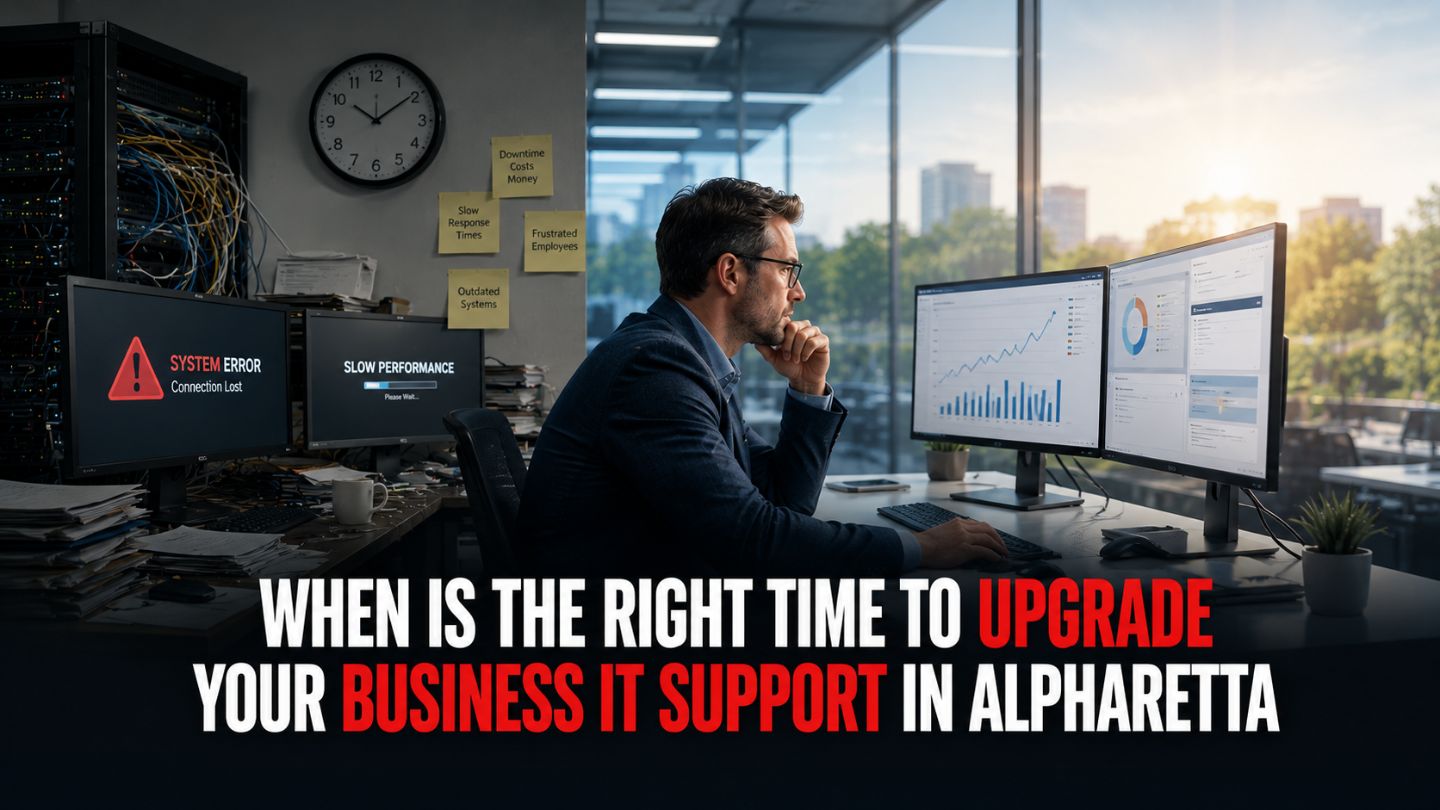
If your team is losing hours each week to slow systems, unresolved tickets, or recurring outages, your IT support has already fallen behind your business needs. For Alpharetta businesses operating in one of the most tech-dense corridors in the Southeast, the question isn’t whether to upgrade your IT support-it’s recognizing the right moment before outdated technology starts draining revenue and exposing your company to serious problems.
Alpharetta is home to roughly 900 technology-driven businesses and approximately 5,096 companies employing around 75,900 people. Sectors like fintech, healthcare, professional services, and insurance dominate the local economy, and each carries strict demands for uptime, security, and compliance. In this environment, settling for reactive or underperforming IT support isn’t just inconvenient-it’s a competitive disadvantage.
This blog walks you through the clear warning signs that signal it’s time for a technology upgrade, the business growth triggers that demand better support services, the common mistakes that delay critical transitions, and the strategic timing considerations that help you plan a smooth transition.
Key Takeaways
- Frequent downtime and slow response times from your IT team are the earliest indicators that your current setup needs an overhaul.
- Security vulnerabilities from outdated systems put Alpharetta businesses at heightened risk for breaches and compliance failures.
- Business growth-new hires, remote workers, cloud adoption-often outpaces legacy IT support capabilities.
- Reactive IT support can lead to increased downtime and costs, making proactive managed IT services the smarter long-term investment.
- A documented IT strategy aligns technology with business goals, and that alignment determines optimal upgrade timing.
Clear Warning Signs Your Alpharetta Business Needs Better IT Support
The most costly IT failures rarely arrive without warning. They build gradually through small disruptions, slow response times, and security gaps that accumulate until they become impossible to ignore. Recognizing these signals early is the difference between a planned, controlled upgrade and an expensive emergency scramble.
Frequent system crashes and slow performance indicate technology needs an upgrade. When your CRM takes minutes to load, when shared databases bog down an entire sales floor, or when your network drops connections during peak hours, these aren’t minor inconveniences. Recurring downtime and unaddressed IT issues lower productivity and harm morale across every department.
Inadequate response times from IT support disrupt business operations at every level. If your Mean Time To Resolution (MTTR) is creeping toward two to four hours for mission-critical systems, you’re firmly in reactive territory. Employees struggling to access files remotely signals IT upgrade necessity, particularly as hybrid and remote workplaces become standard for mid-sized businesses in Alpharetta.
Security concerns also serve as urgent warning signs. Outdated technology can lead to security breaches and compliance issues, especially for healthcare, finance, manufacturing, and professional services companies governed by HIPAA, PCI DSS, FINRA, or contractual security requirements. Outdated infrastructure often lacks the security tools, patching discipline, backup controls, and compliance measures needed to protect sensitive customer data. Every Alpharetta business is a potential target for cyberattacks, and a break-fix approach to IT support can create vulnerabilities that damage customer trust, operations, and local reputation.
Performance and Reliability Issues
Here are the specific technical red flags that should prompt immediate evaluation of your IT support:
- Frequent system crashes in core applications like ERP, accounting, or communication platforms
- Network latency that delays workflows and blocks access to shared resources
- Extended outages requiring hours or days for full recovery
- Aging hardware running unsupported firmware, where security patching is impossible and spare parts are unavailable
- Compatibility issues between legacy on-premises systems and modern cloud services or security tools
- Lack of real-time network visibility that hinders strategic decisions about your IT environment
Lagging productivity may stem from slow equipment and outdated communication methods. If your IT team is spending more time fighting fires than preventing them, your current systems are holding your company back. Outdated systems can limit your team’s potential and efficiency across daily operations.
Business Growth Triggers for IT Support Upgrades
Beyond warning signs of failure, business growth itself creates inflection points where your IT infrastructure must evolve or become a bottleneck. IT infrastructure must scale with business growth to avoid disruptions-and the timing of that scaling matters enormously.
Headcount expansion is one of the most common triggers. When your company grows from 20 to 50 employees, or when you add remote and distributed teams, your current setup for help desk support, network management, device onboarding, and user access often cannot keep pace. Skills gaps emerge in your in-house IT team, responsiveness drops, and new hires may wait days for properly configured equipment.
Read More: In-House IT vs. IT Consulting: Which Is Right for Your Business?
Cloud adoption represents another critical trigger. Moving to cloud-based applications can increase cost efficiency and reduce maintenance burdens, but the transition demands sophisticated support. Cloud solutions support secure remote work for teams, and cloud infrastructure can scale with business growth-but only when your IT partner understands identity management, endpoint security, and network segmentation. Flexible cloud services include secure migrations and hosted servers that require expert guidance to implement correctly.
Revenue growth and business complexity demand predictability. When projects stall because your IT team is overwhelmed, or when leadership wants fixed budgeting rather than surprise repair costs, it’s time to evaluate managed IT services. Managed IT services are essential for modern manufacturers, offering predictable monthly IT expenses that allow your finance team to plan accurately while your operations team focuses on strategic planning.
Regulatory milestones also drive upgrade timing. Entering healthcare contracts that require HIPAA compliance, taking on financial auditing responsibilities, or processing payment card data under PCI DSS standards all demand a stronger IT support posture. Compliance with standards like PCI DSS is crucial for data security, and failure to effectively communicate technology needs hinders business growth at exactly the wrong moment.
As your business grows, proactive IT strategies help avoid financial losses associated with technological stagnation. Managed IT services provide scalable infrastructure for business growth, and understanding co-managed IT services can help organizations expand internal capabilities while ensuring technology evolves in lockstep with business ambitions.
Common Mistakes Alpharetta Businesses Make
Even when the signs are clear, many Alpharetta businesses delay or mishandle their IT support upgrades. Here are the most frequent mistakes:
- Waiting until catastrophic failure rather than acting on early warning signs. Letting a server run years past its end-of-life until it crashes entirely turns a planned upgrade into an emergency with far higher costs.
- Choosing the lowest-cost provider without evaluating SLA details like response times, monitoring coverage, proactive monitoring schedules, and resolution guarantees. The cheapest service provider often delivers the most expensive outcomes.
- Assuming reactive support is “good enough” until problems become impossible to ignore. Many losses from downtime are invisible-lost productivity, reputation damage, compliance harm-and they compound silently.
- Neglecting lifecycle planning for hardware refresh schedules, software update cycles, and decommissioning old devices with weak security. Total Cost of Ownership (TCO) should include maintenance costs of old equipment, not just the purchase price of new systems.
- Ignoring security until a breach occurs. Security concerns arise from insufficient backup protocols and a lack of updates. Companies should upgrade IT support when they experience frequent cyber threats, not after sensitive data has been compromised.
- Failing to document IT strategy. Without a technology roadmap, decisions become reactive by default. IT strategies should be tailored to specific business objectives, and effective IT planning includes business impact analysis for smart decisions.
Strategic Timing Considerations for IT Support Transitions
Understanding when to upgrade is only part of the equation. How you approach the transition determines whether it strengthens or disrupts your operations.
Proactive vs. reactive support models represent fundamentally different philosophies. Reactive IT support operates on a break-fix basis, per-incident billing, unpredictable costs, higher MTTR, and greater exposure to extended downtime. Proactive management through managed IT services involves continuous monitoring, regular patching, capacity planning, and strategic oversight, often including virtual CIO services that provide a technology roadmap aligned with your business goals. Proactive cybersecurity can prevent breaches before they happen, and proactive IT strategies reduce downtime and unforeseen expenses.
Managed IT services reduce downtime and improve operational efficiency. Businesses that moved from a reactive setup to managed services saw downtime reduced by 70–80% within 12–18 months. Industry surveys show that 73% of businesses transitioning to proactive support reported noticeably fewer disruptions within six months. Businesses can focus on goals while IT is managed by professionals who bring expert support and scalable solutions.
Read More: Managed Services vs Outsourcing: What is the Difference?
Optimal timing strategies include:
- Regular evaluation cycles. Assess your IT environment every 18–24 months, covering hardware lifecycle, software versioning, security vulnerabilities, and service provider performance.
- Alignment with strategic initiatives. Upgrade IT support in lockstep with business expansion, cloud migration, new office openings, or acquisitions. Infrastructure upgrades are necessary to prevent profit-draining interruptions during these high-stakes periods.
- Pattern recognition. Three or more critical incidents in six months, MTTR exceeding acceptable thresholds, or declining user satisfaction all indicate your current support model has been outgrown.
- Cost crossover analysis. When the total cost of reactive maintenance, including hidden costs like rework, overtime, and emergency vendor charges, approaches or exceeds the investment in proactive, managed support, the financial case for upgrading becomes undeniable.
- Compliance deadlines. For Alpharetta businesses in healthcare or finance, upcoming regulatory audits or new compliance requirements demand that your cybersecurity and support infrastructure be audit-ready.
Planning the transition itself requires care. A phased roadmap starting with critical systems, servers, network infrastructure, and security, before moving to endpoints and secondary systems, minimizes risk. Budget for discovery audits, overlapping support costs during cutover, and possible hardware refreshes. Schedule migrations during low-business periods and ensure robust data backups and rollback plans for a smooth transition.
Cybersecurity measures, including firewalls, monitoring, endpoint protection, encryption, and tested backups, should be foundational elements of any IT support upgrade. For Alpharetta and Atlanta metro businesses with hybrid teams, cloud services can streamline operations while strengthening secure access to files, applications, and communication tools. As teams expand, many organizations also review their phone systems as teams expand so employees have reliable connectivity and access to critical resources whether they are in the office, at home, or traveling between client sites.
Upgrading IT support is essential for competitive advantage and security in businesses operating in Alpharetta’s demanding market. Strategic IT planning supports long-term innovation and sustainable growth, transforming your IT from a cost center into a strategic partner for growth.
Building a Stronger Foundation for Future Growth

Knowing when to upgrade your IT support is essential for maintaining productivity, security, and business continuity. Frequent technical issues, growing operational demands, cybersecurity concerns, and outdated systems often indicate that current support resources are no longer sufficient. Investing in the right technology support at the right time helps businesses remain efficient, secure, and prepared for future growth.
As a trusted provider of IT support in Alpharetta, IntegriCom delivers responsive service, strategic guidance, and dependable technology management tailored to local business needs. Our team supports organizations across the Atlanta metro area, including Buford, Cumming, Duluth, Dunwoody, and Flowery Branch. Whether your business needs proactive monitoring, cybersecurity guidance, cloud support, or scalable managed IT services, IntegriCom can help strengthen your infrastructure, reduce risk, and support long-term growth. Contact us today to discuss the right IT support strategy for your organization.
Frequently Asked Questions
How often should Alpharetta businesses evaluate their IT support needs?
Evaluate your IT infrastructure every 12–18 months for technical systems, annually for security posture and compliance readiness, and at every major business milestone such as adding staff, opening new locations, or changing your business model. Regular evaluations of hardware and software are needed to meet productivity demands.
What’s the typical cost difference between reactive and proactive IT support?
For Atlanta-area small businesses, reactive outages cost between $5,600 and $8,900 per hour, depending on industry. Over time, reactive support often ends up two to three times more expensive than fixed-fee proactive models when you account for hidden costs like lost productivity, emergency fees, and compliance penalties.
How long does it take to transition to a new managed IT support provider?
With careful planning and auditing, a phased transition of core systems typically takes three to six months. Full maturity-including proactive monitoring, refined SLAs, and complete staff alignment-may take 12–18 months to achieve across your entire IT environment.
Can small businesses in Alpharetta afford managed IT services?
Yes. In many cases, the cost is justified by reduced downtime, stronger cybersecurity, protection from compliance fines, improved productivity, and predictable monthly budgeting. Many managed service providers offer co-managed or hybrid support models that scale to the size, budget, and technical needs of small and mid-sized businesses in Alpharetta and the surrounding Atlanta metro area.
What should businesses look for in an Alpharetta IT support provider?
Look for local presence, clear SLA terms covering response times and uptime guarantees, demonstrated security and compliance expertise, robust monitoring and network management tools, references in your industry, and shared values like integrity and client-centered service. Your IT service provider should function as a strategic partner, not just a vendor.
How do we minimize downtime during an IT support provider transition?
Start with a detailed audit of your current systems. Maintain overlap between your existing and new support during the cutover period. Schedule migrations outside peak business periods. Replicate and test new systems before going live. Ensure comprehensive data backups and rollback plans are in place, and communicate clearly with staff and customers throughout the process.