
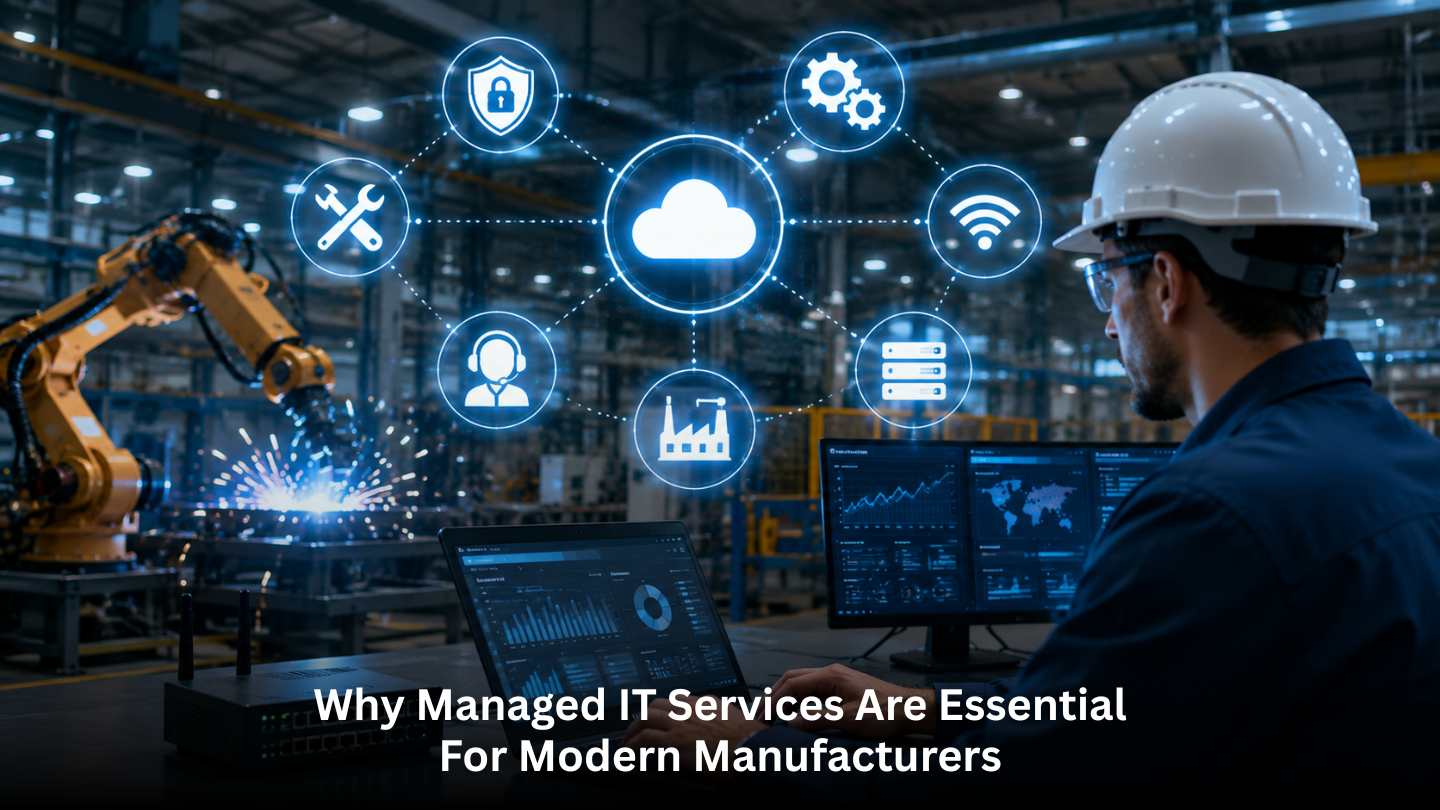
Modern manufacturers rely on complex, connected systems to keep production moving, but many internal IT teams do not have the capacity or specialized expertise to support them effectively. Managed IT services help bridge that gap with proactive monitoring, operational technology expertise, and 24/7 support that reduces downtime and strengthens performance. In this article, we’ll explain the IT challenges manufacturers face, the operational benefits of managed services, and the strategic advantages they provide in an increasingly digital industry.
Key Takeaways
- Managed IT services reduce manufacturing downtime by up to 60% through proactive monitoring and predictive maintenance capabilities
- Manufacturers save an average of 40% on IT costs compared to maintaining equivalent in-house teams
- 24/7 expert support ensures continuous production operations across multiple shifts and facilities
- Enhanced cybersecurity protects against ransomware and cyber threats that specifically target manufacturing systems
- Scalable solutions adapt to changing production demands, seasonal fluctuations, and business growth
Critical IT Challenges That Make Managed Services Essential
Manufacturing businesses face unique IT obstacles that generic technology support cannot address. The convergence of information technology and operational technology creates complexity that most organizations lack the specialized knowledge to address.
Legacy Systems and Integration Complexity
Many manufacturing plants operate equipment built decades ago using proprietary protocols never intended for networked digital environments. These legacy systems require protocol translation, careful calibration, and precise time synchronization to communicate with modern IT infrastructure. Older operational technology often lacks the sensors and data endpoints necessary for condition monitoring or predictive analytics, creating significant gaps in production visibility.
IT/OT Convergence Challenges
The merger of IT systems (enterprise software, cloud platforms, business applications) with OT systems (machinery controls, PLCs, SCADA systems, robotics) has become essential for digital transformation. However, cultural silos between IT and operations teams, distinct standards, incompatible upgrade cycles, and misaligned security policies create barriers. Without proper convergence, manufacturers struggle to scale pilot programs into enterprise-wide Industry 4.0 deployments.
Round-the-Clock Production Sensitivity
Manufacturing operations running 24/7 have minimal tolerance for IT issues. The average industrial manufacturer loses approximately $260,000 per hour during unplanned downtime when all cost factors are consolidated. Hidden costs, including scrap at restart, logistics penalties, excess energy use, and overtime labor, often account for 50-70% of total downtime expenses, yet many plants fail to accurately measure them.
Cybersecurity Threats Targeting Manufacturing
Manufacturing has become one of the most frequently targeted industries for cyberattacks because it depends on sensitive data, connected production systems, and continuous uptime. In 2025, the sector accounted for roughly 27.7% of tracked cyber incidents, including more than 1,060 ransomware victims. Attack activity in industrial sectors also rose sharply between late 2024 and early 2025, with more threat actors targeting OT environments to force production shutdowns. For manufacturers, managed security services and cyber insurance work best together because proactive defense helps reduce risk, while insurance can help offset financial losses after a covered event.
Compliance and Regulatory Requirements
Industry regulations covering safety, environmental standards, data protection laws, and supply chain traceability continue expanding. Manufacturing systems often lack the auditability and detailed logging capabilities that regulators require. As regulatory requirements tighten globally, manufacturers often lack the expertise and resources to manage compliance effectively, making MSPs essential partners in navigating these challenges.
Common Mistakes Manufacturers Make with IT Management
Manufacturing companies frequently undermine their own operations through preventable IT management errors:
- Neglecting security updates on production systems: Fear of disrupting production leads to skipped patches and firmware updates, leaving critical infrastructure vulnerable to cyber threats
- Treating IT as a cost center: Focusing solely on expense reduction prevents IT from enabling strategic growth through automation, data analytics, and innovation
- Under-resourcing internal IT teams: Small teams lack depth in cybersecurity, cloud computing services, integration, and data science, forcing reactive support instead of strategic planning
- Delaying technology refresh: Running equipment and software past end-of-life increases data security risks and prevents integration with modern technologies
- Failing to establish joint IT/OT governance: Conflicting priorities between production and IT stability create dangerous gaps in security measures and operational continuity
Essential Benefits That Transform Manufacturing Operations
Managed service providers deliver measurable improvements across every dimension of manufacturing IT, transforming technology from an operational burden into a competitive advantage. Understanding the different types of managed IT services helps manufacturers choose the right mix of support, cybersecurity, cloud, monitoring, and infrastructure solutions for their specific operations.
Cost Control Through Predictable Spending
Managed IT services help manufacturers control costs by replacing unpredictable break-fix expenses with a more stable, subscription-based model. Instead of carrying the full cost of hiring, training, and retaining a large in-house IT team, manufacturers gain access to broader expertise for a predictable monthly investment. This approach also reduces emergency repair costs, limits expensive downtime, and lowers upfront capital spending through remote monitoring, cloud services, and better infrastructure planning.
Enhanced Operational Efficiency
Managed IT services improve operational efficiency by helping manufacturers connect systems, monitor equipment in real time, and address issues before they lead to costly failures. Through remote monitoring, sensor integration, and predictive maintenance, service providers can identify warning signs early and support more consistent production performance. These capabilities also help manufacturers use data more effectively to reduce downtime, improve maintenance planning, and control operating costs. Managed IT also reduces repetitive technical busywork for internal teams, allowing staff to focus on production priorities, process improvements, and other higher-value work.
Robust Cybersecurity Protection
MSPs help protect manufacturing operations with services such as threat detection, risk assessments, and data protection strategies. With the global average cost of a breach reaching $4.88 million, strong cybersecurity is critical for reducing financial and operational risk. Providers that specialize in manufacturing can also implement network segmentation between IT and OT environments, zero-trust controls, patch management, vulnerability scanning, and proactive threat detection to reduce exposure and improve resilience.
Scalability for Growth and Demand Fluctuations
Scalable managed IT solutions help manufacturing companies expand capacity during seasonal peaks, add production lines, or open new facilities without building a large internal IT department. Cloud and hybrid environments also make it easier to adopt technologies such as edge computing and IIoT as needs evolve. An experienced MSP can guide hardware and software upgrades while aligning new systems with operational requirements and long-term growth plans.
Access to Specialized Expertise
Access to specialized expertise is one of the biggest advantages managed IT services offer manufacturers. Many internal teams do not have deep experience in OT and IoT integration, robotics, cybersecurity, cloud architecture, or advanced data analytics, all of which are increasingly important in modern production environments. A qualified MSP can help manufacturers adopt emerging technologies such as AI, edge computing, and private 5G in a way that aligns with operational goals and security requirements. Understanding the differences between managed services and outsourcing also helps clarify why ongoing strategic guidance and proactive support often deliver more value than simply handing off isolated IT tasks.
24/7 Support and Business Continuity
Managed service providers deliver around-the-clock monitoring and end-user support essential for continuous production operations. Disaster recovery plans provide multi-site redundancy, data backup, and OT-aware incident response capabilities to restore manufacturing systems after disruptions quickly.
Real-World Impact on Manufacturing Performance
The measurable outcomes from managed IT partnerships demonstrate clear value for manufacturing operations:
- Manufacturers adopting predictive maintenance through managed IT services report 40-60% reductions in unplanned downtime within 6-12 months
- By partnering with an MSP, manufacturers can focus more on core production and innovation, relying on experts for IT management
- Utilizing managed IT services in manufacturing can provide cost savings, increased operational uptime, and enhanced cybersecurity
- Companies with mature IT/OT convergence supported by managed services have unlocked incremental value exceeding $100 million in documented cases
- By utilizing managed IT services, manufacturers can achieve significant cost savings through optimized operations and minimized downtime, which leads to better resource management
- Nearly half of manufacturers report 6-10 downtime incidents per week; managed services dramatically reduce this frequency through proactive monitoring
These outcomes reflect the broader benefits of managed IT services, including improved uptime, stronger security, predictable costs, and better long-term technology planning.
Strategic Advantages for Competitive Manufacturing Success

Beyond operational improvements, managed IT services position manufacturing companies for long-term competitive advantage through strategic technology capabilities.
Enabling Industry 4.0 and Digital Transformation
The right managed service provider helps manufacturers bridge the gap between legacy operational technology and modern cloud-based systems, making it easier to support IoT deployments, digital twins, and autonomous processes. By improving security, connectivity, and system reliability, managed IT turns technology into a strategic asset instead of a recurring obstacle. This foundation allows manufacturers to pursue digital transformation with greater confidence and less operational risk.
Advanced Data Analytics and Reporting
Real-time insights into production yield, energy usage, and equipment performance drive better decisions about line balancing, preventive investment, and quality control. Data analytics capabilities through managed services enable manufacturers to develop strategies based on actual operational data rather than assumptions.
Future-Proofing Through Expert Guidance
The IT managed services market is projected to grow from $278.4 billion in 2024 to $304.48 billion in 2025, reflecting a compound annual growth rate (CAGR) of 9.4%. This growth reflects manufacturers’ recognition that staying current with emerging threats and technologies requires partnership with specialists. MSPs that track AI-enabled cyber-attacks, edge vulnerabilities, and supply chain threats help manufacturers avoid obsolescence.
Compliance Support for Evolving Regulations
Managed Service Providers (MSPs) can help manufacturers understand complex regulations and develop strategies to ensure compliance, significantly reducing the risk of audits or penalties. MSPs are familiar with various cybersecurity frameworks that enhance compliance with data protection laws, providing manufacturers with the tools to meet regulatory requirements.
Supply Chain Optimization
Managed IT services support stronger supply chain performance by giving manufacturers better visibility into inventory, procurement, logistics, and demand patterns. With real-time data and better system integration, manufacturers can improve forecasting, allocate resources more effectively, and reduce delays across the supply chain. These capabilities also support just-in-time operations and help lower costs by improving coordination between production and business systems.
IT as Growth Enabler
The subscription-based pricing model for managed IT services enables manufacturers to control IT-related expenses while leveraging top-tier IT expertise, thereby improving operational efficiency. With a reliable IT infrastructure managed by a strategic partner, manufacturers can experiment with new product lines, flexible manufacturing, and mass customization without technology constraints limiting innovation.
Conclusion
Managed IT services have become essential for manufacturers that depend on reliable systems, continuous production, and secure operations to stay competitive. From reducing costly downtime and improving cybersecurity to supporting scalability and operational efficiency, the right IT strategy helps manufacturers adapt to evolving technology demands while keeping production environments stable and productive.
Manufacturers looking for dependable managed IT services in Alpharetta can turn to IntegriCom for proactive support, infrastructure management, and scalable solutions built for modern production environments. With reliable manufacturing IT support, secure cybersecurity consulting, and responsive network services and computer support, businesses can strengthen stability while reducing technology disruptions. Companies can also improve communication with business phone systems and support regulatory readiness through HIPAA compliance consulting. If you want to improve efficiency and build a stronger manufacturing technology strategy, contact us today.
Frequently Asked Questions
What makes managed IT different from traditional IT support for manufacturers?
Traditional IT support operates reactively, fixing problems after they disrupt production. Managed IT services provide proactive monitoring, continuous maintenance, and strategic planning that prevent issues before they affect manufacturing operations. A managed IT service provider also brings specialized expertise in OT/IT convergence, manufacturing-specific cybersecurity, and industry regulations that general IT service providers typically lack.
How quickly can managed IT services reduce manufacturing downtime?
Many manufacturers experience 50-60% reductions in unplanned downtime within 6-12 months of deploying proactive monitoring and predictive maintenance through managed services. The timeline depends on current infrastructure conditions, the complexity of manufacturing systems, and the extent to which remote monitoring and data analytics are implemented across production lines.
What cybersecurity protections are essential for manufacturing companies?
Manufacturing operations require OT/IT network segmentation, zero-trust architecture, regular firmware and patch management on production systems, real-time threat monitoring, incident response capabilities, and comprehensive disaster recovery plans. Staff awareness training and security measures protecting sensitive data and intellectual property are equally critical. Manufacturing has become one of the most heavily targeted industries for cyber-attacks, making these protections non-negotiable.