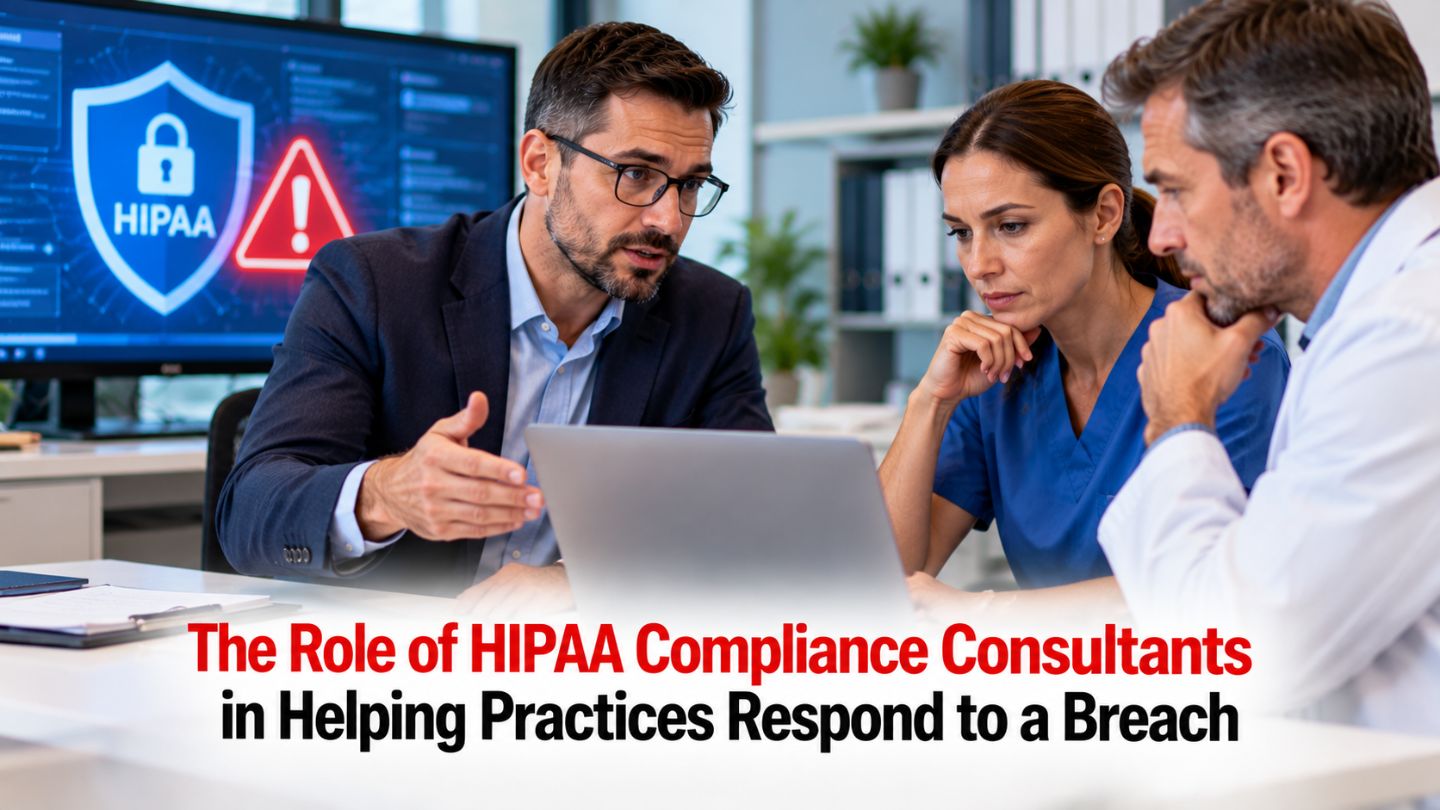
A possible exposure of patient information can leave a healthcare practice unsure what to do first. An unusual email, a lost device, a suspicious account login, or a report from a vendor may signal a security incident. A HIPAA compliance consultant can help the practice organize its response, understand relevant compliance responsibilities, and coordinate with the people who can investigate and address the technical issue.
The consultant’s role depends on the practice’s needs and the consultant’s scope of work. Some provide risk analysis, policy support, and staff training; others may help coordinate incident response with the practice’s IT provider, legal counsel, or a forensic specialist. This guide explains how that support can fit into a breach response and where practices may need additional expertise.
Key Takeaways
- A consultant can help a practice organize facts, document decisions, and understand HIPAA-related responsibilities after a suspected breach.
- The practice should involve its internal privacy or security lead and IT provider promptly; legal counsel or a forensic specialist may also be appropriate.
- Whether an incident is a reportable breach depends on the circumstances and applicable HIPAA requirements.
- Consultants may support risk analysis, policies, training, and coordination, while technical investigation and legal advice may require other professionals.
- After an incident, practices can review identified gaps and update their safeguards, response procedures, and training as needed.
What Counts as a Possible HIPAA Breach?
A potential incident may involve a lost device, a misdirected email, an unfamiliar login, ransomware, improperly discarded paper records, or unauthorized access to a practice system. These examples do not by themselves determine whether a reportable breach occurred. The practice must assess what information was involved, what happened to it, and whether an exception or other applicable rule affects its obligations. Under HIPAA, an impermissible use or disclosure of protected health information (PHI) is presumed to be a breach unless the practice documents a risk assessment showing a low probability that the information was compromised.
An incident can also disrupt day-to-day work. Staff may be concerned about patients, leaders may need to make time-sensitive decisions, and clinicians may need a way to continue care while systems are reviewed. Clear roles and a documented process can help the practice respond in an organized way.
Organizing the Initial Response
When an incident is suspected, the practice should activate its established response process and involve the people responsible for privacy, security, and IT. Clear incident response plans help everyone move quickly and consistently. Depending on the situation, that may include an external IT provider, legal counsel, a cyber insurer, or a qualified forensic specialist. Avoid making technical changes that could destroy useful evidence unless the incident response team advises otherwise. When evaluating an external IT partner, the factors involved in choosing a managed service provider can help clarify service scope, security responsibilities, and incident-response expectations.
A consultant may help the practice gather an initial timeline and identify which systems, records, vendors, and staff may be involved, including whether PHI may have been exposed. If business associates or other outside parties are involved, those relationships should be reviewed early in the response. Technical containment, such as disabling compromised credentials or isolating a device, should be coordinated with the IT team or another qualified technical responder. The consultant can help keep compliance documentation and response decisions organized within the agreed scope of work.
How a HIPAA Compliance Consultant Can Support a Breach Response
A HIPAA compliance consultant can help turn the practice’s incident response plan into a clear sequence of questions and tasks. The consultant may coordinate with leadership, the privacy or security officer, IT, and legal counsel so each group understands its role. The consultant does not replace the practice’s decision-makers or automatically serve as its attorney, IT provider, or forensic investigator.
Depending on the engagement, support may include reviewing existing policies, helping document the incident, assisting with a risk analysis, identifying compliance gaps, and advising on corrective actions. When vendors are involved, covered entities may also need to coordinate quickly with business associates connected to the affected systems or records. The exact work should be confirmed in advance, especially when a practice needs hands-on technical investigation, legal advice, or communications drafted for a specific incident.
Assessing the Incident and the Information Involved
The practice and its response team need to establish what happened and what information may have been affected. A HIPAA compliance consultant can help translate the regulatory requirements into practical tasks during that review. The review may consider the systems involved, the types of protected health information, who may have accessed or received it, the time period, and any safeguards or mitigation already in place. IT or forensic professionals may be needed to review logs, access records, devices, or network activity, especially when the technical details determine how much information was exposed.
A consultant with the appropriate scope can help organize the compliance analysis and its documentation. The consultant may also use a security risk assessment or gap analysis to surface weaknesses in access controls, vendor management, or emergency preparedness. The practice should avoid treating an initial indication—such as an unfamiliar login or missing device—as a final determination about whether a reportable breach occurred. Document the available facts, uncertainties, and decisions as the investigation progresses.
Coordinating Containment and Documentation
Containment is generally a shared effort. The IT provider or qualified technical responder can assess how to limit unauthorized access and preserve relevant evidence. The consultant can help the practice track decisions, interpret the technical findings in light of the HIPAA Security Rule, and connect the technical response to its compliance process. Legal counsel can advise on legal questions, communications, and any applicable privilege considerations. A review of current safeguards through security risk assessments and a gap analysis can also show whether existing controls align with the HIPAA Security Rule.
Maintain a record of what was reported, when it was reported, who was involved, what steps were taken, and why key decisions were made. Keep relevant messages, alerts, system records, and other evidence according to the response team’s instructions. This documentation should follow the practice’s policies and procedures. A clear incident record can support the practice’s own review and help it explain its actions later, including if the U.S. Department of Health and Human Services (HHS) Office for Civil Rights (OCR), which enforces HIPAA, has questions.
Evaluating Notification and Documentation Responsibilities

HIPAA’s Breach Notification Rule may require notices after a breach of unsecured protected health information. Whether notice is required depends on the facts and applicable exceptions. The practice should document its analysis and decisions, and consult qualified compliance or legal professionals when it needs help interpreting requirements and deadlines.
A consultant may help the practice organize the information needed for its assessment, track applicable tasks, and review whether documentation is complete. If notices are required, the practice should confirm who is responsible for determining the content, recipients, and timing. State privacy laws may add requirements, so the relevant jurisdictions and facts should be reviewed by qualified professionals.
- Plan follow-up risk reviews and conduct risk assessments regularly. HIPAA does not set a fixed schedule, but reviewing at least annually and after significant system or staffing changes is a common practice.
- Review whether existing security measures were adequate and strengthen them where gaps are confirmed.
Preparing Notices and Internal Records
If notification is required, affected individuals generally need clear information about what happened, the types of information involved, steps taken by the practice, and ways to ask questions or protect themselves. When notice is required, HIPAA generally requires notifying affected individuals without unreasonable delay and no later than 60 calendar days after the breach is discovered. Breaches affecting 500 or more individuals must also be reported to HHS within that window (and, when more than 500 residents of a state or jurisdiction are affected, to prominent media outlets), while smaller breaches can be logged and reported to HHS within 60 days after the end of the calendar year. Legal counsel or a qualified compliance professional can review notices before they are sent.
The practice should also maintain consistent internal records of the incident, investigation, decisions, remediation, and communications. A consultant may help organize those materials or identify missing information, depending on the engagement. Avoid promising that a particular review or notice will eliminate legal exposure or satisfy every requirement without assessing the facts.
Working with IT Providers, Vendors, and Specialists
Technical investigation and remediation are often handled by the practice’s IT provider, an incident response firm, or a forensic specialist. These professionals may review logs, identify suspicious activity, help contain access, and assess what data may have been viewed or acquired. The consultant can help coordinate compliance-related questions and documentation, while the technical team addresses the systems within its scope.
The practice may also need to review relevant business associate agreements and vendor processes. Determine which vendors handled the affected information, what each party is responsible for, and how they should communicate during the response. A compliance consultant can help the practice organize this review and complete internal records; contract interpretation or legal obligations should be referred to counsel as appropriate.
After immediate containment, the technical team and practice can consider technical safeguards that address the identified issue. Depending on the findings, this may include reviewing access controls, email security, account management, backups, device handling, or staff procedures. Recommendations should be based on the practice’s systems and documented risks rather than treated as a one-size-fits-all list.
Strengthening the Compliance Program After an Incident
Once the immediate response is stable, the practice can review what contributed to the incident and what changes may reduce future risk. A consultant may assist with a security risk analysis, policy development, employee training, or a risk management plan, depending on the services agreed upon. Technical changes should be planned with the IT provider and tested for their effect on patient care and business operations.
A remediation plan can assign an owner and target date to each action. It may cover policy and procedure updates, staff education, reviewing business associate agreements (BAAs) and vendor responsibilities, access controls, or system improvements. In many practices, the privacy or compliance officer oversees the plan, with consultant support for risk management and ongoing monitoring.
The practice should revisit the plan as systems, workflows, and risks change because HIPAA compliance is an ongoing process. For small practices balancing regulatory needs with technology decisions, vCIO services can support IT compliance planning. The frequency of risk analysis and review should be determined in context; avoid assuming that one fixed schedule fits every organization. That follow-up review may also include technical safeguards tailored to the systems involved.
Turning Findings into Practical Follow-Up
After reviewing the incident, practice leaders can prioritize actions based on the risks identified and the resources available. Examples include clarifying who receives security reports, updating response contacts, reviewing access when staff roles change, or practicing how the team will coordinate during a future incident. A consultant can help structure this work, while the practice remains responsible for assigning owners and implementing approved changes. A broader roadmap can connect incident-related fixes with future priorities through long-term technology planning with an IT company.
Common Response Challenges
Practices may face avoidable delays when responsibilities are unclear, records are incomplete, or technical and compliance work proceed without coordination. A response plan can help teams know whom to contact and what information to preserve. During an actual incident, follow the plan while adapting it to the facts and advice from qualified responders. If a provider change is needed, planning an IT transition while maintaining business continuity can help teams coordinate responsibilities, records, and timing.
Common areas to review include documenting decisions, involving the right internal leaders, coordinating with IT and vendors, and ensuring that communications are accurate and consistent. A consultant may help identify process gaps and recommend improvements. Technical recovery, legal interpretation, and clinical continuity may require other specialists or practice leaders.
Examples of How Professional Support May Differ by Incident
A stolen device: A practice learns that a laptop used for work is missing. The practice contacts its privacy or security lead and IT provider, who determine what data may have been stored on the device and what technical steps are appropriate. A compliance consultant may help organize the incident record and risk analysis. The practice and its advisers assess any notification responsibilities based on the facts.
Suspicious account activity: A clinic sees unfamiliar login attempts in a scheduling or billing system. Its IT provider investigates the account activity and takes appropriate containment steps. A consultant may help the clinic document the event, coordinate compliance questions, and review whether its procedures need updates. The findings determine what follow-up is appropriate.
Improper disposal of records: A practice discovers that paper records may not have been disposed of securely. Leaders determine what records were involved and who may have accessed them. A consultant may help structure the compliance review and identify policy or training gaps, while the practice consults counsel or other professionals about applicable obligations.
These examples are illustrative. The response and any notification decision depend on the facts, applicable requirements, and advice from qualified professionals.
Preparing for a More Coordinated Response

A breach response can involve compliance decisions, technical investigation, and coordination across a practice. A HIPAA compliance consultant may help organize the compliance work, while IT, legal, and forensic professionals handle responsibilities within their expertise. Clear roles and a documented response plan can help the practice move from initial concern to considered follow-up.
IntegriCom provides HIPAA compliance consulting in Atlanta for healthcare practices across the metro area that are reviewing their compliance processes. Our managed IT solutions for business support ongoing technology needs, while co-managed IT services can complement an internal team. Practices using hosted systems can consider cloud services within their technology planning. For payment card workflows, PCI compliance consulting addresses a separate compliance need. If you’re reviewing your response plan, contact us today to discuss the support that fits your practice.
Frequently Asked Questions
When should a practice contact a HIPAA compliance consultant after a possible breach?
A practice should follow its incident response plan and involve its privacy or security lead and IT provider promptly. A HIPAA compliance consultant may help organize compliance questions and documentation. If the incident may involve legal obligations, patient notification, or forensic investigation, the practice should also involve qualified counsel or technical specialists.
What information should a practice gather before speaking with a consultant?
Gather a brief timeline, the systems or records potentially involved, who discovered the issue, and what response steps have already occurred. Preserve relevant alerts, emails, and logs as directed by the IT or incident response team. Note what remains unknown; an early summary does not need to establish the final scope.
How does a HIPAA consultant work with a practice’s IT provider?
The IT provider generally investigates and addresses technical issues within its scope, while a compliance consultant may help organize compliance analysis and documentation. They can coordinate questions about systems, access, evidence, and follow-up actions. The practice should confirm each professional’s responsibilities so technical and compliance work stay aligned.
Can a consultant help if the practice has already notified patients or regulators?
A consultant may review the response to date, help organize remaining documentation, and identify open compliance tasks, depending on the engagement. The practice should share what was sent and when. If it needs advice about legal sufficiency, deadlines, or corrective communications, it should consult qualified legal counsel.
How can a practice prepare before a breach occurs?
Maintain an incident response plan with current internal contacts, IT and vendor details, escalation steps, and instructions for preserving evidence. Review the plan when systems or responsibilities change, and practice coordination with relevant staff. A consultant may help assess the plan, update policies, or provide training within the agreed scope.