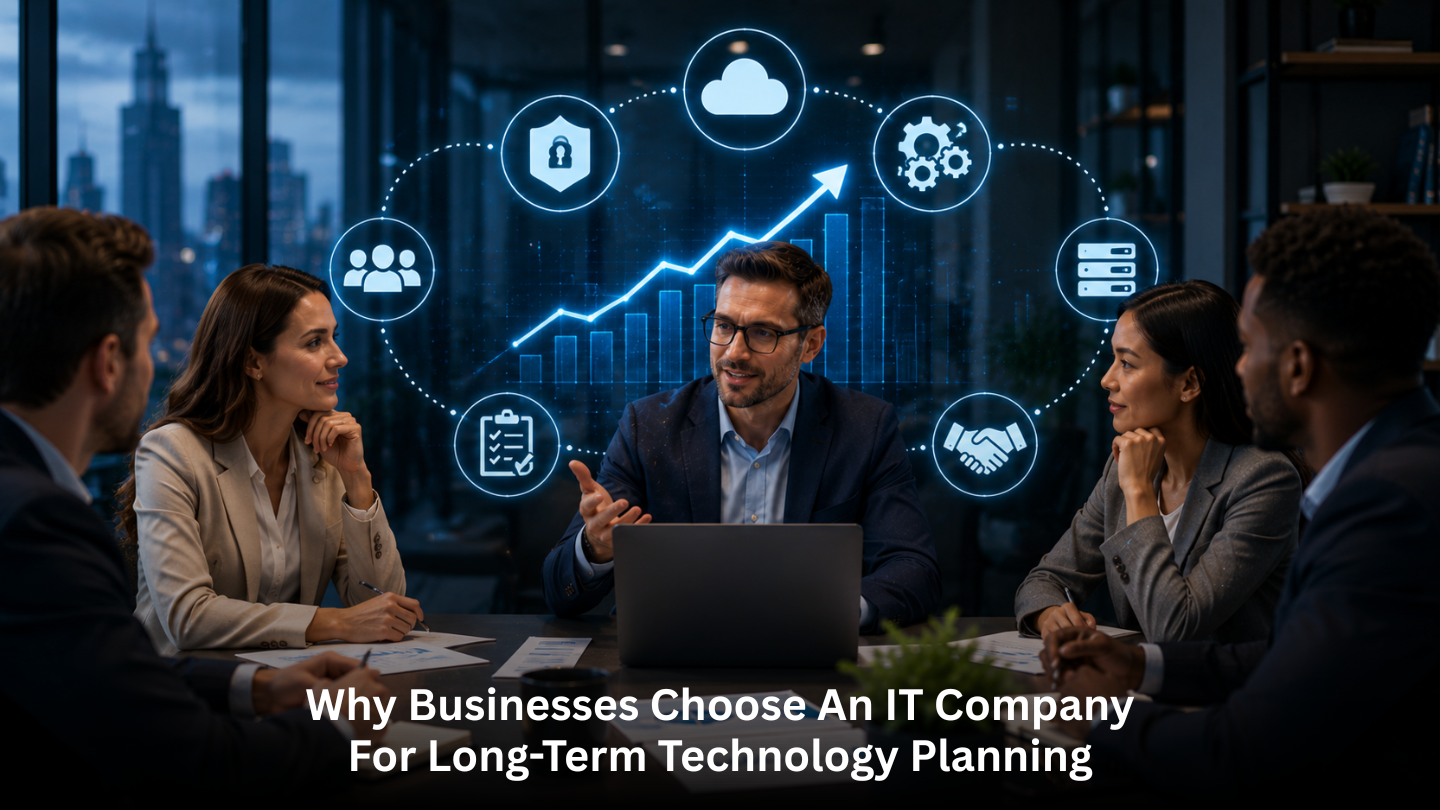
Many businesses struggle with technology decisions that feel more like constant firefighting than strategic progress. When systems fail unexpectedly, security threats emerge, or growth demands outpace current infrastructure, the costs, both financial and operational, mount quickly. This reactive approach leaves business leaders wondering if there’s a better way to manage technology investments. That’s precisely why businesses choose an IT company for long-term technology planning. Rather than treating technology as just a support function, forward-thinking organizations partner with IT companies to transform their technology strategy into a growth engine that aligns with business objectives.
This blog explores the key benefits of partnering with an IT company for strategic planning, including access to specialized expertise, cost predictability, and scalable infrastructure that supports business growth for years to come.
Key Takeaways
- IT companies transform reactive technology decisions into strategic roadmaps aligned with business goals
- External expertise provides specialized knowledge in cybersecurity, cloud solutions, and emerging technologies
- Partnering with IT providers delivers cost predictability and prevents expensive emergency repairs
- Professional IT planning ensures scalable infrastructure that grows with your business
- Managed service providers offer ongoing support and strategic guidance beyond one-time consulting
Strategic Expertise That Internal Teams Often Lack
Specialized IT firms provide access to multi-disciplinary expertise in areas such as cloud architecture, cybersecurity, and regulatory compliance. For most small and medium businesses, building this depth of knowledge internally isn’t practical or cost-effective.
Consider the current landscape: over 90% of organizations report gaps in their staff’s IT skills, with 59% citing critical or significant deficiencies. The United States alone has approximately 500,000 unfilled cybersecurity positions. These aren’t just numbers; they represent the real challenge business leaders face when trying to hire qualified professionals who can manage complex technology systems.
Strategic IT planning is the process of aligning an organization’s technology initiatives with broader business objectives to achieve competitive advantage and drive sustainable growth. When businesses partner with IT companies, they gain immediate access to professionals who specialize in cloud services, data protection, network security, and industry-specific compliance requirements.
Business-IT alignment is the process of ensuring that a company’s technology strategy is fully synchronized with its overall business objectives, enabling technology to be leveraged as a tool for competitive advantage. This alignment happens naturally when experienced IT partners work alongside internal teams.
[Recommendation: This paragraph is a bit definition-heavy and repeats ideas already introduced in the previous paragraph. Tightening it would improve readability and reduce redundancy.]
When experienced IT partners work closely with internal teams, technology decisions become more closely aligned with business priorities. That alignment helps organizations use technology more strategically to improve performance, reduce risk, and support long-term growth.
Access to Enterprise-Level Technologies and Best Practices

IT companies provide access to advanced security tools, cloud platforms, and enterprise solutions that might otherwise require significant capital investment. These can include multi-factor authentication, endpoint detection and response, proactive monitoring, and robust backup and disaster recovery systems. As businesses evaluate which protections belong in their long-term roadmap, understanding the 8 ways to protect your business against malware attacks can help them strengthen endpoint security, backup planning, and employee security awareness.
Access to a team of experts keeps businesses ahead of industry trends and provides the talent needed to implement new technologies. Because IT partners serve multiple clients across industries, they bring lessons learned from diverse environments. They understand which technology solutions work in practice, not just in theory, and can benchmark your business performance against industry standards.
This cross-industry perspective helps businesses stay ahead of market demands and adopt new technologies before competitors, creating a genuine competitive advantage.
Cost Predictability and Budget Optimization
Shifting from a ‘break-fix’ model to proactive planning helps businesses achieve predictable monthly costs and avoid emergency repairs. This transformation fundamentally changes how organizations manage their IT budget—understanding how IT consulting can save your business time and money helps leaders see why proactive planning is often more cost-effective than repeated emergency fixes.
Even short periods of downtime can be expensive for small businesses, leading to lost productivity, missed revenue, compliance concerns, and added recovery costs. By working with an IT partner on long-term planning, businesses can reduce outages, manage budgets more effectively, and improve the return on their technology investments.
A strategic IT plan helps businesses evaluate technology investments based on real operational needs, budget priorities, and long-term goals. Instead of making isolated purchasing decisions, leaders can prioritize solutions that improve performance, support growth, and deliver measurable business value.
Rather than treating technology spending as a cost center with unpredictable spikes, strategic planning converts capital expenditures into stable operational costs. Your IT roadmap accounts for software licenses, hardware lifecycles, cloud services, and security tools, all planned and budgeted in advance.
Common Financial Mistakes Businesses Make Without IT Partners
Without strategic guidance, many businesses fall into costly patterns that create inefficiency, increase risk, and make future technology decisions more expensive.
- Over-purchasing software licenses or subscribing to redundant tools that create vendor sprawl
- Buying technology systems that don’t integrate with existing systems, forcing expensive workarounds
- Deferring maintenance until legacy systems fail catastrophically
- Spending heavily on emergency repairs that could have been prevented with proactive monitoring
- Investing in outdated systems that can’t scale operations as the business grows
IT companies help create a documented technology roadmap that ensures all investments directly support overarching business objectives. This planning process prevents the fragmented “quick fixes” that accumulate into technical debt and drain resources over time.
Proactive Planning vs Reactive Fire-Fighting

The difference between businesses that treat technology as a strategic asset and those that view it only as a support function often comes down to proactive versus reactive management. That is why reliable IT support is critical for business continuity, especially for companies that depend on secure access, stable systems, and fast recovery when disruptions occur.
Proactive monitoring helps detect potential issues before they escalate into costly disruptions, thereby enhancing operational efficiency. Instead of waiting for servers to crash or security breaches to occur, IT partners conduct scheduled assessments, planned upgrades, and regular risk evaluations.
Before planning for the future, businesses need a clear understanding of their current IT environment. That means reviewing existing systems, performance issues, and security risks so they can build a technology roadmap that addresses problems early instead of reacting to them later.
Strategic IT planning delivers tangible benefits for daily operations:
- Technology roadmaps that chart 12-36 month trajectories for infrastructure, software, and security
- Scheduled upgrades that prevent performance degradation and compatibility issues
- Risk assessments that identify technology gaps before they’re exploited
- Disaster recovery planning that ensures business continuity when incidents occur
- Compliance audits that keep regulated industries ahead of requirements
IT partners develop technology roadmaps that avoid fragmented ‘quick fixes’ and ensure cohesive support for business growth. This ongoing process of evaluation and adjustment keeps technology aligned with changing business priorities.
Scalability and Future-Proofing Your Technology
As businesses grow, their technology demands multiply. More employees need access to reliable systems. Data storage requirements expand. New locations require network connectivity. Customer satisfaction depends on systems that perform under pressure.
Scalable IT solutions are essential for businesses to handle increased demand without performance issues, allowing for growth in users, data volumes, and locations. Long-term planning ensures that infrastructure can adapt to emerging technologies and scale rapidly as the business grows.
Investing in cloud-based services and modular software is crucial for creating a scalable IT infrastructure that can adapt as business needs evolve. Modern cloud solutions offer flexibility that traditional on-premises systems cannot match. When your business needs to scale operations quickly, add users, expand to new markets, or handle seasonal demand, cloud platforms accommodate growth without costly hardware investments.
A technology assessment helps identify gaps, performance limitations, and areas that may not support future growth. IT partners use that insight to recommend improvements that keep systems scalable, efficient, and better prepared for changing business needs.
Businesses choose IT companies for long-term technology planning to ensure their systems can scale with future growth while remaining secure and cost-efficient. This forward-thinking approach prevents the painful and expensive process of replacing entire technology systems when they can no longer support growth.
Consider the case of an architecture firm that needed to support multiple distributed offices handling large design files. Their IT partner designed a cloud storage and retrieval system with tiered access, high-speed performance for active files, and lower-cost storage for archived data. This scalable solution saved money while improving flexibility for continued expansion.
Security and Compliance Built Into Strategy
Cybersecurity must be integrated into every layer of an IT strategy from the start, rather than treated as an add-on, to protect against threats effectively. As businesses grow, they become more attractive targets for cybercriminals, making robust cybersecurity measures critical for protecting sensitive information and ensuring business continuity. As threats and compliance expectations evolve, understanding how cyber insurance can help businesses plan stronger security controls and reduce long-term risk exposure.
Dedicated IT partners provide continuous monitoring and proactive risk management, safeguarding sensitive data from evolving cyber threats. This protection extends beyond installing antivirus software to implementing comprehensive security frameworks that address:
- Endpoint detection and response for all devices accessing company data
- Zero-trust architecture that verifies every user and connection
- Security operations monitoring that identifies threats in real-time
- Incident response planning that minimizes damage when breaches occur
- Employee training that reduces human error vulnerabilities
A layered security approach that combines technology, employee training, and proactive monitoring is essential for reducing cybersecurity risks in organizations.
For businesses in regulated industries such as healthcare, finance, insurance, and legal services, compliance adds another layer of complexity to long-term IT planning. Security strategies must support both operational goals and regulatory requirements. Staying aware of the top 10 cybersecurity business attacks helps leaders understand why cybersecurity should be built into their IT strategy from the beginning.
Over time, IT partners develop a deep understanding of a company’s workflows and culture, allowing for tailored, effective solutions that address both security risks and compliance requirements specific to your industry.
Operational Efficiency Through Technology Alignment

When IT and business strategies are aligned, companies can optimize technology use to eliminate redundancies and streamline operations, resulting in greater efficiency and faster project delivery.
Technology can streamline workflows and eliminate manual processes, improving operational efficiency. This transformation happens when technology decisions are made with business outcomes in mind rather than simply maintaining the status quo.
Long-term IT partnerships improve operational efficiency by reducing system failures, optimizing software use, and bringing experienced oversight to day-to-day technology decisions. A strong IT partner evaluates systems, applications, and workflows against the performance measures that matter most to the business.
A clear IT strategy that aligns with business goals can significantly enhance operational efficiency by ensuring that technology investments support key business objectives. This might involve:
- Consolidating redundant tools and software licenses
- Automating repetitive manual processes
- Integrating disparate technology systems for seamless data flow
- Implementing communication and collaboration platforms that boost productivity
- Designing networks that support remote and hybrid work models
Successful IT strategy execution requires careful planning, governance, and continuous evaluation to ensure alignment with business goals and adaptability to changing needs. This continuous improvement approach keeps your technology infrastructure optimized as business priorities shift.
Final Thoughts
Long-term technology planning helps businesses move beyond reactive problem-solving and create a stronger foundation for future growth. With the right strategy in place, organizations can improve operational efficiency, strengthen cybersecurity, reduce unexpected costs, and ensure their technology infrastructure continues to support evolving business goals. Partnering with experienced IT professionals also gives businesses access to strategic guidance and scalable solutions that are difficult to maintain internally.
Businesses looking for a dependable IT company in Atlanta can rely on IntegriCom for strategic technology planning, proactive support, and scalable infrastructure built for long-term success. From reliable business phone systems and secure data backup and recovery to flexible co-managed IT services and advanced AI business automation, businesses can build a technology environment designed for efficiency, collaboration, and growth. Organizations in regulated industries can also benefit from HIPAA compliance consulting services to help maintain security and compliance as their operations evolve. If you are ready to turn technology into a long-term business advantage, contact us today.
Frequently Asked Questions
How often should businesses review their long-term IT strategy?
Most businesses benefit from annual strategic reviews with quarterly check-ins to adjust for growth, market changes, or emerging security threats. Initial assessments typically take 2-4 weeks, with strategy development spanning 90 days to ensure comprehensive planning that addresses all business priorities.
What’s the difference between IT support and strategic IT planning?
IT support focuses on fixing current problems, troubleshooting issues, responding to outages, and maintaining daily operations. Strategic IT planning prevents future issues and aligns technology with business goals, creating technology roadmaps that support long-term business growth rather than just keeping systems running.
How do IT companies help with cybersecurity planning?
IT partners develop comprehensive security strategies that include risk assessments, compliance planning, incident response procedures, and continuous monitoring. They implement layered security approaches combining technology solutions, employee training, and proactive monitoring to protect against evolving cyber threats.