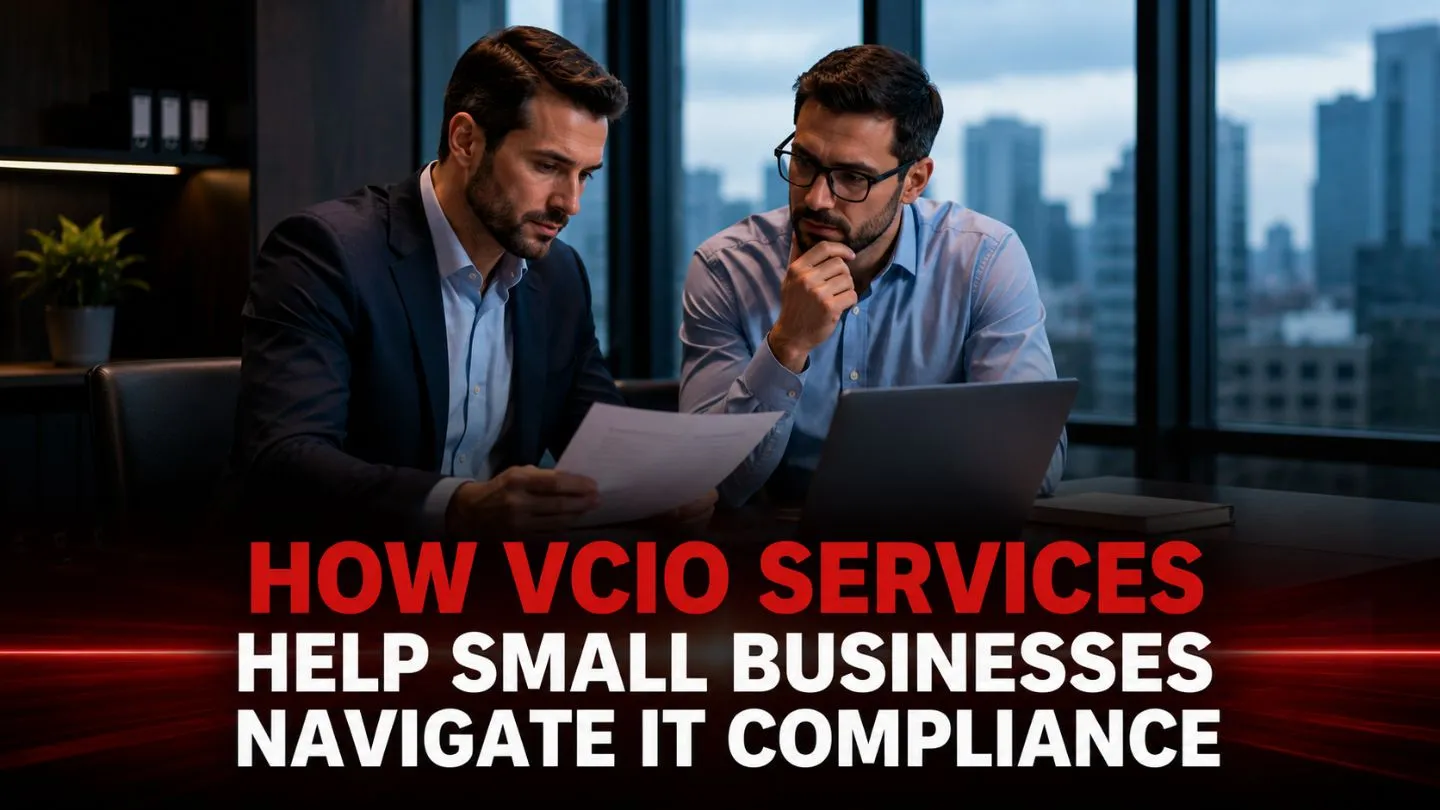
Small businesses in regulated industries face a growing web of compliance obligations — from HIPAA and PCI DSS to CMMC, NIST-based cybersecurity requirements, and, in some cases, SOX-related controls driven by investors or partner contracts. Understanding how vCIO services help small businesses navigate IT compliance starts with a simple truth: you need strategic IT leadership, not just someone fixing servers. A virtual chief information officer brings executive-level compliance guidance, translates complex regulatory requirements into actionable IT policies, and builds audit-ready programs — all without the cost of a full-time executive.
This blog breaks down what vCIO services actually do for compliance, which frameworks matter most, the common mistakes that expose small businesses to penalties, and the real-world advantages of outsourcing this strategic leadership.
Key Takeaways
- vCIO services provide strategic IT leadership without full-time costs, giving small businesses access to executive-level compliance expertise.
- A virtual CIO translates complex regulatory requirements into clear, actionable IT policies and documentation.
- Professional compliance guidance reduces audit stress, penalty risks, and the likelihood of costly data breaches.
- vCIOs align IT security controls with business goals while meeting industry regulations across HIPAA, PCI DSS, CMMC, and more.
- Small businesses gain a competitive advantage through outsourced strategic leadership that scales as the business grows.
Understanding vCIO Services and Compliance Challenges
A virtual chief information officer is an outsourced executive-level advisor who provides strategic technology leadership for businesses that can’t justify—or don’t need—a full-time CIO on payroll. Understanding what a virtual CIO (vCIO) is helps organizations align technology leadership with long-term business goals. Unlike traditional IT support teams focused on helpdesk tickets and server maintenance, a dedicated vCIO focuses on technology roadmap development, risk management, compliance readiness, vendor management, IT budgets, and aligning technology decisions with broader business goals. Virtual CIO services allow access to executive-level IT expertise without full-time costs, and vCIOs help translate technical decisions into business outcomes.
For small businesses across Metro Atlanta and North Georgia-in healthcare, legal, finance, insurance, and defense contracting-the compliance burden is substantial. These organizations must interpret complex regulations, conduct gap assessments, develop and maintain policies, manage vendor risk, train employees, and prepare documentation that satisfies auditors. The pain points are predictable: unclear requirements, outdated policies, inadequate staff training, reliance on ad hoc documentation, and uncertain vendor compliance postures, making it important to evaluate if a virtual CIO is right for your company.
A vCIO bridges the gap between the current IT environment and the compliance standards a business must meet. Rather than reactive decision-making-scrambling when an audit notice arrives-a vCIO acts as a strategic partner who builds compliance into the technology infrastructure from the start. This distinction is critical: most businesses don’t fail compliance because they lack technology. They fail because they lack strategic planning, proper documentation, and someone who understands how technology plays into regulatory obligations.
Major Compliance Frameworks vCIOs Address
vCIOs help small businesses map which compliance requirements apply to their operations-and more importantly, how overlapping obligations across frameworks can be satisfied with shared controls.
HIPAA (Health Insurance Portability and Accountability Act): Any business handling Protected Health Information must comply, regardless of size. Civil penalties for HIPAA violations start at approximately $145 per incident and can exceed $2 million per year for systemic failures. The HHS Office for Civil Rights has investigated over 374,000 complaints and imposed nearly $145 million in penalties. vCIOs guide SMBs through compliance with HIPAA and PCI DSS by developing administrative, physical, and technical safeguards tailored to each practice. For businesses in the Atlanta area, HIPAA compliance consulting provides the specialized support these organizations need.
PCI DSS (Payment Card Industry Data Security Standard): Required for any organization that stores, processes, or transmits credit card data — including merchants, service providers, and non-retail departments within healthcare institutions. Compliance requires accurate scoping, network segmentation, encryption, vulnerability management, quarterly scans where applicable, and coordination with approved scanning vendors or qualified assessors. Recent research citing 2022 data found that only about 32.4% of organizations were fully PCI DSS compliant, which reinforces how difficult these requirements can be for small businesses to maintain without structured oversight.
SOX (Sarbanes-Oxley Act): While primarily targeting publicly traded companies, SOX requirements around internal controls over financial reporting increasingly affect smaller firms through investor demands or partnership agreements. IT systems must support audit trails, segregation of duties, and data retention policies.
NIST Cybersecurity Framework: The NIST CSF 2.0 Small Business Quick-Start Guide provides accessible risk management practices tailored specifically for small businesses. vCIOs use NIST as a foundational framework for building cybersecurity strategy, conducting gap analyses, and prioritizing improvements.
CMMC (Cybersecurity Maturity Model Certification): CMMC applies to DoD contractors and subcontractors that handle Federal Contract Information or Controlled Unclassified Information. As of July 2026, DoD has suspended Phase II CMMC requirements while continuing Phase I self-assessment requirements, so businesses should avoid treating CMMC as paused entirely. Most small contractors still need to understand whether Level 1 or Level 2 applies, maintain required cybersecurity controls, document self-assessments, and monitor DoD updates before bidding on government contracts.
How vCIOs Transform Compliance Management

A vCIO doesn’t just advise-they drive compliance from strategy through implementation. Here’s how that transformation works in practice.
- Conducting comprehensive compliance gap assessments and audits: vCIOs conduct compliance gap assessments for various regulations by performing a thorough assessment of existing systems, policies, and controls against the requirements of applicable frameworks. For a healthcare practice, this means evaluating HIPAA administrative, physical, and technical safeguards. For a retailer, it means mapping PCI DSS scope and identifying where cardholder data flows. These assessments produce risk-prioritized action plans that give business leaders clarity on what needs to happen and in what order.
- Developing and implementing IT policies aligned with regulatory requirements: Strategic guidance from a vCIO includes writing or updating security policies, incident response plans, business continuity planning documentation, data retention schedules, and vendor contracts with compliant clauses. This policy development isn’t generic-a vCIO tailors every document to the organization’s specific workflows, data flows, and regulatory environment. A vCIO implements multi-factor authentication, access controls, and encryption standards that satisfy both security best practices and compliance requirements.
- Creating documentation systems for audit readiness and ongoing compliance: Documentation matters almost as much as the controls themselves. A vCIO builds systems for maintaining evidence of control operations, training records, risk assessments, and incident response steps. This ensures that when an auditor asks for proof, the business has it-organized, current, and complete. vCIOs assess risk exposure and implement security measures that are not only effective but properly documented.
- Coordinating with legal and compliance teams to ensure comprehensive coverage: vCIOs bring unbiased perspectives due to their external consulting role, and they work across functions-legal counsel, HR, IT, and executive leadership-to ensure nothing falls through the cracks. This cross-functional coordination is essential because compliance touches every part of a business, not just the IT department.
- Managing vendor compliance and third-party risk assessments: Small businesses rely heavily on cloud providers, payment processors, and service desks. A vCIO manages vendor contracts and oversees procurement processes, evaluates vendors’ compliance and legitimacy, and ensures that third-party agreements include appropriate compliance obligations. Effective vendor management ensures reliable technology partnerships and helps consolidate technology vendors over time, reducing both risk and cost. A vCIO negotiates contracts to improve pricing and service levels while maintaining compliance standards.
Common Compliance Mistakes vCIOs Help Small Businesses Avoid
Small businesses make several recurring missteps that a vCIO is specifically positioned to prevent:
- Applying generic or outdated policies: It doesn’t reflect the business’s specific regulatory environment-for example, using off-the-shelf HIPAA templates without customizing them for actual workflows and data flows.
- Implementing security controls without proper documentation: Controls without corresponding audit logs, policies, and proof of operation are essentially invisible to auditors.
- Neglecting employee training and awareness programs: HIPAA requires workforce training, PCI DSS expects security awareness-yet many organizations treat training as a one-time checkbox instead of continuous reinforcement.
- Failing to regularly update policies as regulations evolve: PCI DSS 4.0 introduced significant new responsibilities. CMMC enforcement is ramping up. Businesses that rely on yesterday’s practices face tomorrow’s penalties.
- Overlooking third-party vendor compliance requirements: Assuming a vendor is compliant-or that their compliance removes all risk-is one of the most dangerous assumptions a small business can make.
- Improperly scoping compliance efforts: Missing systems that store or transmit regulated data-back-end databases, home office devices, cloud computing environments-creates gaps that auditors will find.
- Underestimating the time and cost of audit evidence assembly: Without proactive planning, the scramble to compile logs, evidence packets, and remediation documentation creates enormous operational disruption.
Real-World Benefits and Strategic Advantages
- Cost-effective access to compliance expertise: Full-time compliance officers or CISOs command compensation packages from approximately $250,000 to $450,000 per year, including salary, benefits, and recruiting costs. vCIO services typically run on monthly retainers-smaller engagements might cost $3,000–$5,000 per month, while more demanding compliance work might run $8,000–$12,000 per month. These arrangements represent savings of 30–70% compared to hiring a full-time CIO or in-house CIO. Vendor management by a vCIO can reduce IT costs significantly, and vCIO services optimize IT investments for maximum ROI. A vCIO creates actionable technology budgets for small businesses and builds annual IT budgets tied to business outcomes, ensuring financial resources are allocated where they drive the most value.
- Reduced audit stress and faster regulatory approval: When documentation is current, controls are operational, and evidence is organized, audits become manageable events rather than organizational crises. A vCIO helps prioritize effective IT spending for growth while ensuring regulatory standards are met consistently. vCIOs develop robust disaster recovery plans for businesses, and comprehensive backup strategies minimize downtime and protect data integrity.
- Enhanced cyber insurance positioning: Cyber insurance underwriters increasingly require proof of compliance and documented security programs. Businesses with vCIO-led enhanced cybersecurity programs and documented risk management practices may see lower premiums or fewer policy exclusions. This represents a tangible financial return on the compliance investment.
- Competitive edge in winning contracts: Healthcare providers needing HITRUST certification, defense subcontractors pursuing CMMC, law firms requiring robust security postures-these businesses bid more competitively when compliance is documented and demonstrable. Compliance has shifted from a regulatory burden to a competitive advantage, and businesses that demonstrate it move business forward faster than those that don’t.
- Representative compliance scenarios illustrate the impact: A healthcare organization may discover during a vCISO or vCIO-led assessment that its payment workflows are not properly scoped for PCI DSS requirements. Strategic remediation could include improved technology controls, better policies, consolidated payment agreements, and clearly defined cross-departmental responsibilities. Another organization might reduce audit scope by mapping where payment card data actually flows and removing unnecessary systems from the cardholder data environment. For growing businesses with multiple locations, centralized documentation, compliance dashboards, and exception tracking can make compliance easier to maintain over time.
- Peace of mind for business owners: For non-technical business leaders, knowing who is responsible for compliance, having documented plans, and maintaining visibility into compliance status reduces both stress and disaster risk. vCIOs ensure that technology investments are aligned with business growth needs, creating a foundation for sustainable growth and digital transformation. A vCIO develops a long-term technology roadmap for businesses and helps integrate digital solutions to enhance customer experiences while maintaining compliance. A vCIO helps small businesses align technology decisions with business goals, ensuring that every technology investment serves both operational efficiency and regulatory obligations.
Read More: What is a vCIO (Virtual CIO) and Why You Need One
Drive Smarter IT Decisions with Strategic Leadership

Virtual CIO services give small businesses the guidance needed to align technology with long-term goals while meeting evolving compliance requirements. With strategic planning, risk management, budgeting, and proactive oversight, organizations can strengthen security, improve operational efficiency, and make informed IT decisions that support sustainable growth.
For dependable Virtual CIO Service in Atlanta, IntegriCom provides strategic technology leadership tailored to your business objectives. We also offer virtual CIO services in Alpharetta, Buford, Gainesville, and surrounding areas, along with cybersecurity consulting, network services, and computer support to help businesses build secure, scalable, and efficient IT environments. Contact us today to discover how we can help you simplify IT management and confidently navigate compliance requirements.
Frequently Asked Questions
What’s the difference between a vCIO and our current IT support for compliance?
Traditional IT support handles day-to-day technical issues-fixing problems, maintaining systems, and keeping things running. A vCIO operates at the strategic planning level, focusing on technology roadmap development, policy creation, risk management, and aligning your IT strategy with compliance requirements and business goals. Think of IT support as operational and a vCIO as directional-both are necessary, but they serve fundamentally different functions.
Can a vCIO help us prepare for specific audits like HIPAA or PCI DSS?
Absolutely. vCIOs conduct compliance gap assessments for specific frameworks, develop the documentation auditors expect, implement required controls such as multi-factor authentication and encryption, coordinate evidence collection, and guide your team through the audit process. Whether you need HIPAA compliance support or PCI DSS readiness, a vCIO brings a deep understanding of what auditors look for and how to demonstrate compliance effectively.
Do vCIO services work alongside our existing legal and compliance teams?
Yes. A vCIO complements rather than replaces your legal counsel, HR, and any existing compliance personnel. The vCIO provides the technology-specific strategic guidance, ensuring IT systems, controls, and documentation meet regulatory standards, while your legal team handles contractual and regulatory interpretation. This cross-functional coordination ensures comprehensive coverage without duplicating effort.
What happens if regulations change after we implement our compliance program?
Regulatory change is inevitable-PCI DSS 4.0 introduced significant new requirements, CMMC enforcement continues to ramp up, and HIPAA guidance evolves regularly. A vCIO continuously monitors regulatory updates, plans for framework version migrations through quarterly business reviews, updates your technology roadmap, and budgets for necessary changes. This ongoing strategic guidance ensures your compliance program remains current rather than becoming obsolete, protecting your business from new cyber threats and evolving compliance standards.