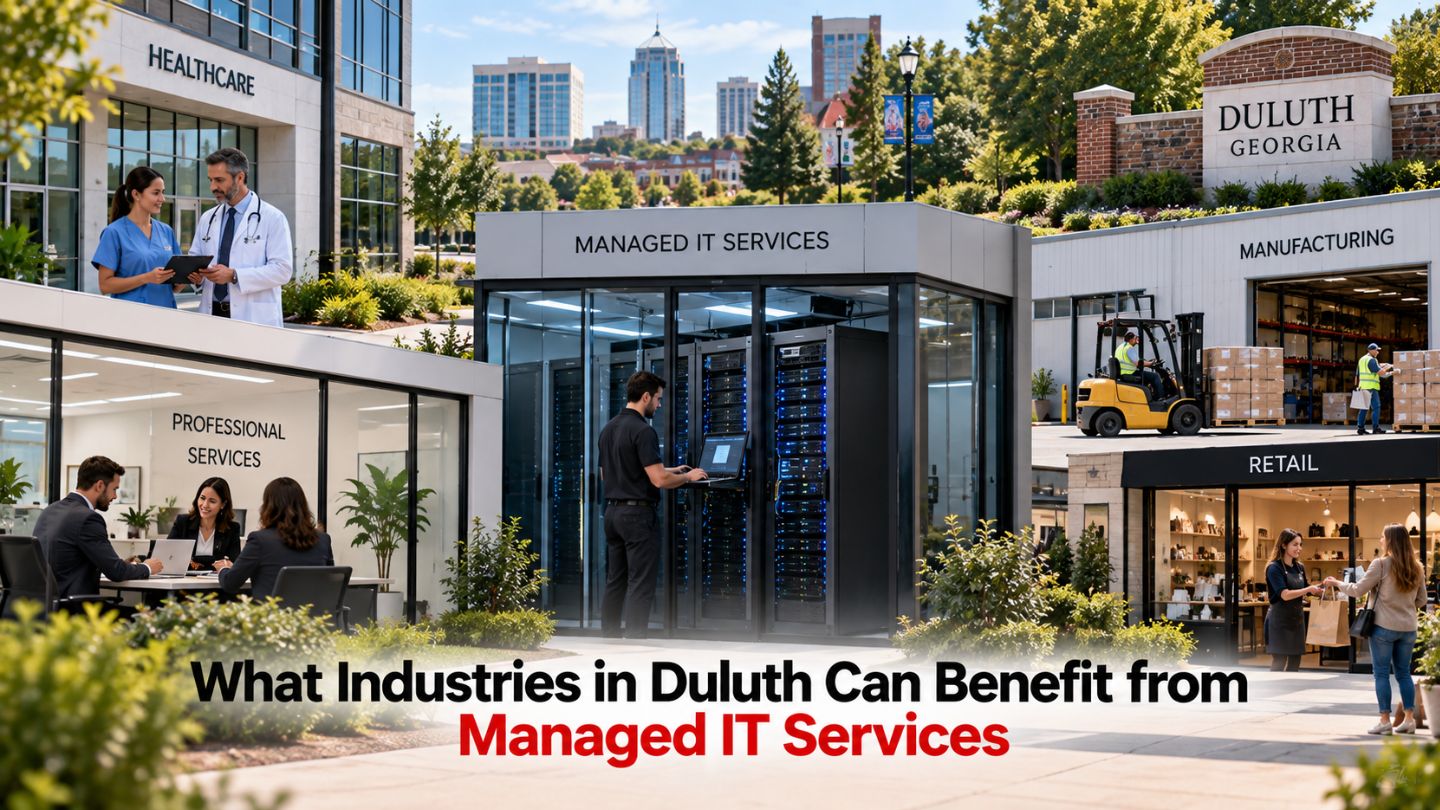
Duluth, Georgia’s economy is built on diversity—corporate headquarters, healthcare providers, manufacturing and distribution operations, financial and insurance firms, retail and hospitality businesses, and schools all operate within this Gwinnett County hub, which demands modern technology to stay competitive. If you’re asking what industries in Duluth, GA can benefit from managed IT services, the short answer is nearly all of them. Every sector faces mounting cybersecurity threats, tightening compliance requirements, and increasing pressure to do more with limited internal resources. Managed IT services bridge the gap between what businesses need and what they can build on their own.
This blog breaks down the specific industries across Duluth that stand to gain the most from partnering with a managed service provider, the unique challenges each sector faces, and why a proactive approach to IT management is no longer optional.
Key Takeaways
- Healthcare, manufacturing, financial services, retail and hospitality, professional services, and educational institutions all benefit significantly from managed IT support.
- Each industry faces unique challenges—from HIPAA compliance to operational technology security—that require tailored solutions and specialized expertise.
- Managed IT provides access to a dedicated team of experts without the overhead of building a full in-house department.
- Local Duluth businesses gain value from IT service providers who understand community needs and regional industry regulations.
- Compliance requirements across healthcare, finance, and education make managed services essential rather than optional for long-term success.
Healthcare Organizations in Duluth
Healthcare is one of Duluth’s leading employment sectors, anchored by Northside Hospital Duluth (formerly Gwinnett Medical Center–Duluth) and supported by clinics, specialty practices, and outpatient centers throughout the area. The demand for reliable, secure IT systems is immense.
Healthcare providers handle sensitive electronic health records governed by strict federal rules, and HIPAA compliance requires airtight data protection at every level. EMR and EHR systems must be integrated across departments and satellite locations, creating complex IT environments that demand constant oversight. The critical nature of uptime in patient care means that even brief system outages can have serious consequences—delayed treatments, inaccessible records, and compromised patient safety.
Telemedicine technology and remote patient monitoring have expanded rapidly, particularly for patients across Gwinnett County and the greater Atlanta area. These systems require secure videoconferencing platforms, access controls, and audit logging to maintain compliance and protect patient privacy.
Specialized Healthcare IT Challenges
Medical device integration presents one of the most pressing concerns for healthcare IT managed services. Legacy imaging systems, telemetry monitors, and diagnostic equipment were often built without modern cybersecurity in mind, creating security vulnerabilities that require careful network management and segmentation.
Data backup and disaster recovery are non-negotiable in healthcare. Patient records must be backed up with encryption both at rest and in transit, with redundant off-site or cloud-based copies ready for rapid restoration. Managed IT providers enforce strict HIPAA compliance for healthcare organizations, ensuring that every layer of the IT infrastructure meets federal and state standards.
Staff training on secure technology practices is equally important. Human error—particularly phishing attacks—remains one of the leading causes of data breaches in healthcare. A managed IT service can deliver ongoing security awareness training to reduce risk across the organization.
Manufacturing Companies

Manufacturing and industrial operations are a meaningful part of Duluth’s economy—the city lists industrial operations, including manufacturing, distribution, and warehousing, among its leading sectors, and Duluth is home to the global headquarters of agricultural equipment maker AGCO. Across Gwinnett County, manufacturers range from precision instruments to HVAC equipment. This sector relies heavily on operational technology such as industrial control systems, programmable logic controllers, and SCADA systems that increasingly intersect with traditional IT networks.
Manufacturers often rely on legacy systems due to budget constraints, and modernizing these environments without disrupting production requires careful strategic IT planning. Proactive IT management minimizes unexpected downtime and enhances production accuracy in manufacturing—critical when even short interruptions can disrupt entire delivery schedules and supply chain commitments.
Supply chain management systems, inventory tracking, and quality control platforms all depend on reliable IT infrastructure. As manufacturing businesses adopt more connected devices and cloud computing for predictive maintenance and analytics, the need for seamless integration between OT and IT grows more urgent.
Industrial Cybersecurity Concerns
Manufacturing is one of the most heavily targeted industries for cyberattacks. Threats specific to manufacturing environments include ransomware targeting production systems, supply chain attacks, and exploitation of unpatched OT devices. The consequences go beyond data loss—compromised industrial controls can halt production lines and even create safety hazards.
Network segmentation for production systems is essential. Separating OT networks from corporate IT networks with firewalls, DMZs, and continuous monitoring prevents threats from crossing domains. Managed IT services are essential for modern manufacturers who need to protect both their digital and physical operations.
Internal IT teams in manufacturing are often small and overworked, making it difficult to stay ahead of evolving threats while maintaining day-to-day business operations. Employee access controls, monitoring, and incident response planning require the kind of technical expertise that a managed service provider delivers without the burden of additional full-time hires.
Financial Services and Insurance Firms

Financial services and insurance are significant employers in Duluth—Primerica, the life insurance and financial services company, is headquartered here—and these firms operate under some of the most demanding regulatory frameworks in any industry.
Managed IT is valuable for professional and financial services, protecting confidential client information while helping firms maintain compliance with evolving state and federal mandates. Customer data protection requires robust cybersecurity measures including advanced threat detection, continuous monitoring, and regular penetration testing. These protections can also help financial and insurance firms address fraud risks, as managed IT services help Duluth businesses reduce fraud and cyber threats through stronger security controls and ongoing monitoring.
Real-time transaction processing demands exceptional system reliability. Financial IT services must support online customer portals, mobile applications, and internal platforms with secure authentication and fraud detection. Digital transformation initiatives—from cloud migration to customer self-service tools—require strategic IT leadership to execute without introducing new risk.
Service providers working with financial institutions must also maintain security programs compatible with the institution’s own obligations. A managed IT partner handles vendor oversight, compliance auditing, and ongoing risk evaluation so that firms can focus on serving their clients rather than managing IT operations.
Retail and Hospitality Businesses
Duluth draws shoppers, diners, and event-goers from across the metro area—with attractions like the Gas South District arena and convention center, the Southeastern Railway Museum, and a lively downtown—driving steady demand across the retail and hospitality sectors. These industries depend on point-of-sale systems, inventory management platforms, and customer-facing technology that must work reliably every day.
Payment security is governed by PCI DSS, which mandates strict technical and operational controls for cardholder data. Achieving and maintaining PCI DSS compliance requires secure device configurations, encryption, and regular vulnerability assessments—all areas where a managed IT provider delivers immediate value.
Managed IT services ensure seamless operations in the hospitality industry by supporting customer-facing technology, from reservation systems and online ordering platforms to guest Wi-Fi networks and IoT devices for climate control and room access. These interconnected systems create broad attack surfaces that require ongoing network monitoring and proactive solutions.
E-commerce platform management, online presence optimization, and marketing technology integration add further complexity. Seasonal fluctuations, staffing turnover, and capacity changes increase the risk of misconfigurations or security lapses. Retailers and hospitality businesses that rely on managed services can streamline operations, maintain PCI compliance, and protect customer data without building an expensive in-house IT department.
Professional Services Firms
Duluth’s business community includes engineering consultancies, legal practices, and accounting firms—all of which handle confidential client data that requires careful protection. Professional services firms face unique challenges around data security, ethical obligations, and the increasing complexity of remote work technology.
Professionals in Duluth often rely on managed IT for comprehensive cybersecurity and compliance needs. Whether it’s an accounting firm safeguarding financial records, a law practice protecting privileged communications, or an engineering consultancy securing intellectual property, the stakes of a data breach are enormous. IBM’s 2026 Cost of a Data Breach Report puts the global average cost of a breach at $4.99 million and the U.S. average at $11.5 million, making prevention far more cost-effective than remediation.
Remote and hybrid work environments require secure file sharing, encrypted cloud storage, VPN access, and zero-trust architecture. Collaboration platforms, document management systems, and time tracking and billing integrations must work together without creating security gaps. A managed IT service delivers these innovative solutions while providing ongoing cybersecurity services tailored to each firm’s specific business needs.
Educational Institutions
Duluth’s public schools are part of Gwinnett County Public Schools, Georgia’s largest school district, and nearby Georgia Gwinnett College and Gwinnett Technical College (both in Lawrenceville) round out the area’s education landscape. Alongside them, independent schools, childcare providers, and training centers manage complex IT environments on constrained budgets.
Student information systems, learning management systems, email infrastructure, wireless networks, and computer labs all require consistent IT management. Educational institutions serve multiple user types—students, faculty, staff, and the public—creating challenges around device security, content filtering, and privacy compliance under FERPA and state equivalents.
Managed IT can provide critical systems monitoring, compliance support, and disaster recovery for education sectors without requiring schools to hire specialized IT staff they often cannot afford. Distance learning technology, which expanded dramatically in recent years, demands secure platforms, reliable connectivity, and proactive support to keep classrooms running whether they’re physical or virtual.
Budget constraints make managed services particularly attractive for education. Rather than absorbing the full cost of in-house specialists, schools can gain access to comprehensive managed IT services that deliver economies of scale, shared infrastructure, and predictable pricing models without hidden fees.
Why Local Duluth Businesses Choose Managed IT
Local Duluth business owners value responsive service from IT service providers who understand the community and regional regulations. Working with a managed service provider that combines remote support with on-site availability ensures that critical issues get resolved quickly, with response times that match the urgency of the situation.
The cost advantages are significant. Many businesses cannot justify full-time specialized roles like a CISO or network security engineer. A virtual CIO (vCIO) provides executive-level IT strategy, helping organizations align technology with their business goals through multi-year IT roadmaps. vCIO services are cost-effective compared to full-time roles, and they improve decision-making by giving leadership clear technology roadmaps and budget priorities.
Managed IT services can significantly elevate efficiency, security, and scalability across every industry. Businesses that adopt managed IT services typically gain more predictable per-user costs and fewer disruptions. With proactive monitoring that prevents downtime rather than reacting to it, businesses move from a break-fix mentality to a model that drives growth and supports long-term success.
Strengthening Industry Growth With Reliable IT Support

Managed IT services help businesses improve efficiency, security, and daily operations by providing proactive technology management and expert support. Industries in Duluth can benefit from reliable IT solutions that reduce downtime, protect sensitive information, and support business growth. A strategic technology approach helps organizations stay competitive in an evolving digital environment with confidence.
IntegriCom helps businesses improve their technology infrastructure with solutions designed for long-term success. With our expertise in managed IT services in Duluth, we support organizations through managed IT services in Dunwoody, Flowery Branch, Forsyth, Johns Creek, and Lawrenceville to enhance performance and security. Contact us today to learn how we can help your business achieve dependable IT management and reach its technology goals.
Frequently Asked Questions
Which Duluth industries need managed IT services the most?
Healthcare, manufacturing, financial services, retail and hospitality, professional services, and education all have significant IT demands that benefit from managed services. Healthcare and financial services face the most rigorous compliance requirements, while manufacturing businesses deal with operational technology security and legacy system challenges that require specialized expertise.
How do managed IT services help with industry compliance requirements?
A managed IT provider handles the ongoing work of maintaining compliance—from HIPAA in healthcare to PCI DSS in retail to financial data-protection rules such as GLBA. This includes risk assessments, policy management, encryption, access controls, audit preparation, and vendor oversight, helping your organization stay aligned with applicable industry regulations.
What’s the difference between managed IT and traditional IT support for businesses?
Traditional IT support typically operates on a break-fix model—you call when something goes wrong. Managed IT services take a proactive approach with continuous monitoring, strategic planning, and preventive maintenance. This reduces downtime, lowers overall costs, and provides a predictable pricing structure rather than surprise repair bills.
Can small Duluth businesses afford managed IT services?
Managed IT is designed to be cost-effective for organizations of all sizes. Rather than hiring multiple full-time IT specialists, small businesses pay for the services they need through flexible pricing models. Cloud computing offers flexibility and scalability, and managed services eliminate the need for significant capital investment in physical infrastructure.
How quickly can managed IT services be implemented for my industry?
Implementation timelines vary depending on the complexity of your IT environment and industry-specific requirements. A thorough assessment of your current systems, business needs, and compliance obligations comes first, followed by a phased transition plan that minimizes disruption to daily operations. Most organizations begin seeing measurable improvements in operational efficiency within the first few months.
Do managed IT providers understand specific industry regulations?
The best managed service providers bring deep knowledge of the regulatory frameworks governing their clients’ industries. vCIO services and compliance consulting ensure that your technology strategy accounts for every relevant regulation—whether that’s HIPAA for healthcare, PCI DSS for retail, or FERPA for education. This specialized knowledge is essential for aligning technology with compliance obligations.