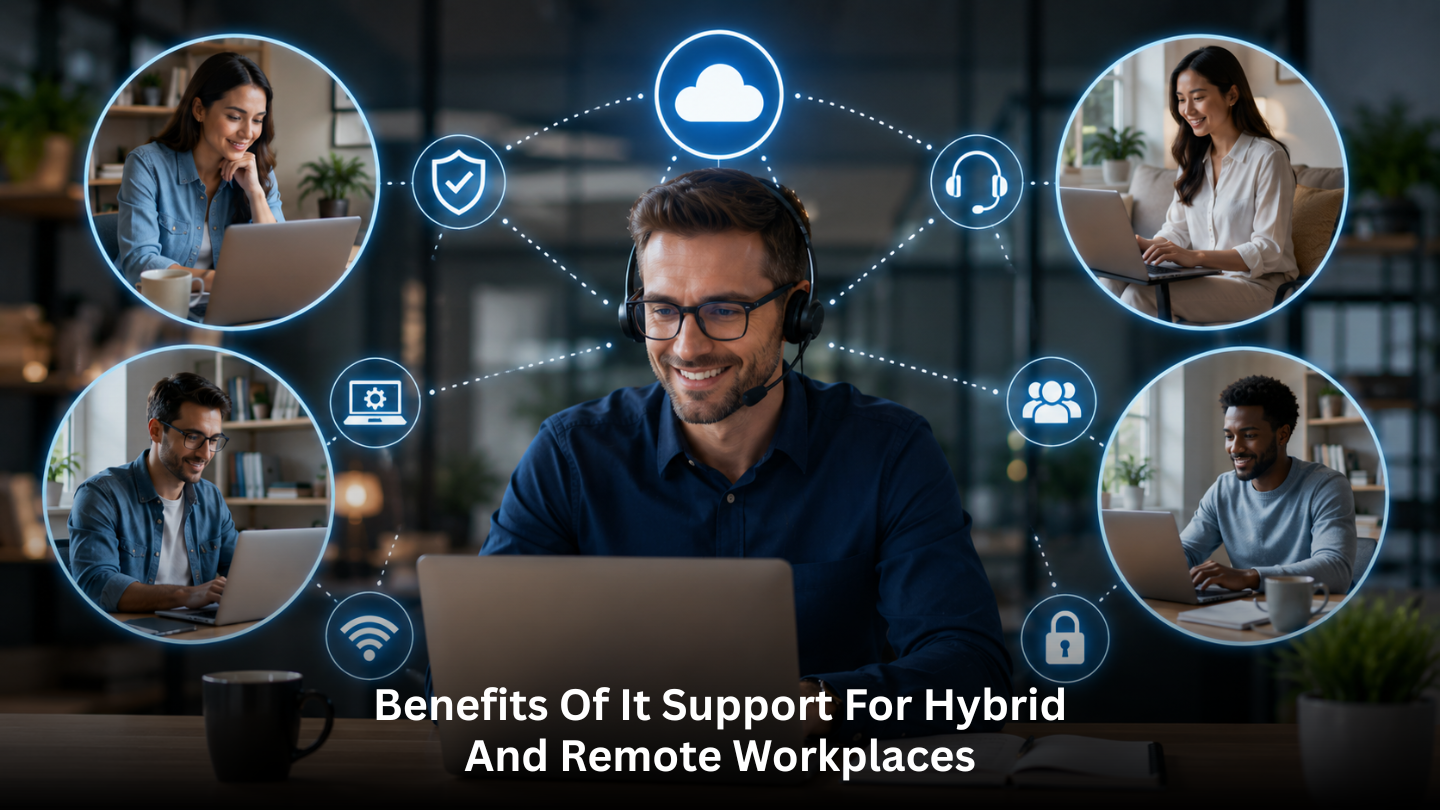
Approximately 52% of U.S. full-time employees in remote-capable jobs now work in a hybrid model, with another 26% fully remote. This shift has fundamentally changed how businesses operate and how they must protect, support, and optimize their distributed teams. Professional IT support for hybrid workplaces has become increasingly important as more employees split their time between home and the office. Recent workforce data shows that many U.S. employees in remote-capable roles now work either in hybrid or fully remote arrangements, creating new demands for secure access, reliable collaboration tools, and responsive technical support. In this article, we explore seven benefits of remote workplace IT support, including stronger security, better productivity, and more efficient operations.
Key Takeaways
- Professional IT support enhances security for remote workers through advanced endpoint protection, multi-factor authentication, and 24/7 threat monitoring
- Managed IT services reduce unplanned downtime by over 75% compared to reactive internal IT approaches
- 24/7 remote support increases employee satisfaction and maintains productivity across hybrid teams regardless of time zone or location
- Strategic IT partnerships deliver cost savings of up to $10,600 per remote employee annually through reduced operational overhead
- Proactive monitoring and maintenance prevent the majority of potential system failures before they affect users or disrupt business operations
Enhanced Security and Data Protection
Remote work environments introduce significant security risks that many organizations underestimate. Employees working from home or co-working spaces often rely on unsecured networks, increasing the risk of cyberattacks. Remote access services were the entry vector in roughly 87% of ransomware claims in 2025, with VPN compromises accounting for 73% of intrusions when the vector was identified. These challenges are often early signs that a business may need stronger cybersecurity support to protect remote workers, devices, and sensitive company data.
Professional IT support implements comprehensive security measures, including multi-factor authentication, VPNs for secure remote access, and endpoint protection across all mobile devices and personal devices. These measures ensure that remote employees can safely access sensitive data while maintaining compliance with industry regulations.
Data protection is critical in hybrid work environments, as remote workers often access and store sensitive data on various devices, increasing the risk of data breaches. Cybersecurity threats increase as employees access company systems from various locations, necessitating robust measures such as firewalls, antivirus software, and regular security assessments to protect against phishing and malware attacks.
For businesses in regulated industries like healthcare and finance, maintaining compliance becomes significantly more complex when employees work remotely. IT teams implement role-based access controls, encryption protocols, and audit trails that ensure remote work setups meet HIPAA, PCI, and other regulatory requirements. Enhanced security is ensured by dedicated support that keeps remote devices secure, up to date, and compliant, thereby protecting company data outside the office.
Advanced Threat Detection and Response
A solid IT infrastructure includes 24/7 security monitoring and threat intelligence systems that detect anomalies before they escalate into breaches. Security Operations Centers continuously monitor endpoints, servers, and networks using automated patching and predictive analytics to prevent incidents.
In one documented case, a utilities company achieved zero security incidents in the first six months after implementing managed IT services with continuous monitoring and automated patch management. This proactive approach to security represents a fundamental shift from reactive troubleshooting to prevention-focused protection.
Rapid incident response procedures ensure that threats are contained immediately when detected. Managed IT providers offer real-time response capabilities, with some achieving response times of under one hour compared to 8+ hours with reactive internal approaches. This speed is essential for protecting the hybrid workforce, where a compromised remote endpoint could give attackers access to the entire company’s systems.
Improved Productivity and Operational Efficiency

Remote IT support enables businesses to respond to issues in real time, reducing downtime and helping employees stay focused on their work rather than troubleshooting technical issues on their own. Reliable network support helps ensure employees can connect securely from any location, with proactive monitoring and troubleshooting that reduce the risk of outages and slow connections.
Research indicates that hybrid workers can be up to 13% more productive than fully onsite workers, but only when their digital infrastructure supports seamless connectivity and collaboration tools function properly. Managed IT providers offer 24/7 remote help desk support, ensuring employees receive timely assistance whenever they encounter IT problems, which is essential for maintaining productivity in remote work environments.
IT support manages the secure integration of cloud-based platforms with local systems, ensuring remote workers can safely access files from anywhere. This seamless integration between cloud services and on-site resources eliminates the frustrating delays that kill productivity, slow file access, cause connection failures, and result in underperforming collaboration tools.
One manufacturing company saw tool adoption increase from 10% to 80% after implementing robust IT infrastructure, resulting in an 18% productivity gain. The lesson is clear: providing access to technology isn’t enough. IT services must ensure those tools work reliably across remote environments.
Read More: Enhancing Remote Work: The Role of Managed IT Services in Remote Working Environments
Common IT Mistakes That Kill Remote Productivity
Many organizations make critical errors when establishing their hybrid setup that compound over time:
- Network configuration problems top the list. Without proper remote support, businesses often deploy VPNs and remote access solutions that create bottlenecks, slow connections, or security gaps. Proactive network monitoring, troubleshooting, and performance tuning are essential strategies to reduce the risk of outages.
- Inadequate endpoint management leaves remote employees struggling with outdated software, incompatible applications, or devices that lack proper security configurations. IT teams must maintain visibility across all devices, company-issued and personal devices alike, to ensure system performance remains consistent.
- Communication tool integration failures fracture collaboration across hybrid teams. IT teams maintain and support communication platforms, such as video conferencing tools, ensuring consistent connectivity for remote and in-office staff. When these software solutions aren’t properly integrated, remote teams waste time due to technical difficulties, and nearly 80% of hybrid workers report reduced productivity from constant meeting glitches.
- Backup and recovery oversights represent perhaps the most dangerous mistake. Disaster recovery planning is essential for businesses operating in hybrid work environments, enabling them to recover from disruptions and maintain business continuity quickly. Without proper backup protocols for remote work setups, a single system failure can result in catastrophic data loss.
This is why reliable IT support is so important for maintaining business continuity when teams depend on remote access, cloud platforms, and connected systems every day.
Read More: Benefits of Disaster Recovery as a Service from an IT Services Provider
Strategic Business Advantages and Cost Savings
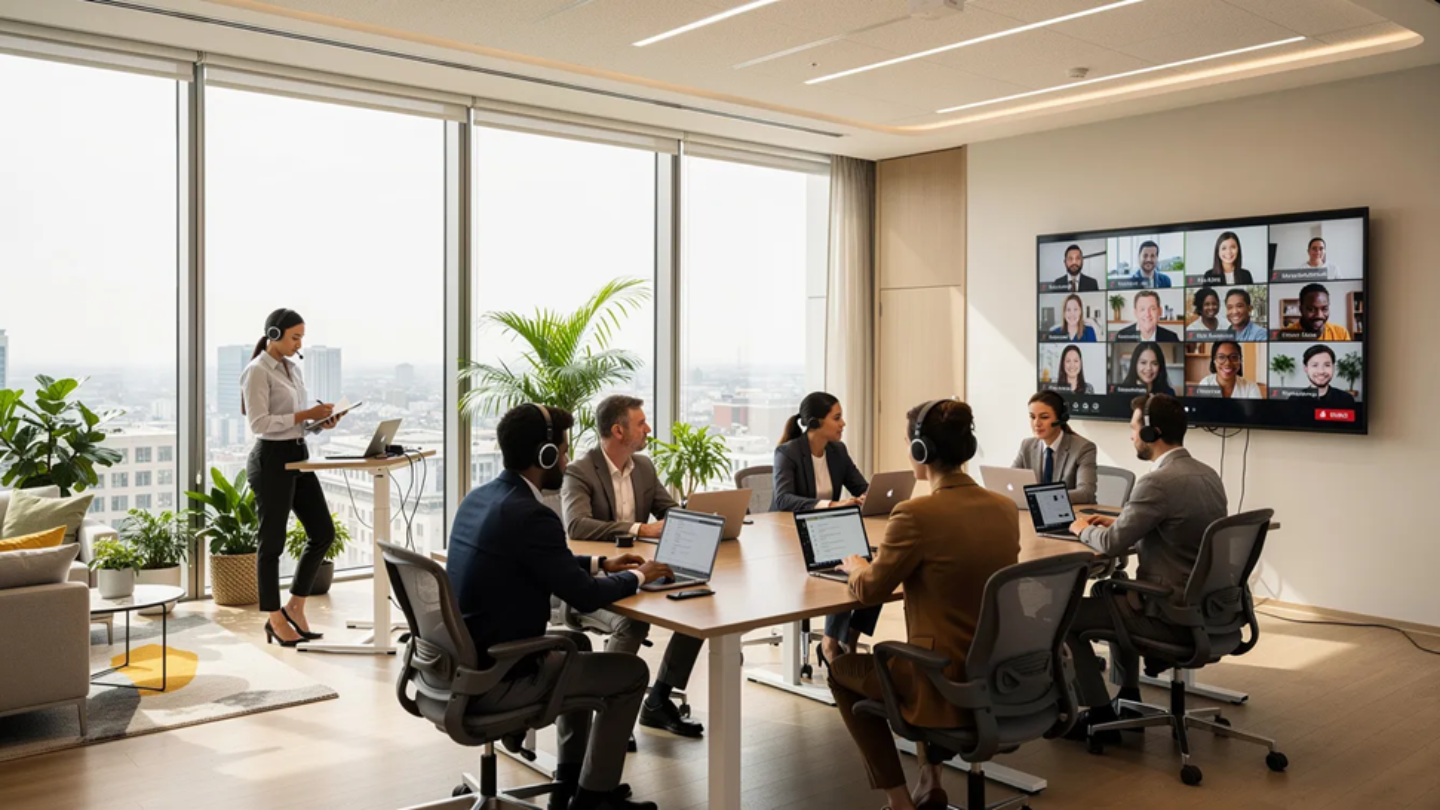
Companies can save up to $10,600 per remote employee, significantly reducing operational overhead costs. These savings come from reduced office space requirements, lower utility costs, and optimized IT operations, but only when proper IT support enables the hybrid model to function efficiently. For growing companies, understanding how an IT managed service provider differs from traditional IT support can make it easier to choose a scalable model that supports both daily operations and long-term planning.
Outsourced IT services provide a cost-effective alternative to in-house support teams, often reducing IT expenditures through fixed monthly fees and streamlined operations. A detailed cost analysis shows that a mid-level in-house IT support role costs around $129,000 per year, fully loaded, for a 15-user environment, while managed IT services might cost approximately $24,000 per year, resulting in savings exceeding $50,000 annually with broader coverage.
IT managed services providers offer essential data backup and recovery services, helping businesses quickly restore critical data after incidents such as cyberattacks or system failures, thereby reducing downtime and protecting their reputations. One utilities organization reduced unplanned outages by over 75% through managed services, enabling employees to regain approximately 5 hours per month in productive time.
Many businesses pair remote support with managed IT services to create a predictable, scalable support structure, allowing for better budgeting and fewer unexpected expenses. This scalability proves essential for business growth, whether adding remote employees, expanding to multiple locations, or adapting to hybrid working arrangements that change over time.
Strategic technology planning through vCIO/CTO services helps smaller businesses access enterprise-level capabilities and long-term technology roadmaps. These services guide cloud migration, security architecture, and compliance requirements that would otherwise require expensive specialized hires. For businesses in industries with constantly evolving regulatory requirements, this strategic guidance proves invaluable.
Final Thoughts
Professional IT support plays a critical role in helping hybrid and remote workplaces stay secure, productive, and connected. From reducing downtime and strengthening cybersecurity to improving collaboration and supporting long-term growth, the right IT strategy allows businesses to adapt confidently to today’s evolving work environment while keeping employees focused on what matters most.
Businesses looking for reliable IT support in Alpharetta, Buford, Cumming, Duluth, Dunwoody, and Flowery Branch can turn to IntegriCom for managed IT services, cybersecurity consulting, compliance support, and proactive technology solutions tailored to modern hybrid teams. With the right support in place, companies can create a more efficient and secure remote work experience without the stress of managing complex IT challenges on their own. Ready to strengthen your hybrid workplace strategy? Contact us today.
Frequently Asked Questions
What specific IT services are most critical for hybrid work environments?
The most critical IT services for hybrid teams include secure remote access solutions (VPNs and zero-trust architectures), endpoint protection for mobile devices and personal devices, cloud-based collaboration tools with proper integration, 24/7 help desk support, and proactive monitoring of network performance. Data protection and backup services are equally essential for business continuity when employees access company systems from multiple locations.
How does managed IT support differ from traditional reactive IT help?
Managed IT services provide proactive monitoring, automated patching, and continuous security surveillance rather than waiting for problems to occur. Traditional reactive IT responds only after issues affect users, leading to extended downtime and frustrated remote workers. Managed providers use remote monitoring tools to identify and resolve potential system failures before they impact productivity, often achieving 99.9% uptime, compared with significantly lower availability under break-fix approaches.
What should businesses look for when choosing an IT support partner for remote teams?
Businesses should evaluate potential partners based on expertise in cybersecurity (endpoint protection, multi-factor authentication, threat detection), compliance experience aligned with their industry regulations, 24/7 support capabilities, and demonstrated success in remote work environments. Transparent SLAs covering response times and resolution guarantees are essential, as is the ability to scale services as workforce needs change with business growth.