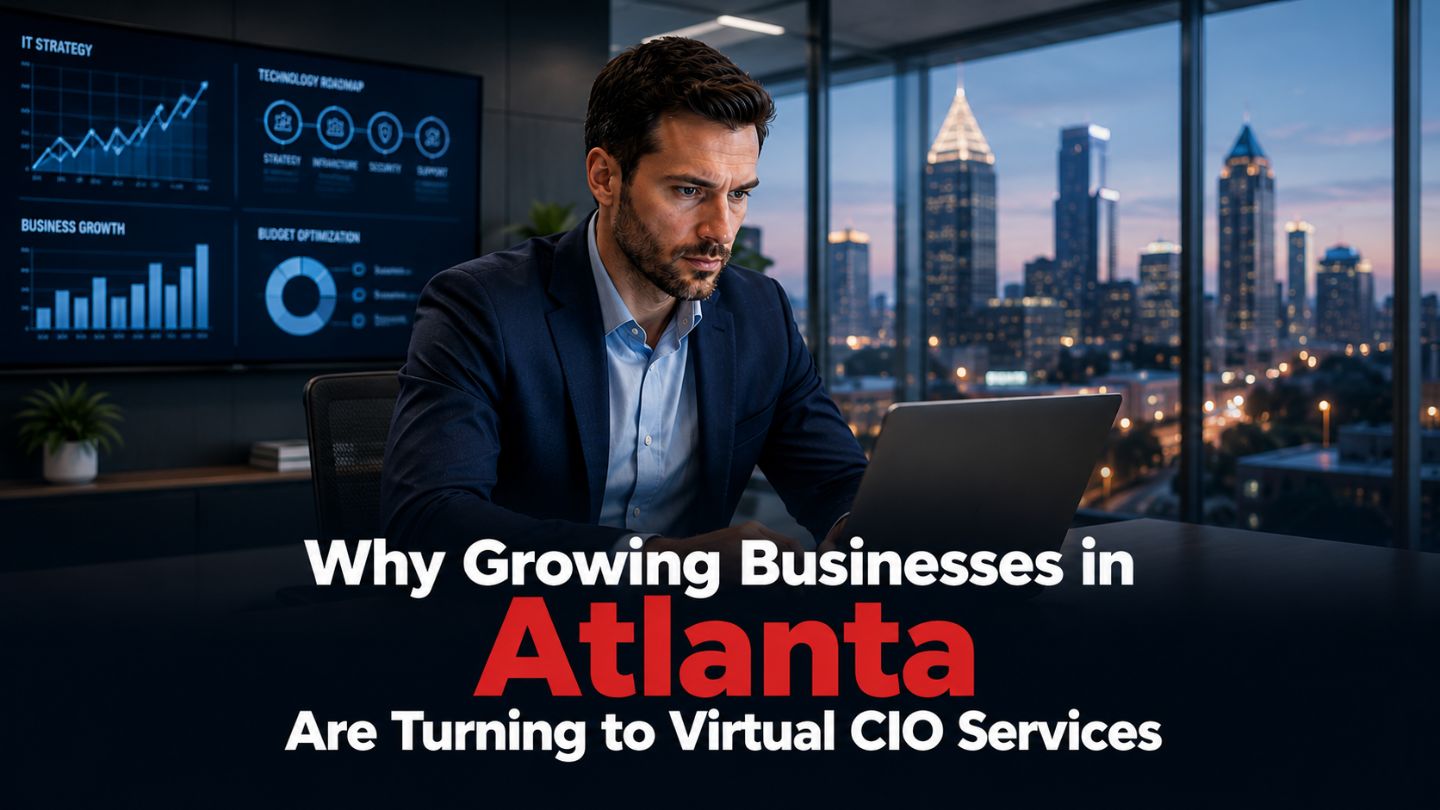
Atlanta’s business landscape is expanding fast, and with that growth comes a level of IT complexity that many internal teams are not built to handle alone. From healthcare practices navigating HIPAA compliance to law firms managing sensitive data across multiple offices, companies across Metro Atlanta face technology decisions that demand executive-level expertise. Depending on the source, role definition, and compensation included, Atlanta CIO salary estimates vary widely, with some executive compensation benchmarks reaching roughly $342,000 per year. That level of investment can put full-time strategic IT leadership out of reach for many small and medium-sized businesses. A virtual CIO helps close that gap by delivering technology roadmap development, risk management, budgeting, and strategic guidance through a flexible service model rather than a full-time executive hire.
This blog breaks down the specific reasons behind this shift, the measurable benefits driving adoption, and the real outcomes businesses across Atlanta are achieving through vCIO partnerships.
Key Takeaways
- Cost savings without sacrificing expertise: Virtual CIO services give growing businesses access to executive-level IT strategy for a predictable monthly retainer, avoiding six-figure salary commitments.
- Strategic alignment: A vCIO creates a 3-year technology roadmap for businesses, ensuring that IT investments support business growth rather than just keeping the lights on.
- Stronger security posture: With both cyber threats and compliance mandates increasing, vCIO services provide the governance and cybersecurity risk assessment capabilities that small businesses need but rarely have in-house.
- Better technology spending: vCIOs help prioritize IT projects and manage technology budgets effectively, eliminating waste from redundant tools and poorly negotiated vendor contracts.
- Competitive advantage: Companies that tie technology decisions to business objectives consistently outperform those making ad-hoc IT investments.
The Atlanta Business Growth Challenge
Metro Atlanta is one of the fastest-growing business corridors in the Southeast. According to the U.S. Small Business Administration’s 2025 profile, there are nearly 898,622 small businesses in the Atlanta–Sandy Springs–Roswell metro area, representing 99.6% of all employers and accounting for 43.1% of total employment. Between 2012 and 2022, the number of small business employers in the region grew from roughly 103,351 to approximately 127,952.
That growth trajectory creates real IT infrastructure challenges. Expanding companies in Atlanta need technology strategies aligned with business growth, but the gap between needing strategic IT leadership and being able to afford it can be significant. Depending on the source and how compensation is measured, Atlanta CIO pay estimates vary considerably, with some executive benchmarks exceeding $300,000 annually. At the same time, the Federal Reserve Bank of Atlanta’s 2025 Small Business Credit Survey found that 58% of Georgia small employer firms reported poor or fair financial conditions in 2024, highlighting the cost and cash-flow pressure many local businesses face.
For a healthcare practice with 60 employees, a growing law firm opening a second office, or a financial services company facing expanding compliance requirements, hiring a full-time CIO may not make financial sense. Operating without a technology strategy can be just as costly. This is the gap virtual CIO services are designed to fill: they give Atlanta SMBs access to proactive IT leadership without adding a full-time executive. For business owners weighing this option, understanding what a vCIO is is a practical first step.
Businesses can often reduce leadership costs by using vCIO services instead of hiring a full-time CIO. Pricing varies based on the provider, scope, employee count, environment complexity, and regulatory requirements, and engagements may use monthly retainers, project fees, or a combination of both. The key budgeting advantage is predictability: business owners can define the strategic services they need and compare that cost with the salary, benefits, and overhead associated with a full-time executive.
When Internal IT Teams Reach Their Limits
Most businesses with internal teams eventually hit a ceiling. The IT staff who keep your systems running, manage endpoint protection, and resolve daily tickets are doing essential work. But strategic IT planning requires a fundamentally different skill set than troubleshooting network issues or provisioning new laptops.
Here are the specific signals that a business needs strategic leadership beyond daily support:
- Technology decisions are reactive, not proactive: Every major purchase or platform change happens in response to a crisis rather than as part of a planned strategy.
- Multiple critical projects are competing without a roadmap: Cloud migrations, cybersecurity improvements, and software upgrades are all on the list, but nobody is prioritizing them against business objectives.
- Vendor contracts and renewals go unmanaged: Licensing agreements auto-renew at unfavorable rates, tools overlap in functionality, and nobody is tracking total technology spend.
- Compliance requirements are growing: Industries like healthcare, financial services, insurance, and legal are facing stricter industry regulations around data privacy, security controls, and documentation of controls and vendor oversight-and internal teams aren’t equipped to manage this alongside their operational workload.
- The IT budget has no clear connection to business priorities: Technology investments should be tied to overall business objectives for optimal performance, but without executive-level oversight, IT spending becomes a cost center rather than a growth enabler.
These warning signs often become more visible as a company adds employees, locations, cloud services, vendors, or compliance obligations. There is no universal headcount at which strategic IT leadership becomes necessary; the better test is whether technology decisions are affecting growth, risk, budgeting, or executive priorities. At that point, the difference between operational IT support and strategic consulting services becomes difficult to ignore.
Read More: What is a vCIO (Virtual CIO) and Why You Need One
Five Key Benefits Driving the Virtual CIO Trend

The rise of virtual CIO services in Atlanta isn’t driven by a single factor. It’s a convergence of five specific advantages that address the most pressing challenges growing companies face. Companies evaluating their technology needs should consider whether a virtual CIO is right for their company based on their goals, budget, and available internal IT resources.
1. Cost-Effective Access to Executive-Level IT Expertise
The cost difference can be substantial. A full-time CIO requires salary, benefits, bonuses, recruiting expense, and other overhead, while a vCIO engagement is scoped around the strategic guidance a business actually needs. Pricing varies with company size, environment complexity, regulatory requirements, and the depth of the engagement, but the model can give growing companies access to IT strategy, budgeting, and governance without carrying the full cost of an executive hire. That allows more of the technology budget to remain focused on security, modernization, and business growth.
2. Strategic Technology Planning Aligned with Business Growth
A vCIO creates a multi-year technology roadmap that maps major initiatives against timelines, budgets, business priorities, and dependencies. Instead of making ad hoc investments that may not integrate well or scale properly, companies get a coherent plan that supports long-term growth. This roadmap helps ensure that each technology investment serves a specific business goal, whether that means opening a second office, enabling secure remote work, strengthening cybersecurity, or preparing for a compliance audit.
3. Enhanced Cybersecurity Strategy and Risk Management
Cybersecurity is increasingly a business-level concern for Atlanta SMBs. Risk assessments identify gaps in technology, processes, and governance before those weaknesses contribute to an incident, and they help leaders adjust security priorities as threats, systems, and compliance obligations change. Many organizations conduct a formal assessment annually, but the appropriate frequency should reflect the company’s risk profile and major business or technology changes. A virtual CIO can establish the assessment process and governance framework needed to reduce risk, prepare incident response plans, and maintain compliance with industry-specific security requirements. This includes setting access-management policies, multifactor authentication standards, and security controls appropriate to the organization.
4. Vendor Management and Technology Procurement Guidance
As companies accumulate SaaS subscriptions, cloud service contracts, phone systems, and network services, tracking costs, performance, and risk becomes increasingly difficult. Verizon’s 2025 Data Breach Investigations Report found third-party involvement in 30% of the breaches it analyzed, up from roughly 15% the previous year. A vCIO can evaluate vendor contracts, identify redundant services, support contract negotiations, and help ensure that each tool in the technology stack serves a clear business purpose without introducing unmanaged risk.
5. Improved IT Budget Planning and ROI Measurement
Without strategic oversight, technology spending tends to balloon without corresponding returns. vCIO services bring discipline to IT budget planning by categorizing expenditures, measuring ROI on technology investments, and ensuring that spending decisions reflect business priorities rather than vendor pressure. This data-driven approach helps companies make informed decisions about where to invest, where to cut, and where to hold steady.
Why Choose IntegriCom for Virtual CIO Services in Atlanta
IntegriCom, Inc. stands out as a trusted partner for growing businesses in Atlanta seeking virtual CIO services. IntegriCom brings over two decades of experience delivering full-spectrum IT solutions tailored to the unique needs of small and medium-sized businesses across Metro Atlanta and North Georgia.
What sets IntegriCom apart is a commitment to four core values: being selfless for our clients and each other, relentless in improving, professional with unassuming confidence, and joyful in doing the right thing regardless of the circumstances. These principles guide every engagement so clients receive both strategic IT leadership and a relationship grounded in integrity and trust.
IntegriCom’s vCIO services connect technology decisions to business goals, cybersecurity priorities, and operational needs. The process begins with an assessment of the current environment, identifies material risks and opportunities, and turns those findings into prioritized recommendations, budgets, and a practical technology roadmap that leadership can review over time.
With deep expertise in industries like healthcare, finance, insurance, and legal, IntegriCom understands the compliance demands and cybersecurity challenges specific to these sectors. Their consulting services extend beyond strategy to include vendor management, risk assessments, and proactive operational support that scales with your business growth.
Choosing IntegriCom means partnering with a local team that combines technical excellence with a personal touch, ensuring your technology roadmap supports your long-term vision while protecting against cyberattacks and operational disruptions. For Atlanta businesses ready to elevate their IT strategy without the cost of a full-time CIO, IntegriCom offers a proven, cost-effective solution tailored to your needs.
Real Outcomes Atlanta Businesses Are Achieving
The trend toward vCIO services isn’t theoretical. Companies across Metro Atlanta are achieving measurable results through strategic IT partnerships.
- Healthcare practices strengthening compliance and uptime: Healthcare organizations in the Atlanta area have partnered with vCIO providers to manage complex EMR system transitions, address HIPAA compliance gaps, and maintain server infrastructure reliability. In documented cases, these engagements have resulted in reduced downtime, streamlined compliance documentation, and scalable systems that supported 15+ years of sustained practice growth. A risk assessment provides a roadmap for improving security, and for practices handling protected health information, this isn’t optional-it’s essential for business continuity.
- Professional services firms enabling distributed work: For professional services firms, vCIO-guided planning can support office consolidation and distributed work by evaluating cloud-hosted desktop environments, secure file access, identity controls, collaboration tools, and recovery requirements as one coordinated strategy. That same governance is increasingly important as firms evaluate AI and automation tools, helping leaders assess security, privacy, integration, cost, and business value rather than relying on vendor claims alone.
- Financial services and insurance companies managing regulatory complexity: Companies in Atlanta’s financial services sector face mounting compliance mandates around data protection, financial data handling, and client privacy. vCIO engagements have helped these firms build governance frameworks, document security controls, conduct vendor risk assessments, and implement multi-layered cybersecurity strategies that satisfy regulatory requirements while supporting growth.
- Growing companies eliminating technology waste: Across industries, a common outcome of vCIO engagement is the identification and elimination of redundant technology spending. Firms with 50 to 150 employees frequently discover overlapping SaaS subscriptions, underutilized licenses, and poorly negotiated contracts. A vCIO-led audit and rationalization process has helped companies redirect those funds toward IT investments that directly support business objectives.
vCIO services can scale as a business adds locations, employees, service lines, vendors, and compliance obligations. The technology roadmap created during the initial engagement evolves through regular reviews, helping the IT strategy stay aligned with where the business is heading rather than where it has been.
Dozens of business expansions in the Metro Atlanta region-involving software companies, data firms, and shared services providers-have created technology demands that often outpace a company’s internal capacity to manage them. vCIO services help align IT with business goals during these critical growth periods, ensuring that infrastructure, cybersecurity, and cloud services are in place before they become bottlenecks.
Read More: How Can IT Consulting Save Your Business Time and Money?
Drive Smarter Technology Decisions as You Grow

Growing businesses in Atlanta need technology that can keep pace with expansion without creating unnecessary complexity or costs. Virtual CIO services provide strategic guidance for technology planning, cybersecurity, infrastructure, compliance, and long-term growth. With experienced leadership, businesses can align IT investments with goals while improving efficiency, scalability, and operational resilience.
IntegriCom helps Atlanta-area businesses make strategic technology decisions through virtual CIO services in Atlanta, with experienced guidance tailored to each organization’s goals, risks, and growth plans. Our virtual CIO and vCTO services, cybersecurity consulting, and network services and computers give clients a coordinated approach to technology planning and operations. Contact us to discuss where your current IT strategy is working, where risks or costs are increasing, and what a practical roadmap could look like for your business.
Frequently Asked Questions
How does a virtual CIO work with our existing IT team or managed service provider?
A virtual CIO operates at the strategy layer, not the operational layer. Your internal IT team or IT provider continues handling daily support, troubleshooting, and infrastructure management. The vCIO defines priorities, develops the technology roadmap, manages the IT budget, oversees vendor relationships, and ensures that operational work aligns with broader business objectives. This structure gives internal teams clearer direction and better support without replacing anyone.
What specific deliverables should we expect from virtual CIO services?
Core deliverables include a multi-year technology roadmap, an annual IT budget plan, a vendor contract register, a cybersecurity risk assessment report, compliance gap analysis, and periodic strategic reviews with your leadership team. vCIO services also typically include recommendations for modernization-such as cloud migration planning, security upgrades, and infrastructure scaling-along with documentation that supports governance and compliance in regulated industries.
How quickly can a virtual CIO help us develop our technology strategy?
The time needed to develop a technology strategy depends on the size and complexity of the environment, the availability of documentation, the number of vendors involved, and the urgency of identified risks. An initial assessment can often surface immediate gaps and priorities within the first few weeks, while a complete roadmap and budget require additional discovery and leadership input. Major initiatives such as cloud migrations, security improvements, or infrastructure upgrades are then phased according to risk, resources, and business priorities.
Do virtual CIO services include hands-on IT support or just strategy?
Virtual CIO services focus on strategic leadership rather than day-to-day technical support. A vCIO defines priorities, budgets, governance, and desired outcomes, then coordinates with the internal IT team, managed IT services provider, or other technology partners responsible for implementation. Depending on the provider’s service model, the same organization may also deliver hands-on support through a separate technical team. This structure keeps strategic oversight distinct while giving operational teams clear direction and accountability.
What makes Atlanta businesses particularly suited for virtual CIO services?
Atlanta’s combination of rapid business growth, a strong technology talent pipeline, and heavy representation in regulated industries like healthcare, finance, insurance, and legal creates ideal conditions for vCIO adoption. The region’s small businesses face mounting cybersecurity threats, increasing compliance requirements, and competitive pressure to modernize-all while managing tight budgets. Virtual CIO services deliver the strategic expertise these companies need to identify vulnerabilities, protect sensitive data, and make technology decisions that drive long-term success without overextending their resources.