When your systems go down or a team member can’t log in, you need the problem fixed fast. But deciding which type of technology service to invest in-IT support or help desk-requires understanding what each actually delivers. The terms get used interchangeably, which creates confusion when businesses are evaluating their options.
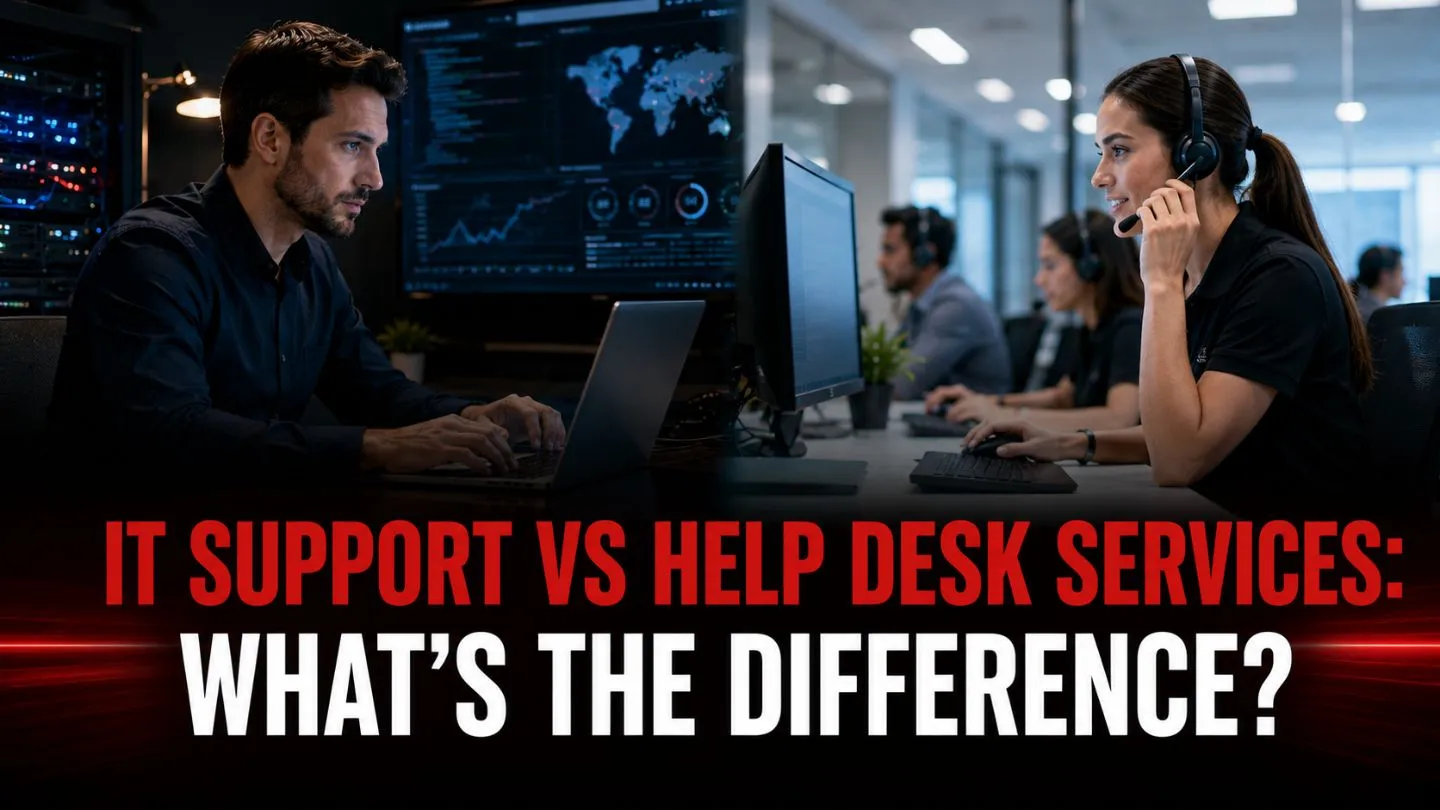
Understanding the difference between IT support and help desk services is essential for making informed technology decisions. Both play critical roles in keeping your organization running, but they serve fundamentally different purposes. One is built to resolve immediate technical issues. The other is designed to manage, protect, and strategically grow your entire IT environment. This blog breaks down the definitions, key differences, and real-world scenarios that help you determine when to use each service-or both.
Key Takeaways
- IT support encompasses comprehensive technology management, including proactive monitoring, cybersecurity, compliance, and strategic planning.
- Help desk services focus primarily on reactive issue resolution and immediate user assistance.
- IT support typically includes broader infrastructure management, while a help desk centers on solving individual technical problems quickly.
- Many businesses benefit from combining both services for complete, end-to-end delivery of technology coverage.
- The right choice depends on your business size, regulatory requirements, complexity, and growth objectives.
What is IT Support?
IT support is a broad, multi-layered set of services that goes well beyond fixing individual technical issues. It covers the management, security, and strategic planning of an organization’s entire IT infrastructure-from networks and servers to cloud platforms and cybersecurity protections. IT support encompasses broader technical functions beyond immediate user issues, addressing both user and system-related IT challenges.
What sets IT support apart is its proactive approach. Rather than waiting for something to break, an IT support team actively monitors systems, performs maintenance, optimizes performance, and plans for future growth. IT support includes proactive measures to prevent technical issues before they disrupt operations, and it is involved in strategic planning for IT infrastructure.
In practice, IT support activities include network architecture design, cybersecurity implementations, compliance audits, disaster recovery planning, and aligning workplace technology investments with broader business goals. For growing organizations-or those in regulated industries like healthcare and finance-IT support is what keeps the business resilient and competitive.
IT support aligns technology with business objectives, supports IT support for business continuity, and ensures your environment can scale as your needs evolve. This goes beyond problem resolution into service lifecycle management and long-term solutions.
Core Functions of IT Support
The core functions of IT support reflect its broader scope and strategic depth:
- Network infrastructure management: Designing, maintaining, and securing your network environment to ensure reliable connectivity and performance across all locations.
- Cybersecurity implementation: Deploying endpoint protection, vulnerability management, performing security verification, and incident response. IT support involves maintaining cybersecurity protections and system security as an ongoing priority while helping organizations recognize the signs your business needs cybersecurity support before threats disrupt operations.
- Cloud services and infrastructure: Managing cloud migrations, hybrid environments, and ensuring availability-critical for organizations embracing remote or hybrid work.
- Compliance and regulatory support: For industries like healthcare, finance, legal services, and businesses subject to cyber insurance requirements, IT support includes ongoing evaluations, documentation, policy alignment, and audit preparation for frameworks such as HIPAA, PCI, and GLBA. This keeps compliance from becoming a one-time checklist and makes it part of the organization’s ongoing technology management.
- Strategic planning and virtual CIO/CTO services: Providing technology roadmap development, budget forecasting, and capacity planning to ensure your technology investment matches your business trajectory.
- Proactive monitoring and maintenance: Using remote monitoring and management (RMM) tools and SIEM platforms to detect and resolve issues before they impact end users-a far cry from the break-fix model.
Support tiers include different levels of troubleshooting expertise: IT support may include Tier 2 and Tier 3 specialists for complex issues, bringing engineering-level knowledge to problems that front-line agents simply cannot address.
What are Help Desk Services?

Help desk services are the front line of technical support, designed to provide immediate, reactive IT support to end users experiencing problems. Help desks are often perceived as the first line of IT support-the single point of contact for anyone who needs help with a password reset, a software glitch, a printer that won’t cooperate, or a login failure.
Help desk services focus on immediate user-centric issues. Help desk technicians document incidents in a ticketing system, log, manage, and resolve IT support tickets, and work to restore normal operations as quickly as possible. The main focus is quick fixes for simple IT issues, resolving specific IT problems fast so employees can get back to work.
A help desk is primarily reactive, addressing issues as they arise. Help desks typically focus on internal employees or customers needing quick solutions, and they operate on what is often called the break-fix model: something breaks, they fix it. Help desk agents typically have a customer service background and are trained on common tools and procedures. Because users often judge support by speed, clarity, and personalization, responsive help desk support should prioritize clear communication, fast triage, and a consistent service experience.
Common help desk scenarios include:
- Password resets and account unlocks
- Software installation and troubleshooting
- Printer and peripheral device issues
- Email and connectivity problems
- General inquiries about workplace technology
Help desk services handle daily user issues such as these efficiently, with an emphasis on speed, first-contact resolution, and customer satisfaction.
Common Misconceptions About Help Desk Services
One of the most frequent misunderstandings is treating help desk and full IT support as interchangeable. While a help desk acts as the first point of contact for users experiencing issues, it doesn’t include strategic technology planning, infrastructure management, or ongoing security services. Help desks typically have a narrower scope than service desks or comprehensive IT support teams.
Another misconception: that help desk support alone can handle complex issues like network outages, ransomware incidents, or compliance gaps. Help desks focus on immediate problem resolution, not on managing incidents at a systemic level, handling change management, or performing asset management across your environment.
Many businesses outgrow basic help desk services as they scale. When support tickets start to pile up with recurring problems, when regulatory audits loom, or when critical issues affect entire departments rather than individual users, that is a signal that broader IT support is needed. Under the ITIL framework, a service desk expands beyond the traditional help desk model by supporting service request management, incident management, problem management, knowledge management, and end-to-end service delivery.
Key Differences Between IT Support and Help Desk Services
Understanding the key differences between IT support and help desk services helps you invest in the right level of support capability for your specific business needs. Here’s how they compare across the most important dimensions:
- Scope and approach: Help desks focus on immediate, reactive IT issue resolution, resolving user issues one ticket at a time. IT support covers both reactive and proactive functions, with long-term oversight of systems, security, and strategy. Service desks manage incidents and service requests proactively, aligning IT services with business objectives.
- Service depth and technical complexity: A help desk handles issues that can be resolved with known procedures-Tier 1 tasks, sometimes Tier 2. IT support includes deeper technical domains: network architecture, cybersecurity, cloud infrastructure, and regulatory compliance. IT support services handle escalated and complex technical problems that go beyond what a desk technician can address.
- Staffing and expertise: Help desk roles are typically staffed with agents skilled in customer service and familiar with common service desk tools. IT support requires engineers, security specialists, cloud architects, and possibly virtual CIO/CTO roles. The difference in expertise directly affects the range of problems each team can solve, especially when evaluating managed IT service providers vs traditional IT support for long-term business needs.
| Feature | Help Desk Services | IT Support Services |
| Primary Focus | Immediate issue resolution, quick fixes | Comprehensive technology management |
| Approach | Reactive (break/fix) | Proactive and strategic |
| Scope | Individual user issues, support tickets | Infrastructure, security, compliance, planning |
| Staffing | Help desk agents, desk technicians | IT engineers, security specialists, virtual CIO |
| Incident Handling | Tier 1 (sometimes Tier 2) | Tier 1 through Tier 3 |
| Service Management | Basic ticketing and self-service | Full ITSM: incident, problem, change management |
| Compliance | Limited | Active compliance consulting and audits |
| Tools | Ticketing systems, knowledge base, chat | RMM, SIEM, endpoint protection, cloud platforms |
| Ideal For | Small teams, simple IT environments | Growing or regulated businesses |
| ROI Drivers | Productivity, fast response times | Downtime prevention, security, strategic growth |
Service desks provide end-to-end ownership of user issues and encompass broader IT service management activities, including service request fulfillment and service lifecycle management. Service desks often follow the ITIL framework for best practices, which structures service desk operations around managing incidents, service requests, and overall service quality.
Current managed IT services research shows that MSP adoption is now common among small and midsize businesses, with one 2026 industry analysis reporting that 76% of SMEs rely on a managed service provider for at least some IT functions. The most effective IT service providers deliver both help desk and full IT support under one roof, giving businesses immediate assistance for user issues while also strengthening long-term resilience through monitoring, cybersecurity, compliance support, and strategic planning.
For businesses considering how these services fit within a managed IT services model, the distinction is especially important. Managed IT goes beyond traditional help desk support by including proactive monitoring, cybersecurity, and strategic oversight-all coordinated by a dedicated support team.
Read More: Benefits of IT Support for Hybrid and Remote Workplaces
Choose the Right IT Support for Long-Term Success

Understanding the difference between IT support and help desk services helps businesses make smarter technology decisions. While help desk teams resolve day-to-day technical issues, comprehensive IT support provides proactive management, strategic planning, and long-term solutions that improve security, productivity, and overall business performance.
For reliable IT support in Duluth, IntegriCom delivers proactive technology solutions designed to keep your business running efficiently and securely. We also provide co-managed IT services, cloud services, network services, and computers to support your evolving technology needs. Contact us today to learn how we can help your business build a stronger, more dependable IT environment.
Frequently Asked Questions
Can a business use both IT support and help desk services simultaneously?
Absolutely. A combined model is often the most effective approach. Your help desk handles the high volume of immediate issues-password resets, software troubleshooting, user inquiries-while your IT support team focuses on infrastructure, security, compliance, and strategic initiatives. This two-desk approach ensures fast response times for end users and proactive protection for your broader environment.
What size business typically needs full IT support versus just help desk services?
Businesses with 50 to 250 employees commonly begin needing full IT support, especially when managing multiple locations or cloud environments. However, companies in regulated industries like healthcare or finance often need comprehensive IT support even at smaller sizes due to compliance requirements and the elevated risk of security incidents.
How do managed IT services differ from traditional help desk support?
Managed IT services include ongoing, proactive service delivery, system monitoring, cybersecurity, compliance management, and strategic planning, in addition to reactive support. Traditional help desk support is limited to resolving IT issues as they arise. A managed service provider takes responsibility for the health and performance of your entire IT environment, not just individual support tickets.
When should a growing business transition from help desk to comprehensive IT support?
Key signals include frequent or recurring outages, upcoming regulatory audits, security incidents, expansion to multiple offices, adoption of cloud services, and growing support ticket volume that your current team can’t keep up with. If your IT teams are spending more time fighting fires than improving systems, it’s time to invest in broader support operations.
How does IntegriCom’s approach combine the benefits of both service types?
IntegriCom delivers responsive help desk support for resolving user issues quickly alongside full-spectrum IT support including cybersecurity consulting, compliance management, cloud services, and virtual CIO guidance. This integrated model means your end users get immediate assistance while your business benefits from proactive monitoring, security, and a technology roadmap aligned to your broader business goals.