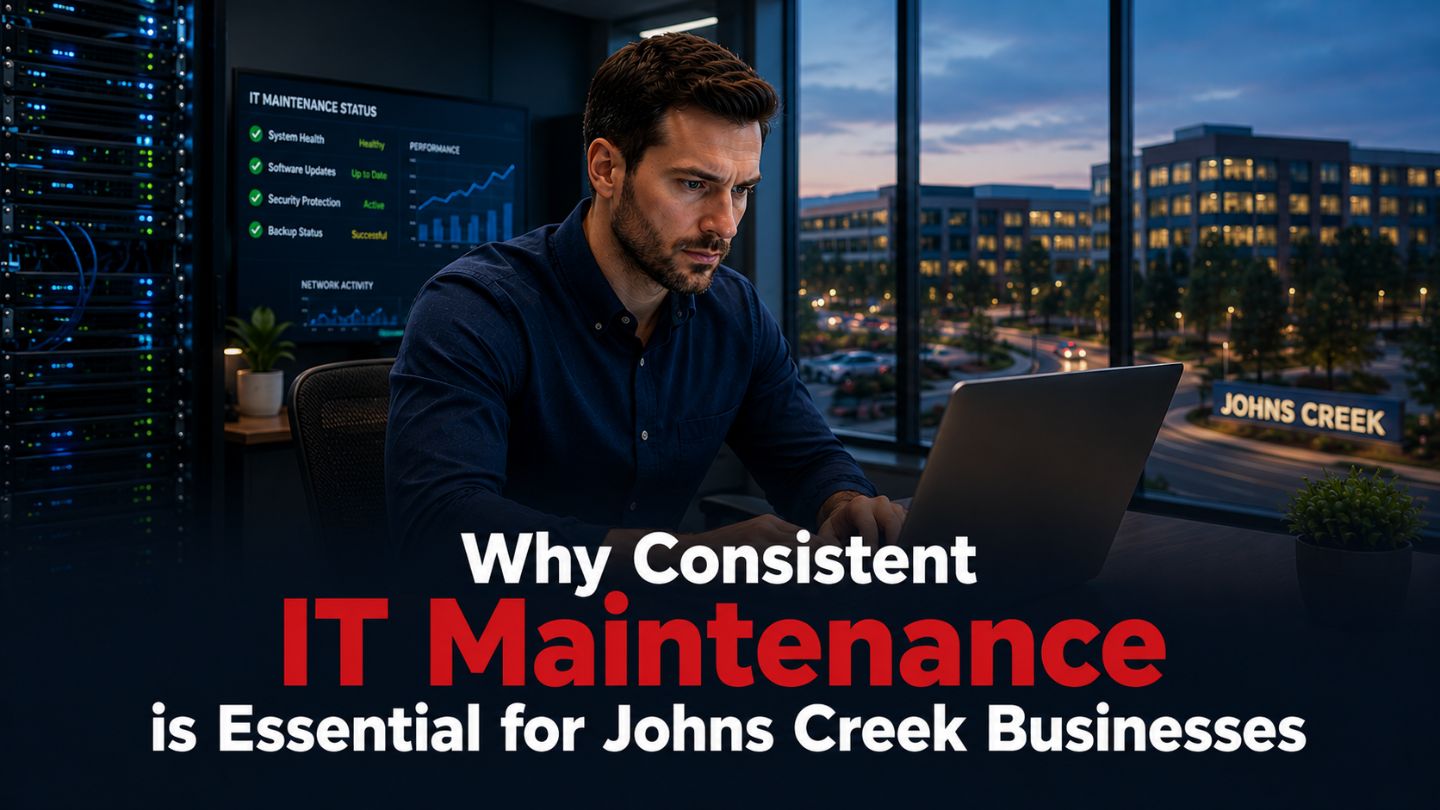
A single unpatched server, skipped backup verification, or outdated firewall rule can bring a Johns Creek business to a standstill. Consistent IT maintenance helps prevent avoidable outages, security incidents, and productivity losses. This guide explains the financial, security, and operational value of proactive maintenance and how it helps local businesses protect their data, employees, customers, and bottom line.
Key Takeaways
- Proactive IT management can reduce downtime and support defined availability goals for business-critical systems.
- Downtime costs vary by company and industry, but published SMB benchmarks show that even short outages can create substantial losses.
- Fast, risk-based patching helps reduce exposure to known vulnerabilities, especially when active exploitation is underway.
- Planned maintenance improves system reliability, employee productivity, and customer experience.
- Healthcare organizations, payment-card environments, and other regulated businesses require consistent oversight to support obligations under HIPAA, PCI DSS, and applicable Georgia requirements.
What Consistent IT Maintenance Really Means for Johns Creek Companies
Consistent IT maintenance extends far beyond fixing things when they break. It encompasses scheduled system health checks- both on-site support visits and remote diagnostics-along with regular patching of operating systems, firmware, and applications. It includes proactive monitoring of network infrastructure, preventive hardware replacement before equipment failures occur, periodic disaster recovery drills, backup verification, configuration audits, and continuous cybersecurity hygiene.
At its core, proactive technology management treats your IT environment as a living system that requires ongoing attention. Every device added to a network, every software update released by a vendor, and every new employee onboarded expands the attack surface and introduces potential points of failure. Without regular maintenance, these risks compound silently until they surface as costly downtime, data loss, or a security breach.
The distinction matters because many Johns Creek businesses still operate under the assumption that IT systems only need attention when something goes wrong. That assumption is expensive-and increasingly dangerous.
The Difference Between Break-Fix and Proactive Maintenance
In a break-fix model, a business waits for a hard drive, network switch, or critical application to fail before calling for help. A technician must then diagnose the issue, source any required parts, restore service, and verify data integrity while employees may be unable to work. Unplanned emergency labor, expedited shipping, data recovery, and lost productivity often make this approach more expensive and disruptive than scheduled maintenance.
By contrast, a managed IT services provider can monitor system health, identify warning signs such as drive errors or capacity issues, and schedule corrective work before a failure interrupts operations. Updates can be deployed according to a documented patching policy, backups can be tested on a defined schedule, and critical vulnerabilities can be prioritized based on severity, exploit activity, and business impact.
Proactive IT support helps maintain business continuity during disruptions because problems are resolved before they impact operations. For Johns Creek companies competing in fast-moving industries, that reliability is a measurable advantage. 24/7 monitoring is a key feature of proactive IT support, and it’s what separates businesses that experience occasional inconveniences from those that face full-blown crises.
Financial Impact: Why Consistent Maintenance Saves Johns Creek Businesses Money

The numbers tell a clear story. According to 2026 benchmarks from OutageCost, SMBs in the United States lose between $8,000 and $25,000 per hour of downtime. For a 20-person business generating $5 million in annual recurring revenue, even a four-hour outage can cost approximately $5,700 in direct lost productivity, revenue, and recovery expenses-and that figure excludes reputational damage and compliance penalties.
Predictable budgeting for IT costs is achieved through consistent maintenance. Instead of absorbing unpredictable emergency repair bills, businesses pay a steady monthly fee for comprehensive managed services that cover patching, monitoring, backup services, and hardware lifecycle management. This approach is dramatically more cost-effective than the alternative.
Strategic IT planning aligns technology with business objectives, turning IT budgets from a reactive expense into a strategic investment. A small healthcare practice in Metro Atlanta that invests $1,500 per month in quarterly patching, monthly backup testing, and continuous monitoring might spend $18,000 annually-but avoids a single breach that could cost $100,000 or more in fines, legal fees, and remediation. The ROI compounds year after year.
Hidden Costs of Inconsistent IT Maintenance
The visible costs of a system failure-repair bills, replacement hardware-are only part of the picture. When systems go down unexpectedly, employees sit idle. An outage event can reduce productivity by 70% or more during the incident, and the ripple effects continue for days as backlogs accumulate.
Emergency IT services cost significantly more than planned maintenance. Rush hardware orders carry premium pricing. Data recovery after a breach or failure can run tens of thousands of dollars-and there’s no guarantee of full recovery.
For regulated and contractually governed environments, the consequences can be more serious. Healthcare organizations may face HIPAA-related investigations or penalties, while businesses that handle payment cards can face contractual consequences, higher processing costs, or loss of card-processing privileges if they fail to meet PCI DSS requirements. A 2020 Infrascale survey found that 25% of SMB respondents estimated downtime losses of $20,001 to $40,000 per hour, while about 10% reported losses above $50,000 per hour. Consistent maintenance also helps extend hardware life and supports more predictable capital planning.
Cybersecurity: How Regular Maintenance Protects Johns Creek Businesses
Outdated software, unsupported operating systems, misconfigured network ports, and unmonitored IoT devices all create openings for attackers. Proactive IT maintenance strengthens cybersecurity by closing these gaps before they’re exploited. Businesses face threats from ransomware, phishing, and data breaches on a daily basis, and attackers specifically hunt for low-hanging fruit-any unpatched service represents an open door.
The data illustrates the operational risk of delayed remediation. A 2026 survey of more than 900 cybersecurity practitioners and leaders found that only 9% of organizations remediated high-severity production vulnerabilities within 24 hours, while 74% took one to seven days. Organizations in the four-to-seven-day group reported incidents involving known vulnerabilities at a 97% rate, compared with 77% among organizations patching within 24 hours. The Cloud Security Alliance also reported that more than 80% of organizations missing the 24-hour window experienced security incidents involving known vulnerabilities.
Perhaps most alarming: 55% of companies experienced security incidents even though patches existed but were never applied. These aren’t exotic zero-day exploits-they’re entirely preventable failures of maintenance discipline. Layered security includes Endpoint Detection & Response and email protection, but these tools only work when they’re kept current.
Maximizing Employee Productivity Through Reliable IT Systems
Optimizing IT systems boosts employee productivity. When networks are slow, applications crash, or employees can’t log into their systems, work stops-and frustration mounts. Reliable technology eliminates these daily friction points, keeping your team focused on revenue-generating activities instead of troubleshooting technical problems.
Proactive IT support reduces downtime by addressing issues early, sometimes before employees notice a problem. For business-critical systems, an organization may set an availability target such as 99.9%, then track outages, response times, recurring incidents, and third-party dependencies against that goal. Managed IT services also support productivity by keeping workstations, applications, identity systems, and network connections monitored and maintained throughout the business day.
Cloud services reduce in-house infrastructure stress, while cloud solutions improve collaboration for remote teams. Cloud environments support hybrid work models effectively, giving employees seamless access to the tools and data they need regardless of location. This is especially relevant for Johns Creek businesses embracing flexible work arrangements-IT support for hybrid and remote workplaces has become a baseline expectation rather than a luxury.
Customer Experience and Business Reputation
For customer-facing systems-web portals, e-commerce platforms, business phone systems, and customer databases-failures translate directly to lost sales and damaged trust. The Infrascale survey found that 37% of SMBs lost customers due to downtime, and 17% reported direct revenue losses. Even minutes of unavailability can drive customers to competitors, especially outside normal business hours when issues may go unnoticed without proper monitoring.
Consistent IT maintenance enhances customer confidence in data management. In competitive markets like finance, healthcare, and professional services in Johns Creek, clients evaluate vendors partly on their technology reliability. A single prolonged outage or data breach can undermine years of relationship-building. System reliability becomes a competitive differentiator-and a reflection of how seriously a business takes its obligations to the people it serves.
Industry-Specific Benefits for Johns Creek Businesses

Different industries face unique business needs when it comes to IT maintenance, and solutions tailored to each sector deliver the strongest results.
- Healthcare practices must protect electronic protected health information and maintain reliable clinical systems. HIPAA requires appropriate safeguards for protected health information, while Georgia Chapter 480-27 addresses prescription drug orders transmitted electronically, including authentication, security, and recordkeeping provisions. Healthcare IT services can support these obligations through risk-based patching, access management, monitoring, and routine backup and recovery testing.
- Covered financial institutions may have obligations under the Gramm-Leach-Bliley Act and applicable state privacy or breach-notification laws. Separately, any business that stores, processes, or transmits payment-card data must address PCI DSS requirements. PCI compliance consulting can help organizations document controls, identify gaps, and maintain evidence, while regular patching, access reviews, and network monitoring support the underlying security program.
- Professional services-legal firms, consultants, accountants-handle confidential client data, case files, and sensitive communications. A breach caused by neglected system updates or failing backups can create malpractice exposure and irreparable reputational damage. Comprehensive solutions that cover desk support, software deployment, and disaster recovery planning keep these firms protected.
- Note: Correct “desk support” to “help desk support” and soften the legal conclusion around malpractice exposure.Professional-services firms—including law firms, consultants, and accounting practices—handle confidential client data, case files, financial records, and sensitive communications. A breach caused by neglected updates or unreliable backups can create legal, contractual, and reputational consequences. Comprehensive IT support that includes help desk services, software management, security controls, backup testing, and disaster recovery planning helps reduce those risks.
- Manufacturing operations face a different set of risks. System failures can halt production lines, and losses extend beyond data to physical throughput. Legacy control systems are frequent targets for attackers. Managed IT services for manufacturers that include industrial-grade patching, network management, and proper segmentation are essential for maintaining operational continuity. Annual IT infrastructure evaluations are recommended for businesses in every sector to identify aging equipment and plan technology investments strategically.
Keeping Your Business Technology Reliable
Consistent IT maintenance helps Johns Creek businesses prevent unexpected disruptions, protect important data, and keep employees productive. Regular updates, system monitoring, security checks, backups, and proactive maintenance can identify issues before they become costly problems, making technology more reliable and supporting smoother day-to-day operations.
IntegriCom provides managed IT services in Johns Creek designed to help businesses maintain secure, dependable technology with proactive support. We also provide managed IT services in Atlanta, Alpharetta, Peachtree Corners, and Flowery Branch, giving businesses practical solutions for evolving technology needs. Partner with us to strengthen your IT environment and keep your business running efficiently.
Frequently Asked Questions
How often should Johns Creek businesses perform IT maintenance?
Maintenance frequency should be based on risk, system criticality, vendor guidance, and operational requirements. Actively exploited or high-risk vulnerabilities should be assessed immediately and remediated or mitigated as quickly as practical. Antivirus and security intelligence may update daily, routine operating-system and application patches are commonly reviewed on a monthly cycle, backups should be monitored continuously and tested on a defined schedule, and disaster recovery exercises should be performed at least annually or whenever major systems change. Continuous monitoring provides the visibility needed to identify issues between scheduled maintenance windows.
What happens if a Johns Creek business skips regular IT maintenance?
The risks compound over time. Unpatched systems become easier targets for ransomware and credential theft, untested backups may fail during a real emergency, and aging hardware can interrupt operations without warning. In a 2026 survey of more than 900 cybersecurity practitioners and leaders, organizations taking four to seven days to remediate high-severity production vulnerabilities reported incidents involving known vulnerabilities at a 97% rate. Although that finding should not be treated as a universal breach probability, it underscores the value of shortening exposure windows. Skipped maintenance can also lead to slower systems, frustrated employees, recovery backlogs, and customer loss.
Can small Johns Creek businesses afford consistent IT maintenance?
Small businesses often find that managed IT services are significantly more cost-effective than maintaining an internal IT person or relying on break-fix support. Fully managed plans offer predictable monthly costs rather than unpredictable emergency bills. The cost of prevention is a fraction of the cost of recovery-cloud services alone reduce in-house infrastructure stress and eliminate the capital expense of maintaining on-premises hardware. When a single four-hour outage can cost thousands of dollars, the question becomes whether a business can afford not to invest in consistent maintenance. Services cost less when they’re planned rather than urgent.
What IT systems require the most frequent maintenance?
Servers, network security appliances (firewalls, intrusion detection systems), and backup infrastructure demand the most frequent attention because failures in these systems affect every user and every application. Cloud solutions require ongoing configuration reviews and access management. Multi-factor authentication systems need regular policy updates. Business phone systems and customer-facing platforms should be monitored continuously to prevent service interruptions. On-premises systems generally require more hands-on maintenance than cloud services, but both need consistent oversight to remain secure and performant.
How can Johns Creek businesses measure the effectiveness of their IT maintenance?
Key metrics include system uptime percentage (targeting 99.9% or higher for business-critical systems), number of security incidents or near misses, mean time to patch critical vulnerabilities, number of devices with overdue patches, backup failure frequency, and employee productivity metrics during any downtime events. Tracking cost savings from avoided incidents-comparing emergency repair costs against planned maintenance expenses-provides a clear ROI picture. A virtual CIO can provide strategic guidance on aligning these metrics with broader business goals and ensuring transparent, regular reporting.
What should Johns Creek businesses look for in an IT maintenance provider?
Look for a provider with a local presence, documented response targets, proactive monitoring, qualified technicians, and experience supporting businesses in regulated industries. Reporting should clearly show patch status, backup results, security findings, recurring issues, and progress against agreed service levels. Comprehensive agreements should define what is included, how escalations are handled, and which responsibilities remain with the customer. Cybersecurity services should integrate with the provider’s broader maintenance, backup, identity, and incident-response processes rather than operate as an isolated add-on.