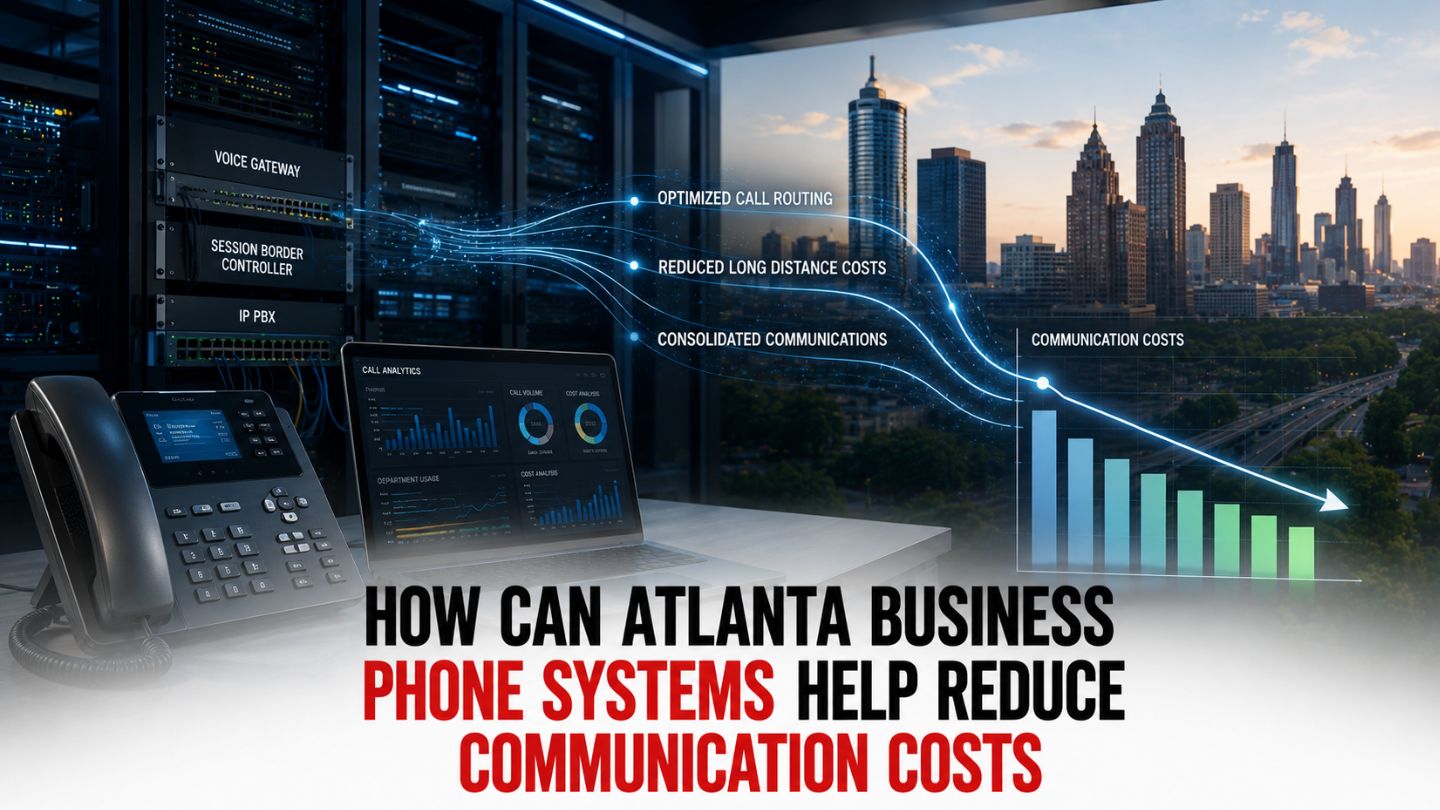
Atlanta businesses spend thousands every month on communication expenses that could be cut in half or more. If you’ve been wondering how Atlanta business phone systems can help reduce communication costs, the answer comes down to replacing outdated infrastructure with modern VoIP solutions that deliver more features for significantly less money. From eliminating copper line fees to consolidating multiple vendors into a single platform, the right phone system turns communication from a budget drain into a strategic advantage.
This blog breaks down exactly where the savings come from, how to avoid common pitfalls, and what kind of ROI Metro Atlanta companies are seeing after making the switch.
Key Takeaways
- VoIP phone systems can reduce communication costs by 40–60% compared to traditional landline systems, with some Atlanta businesses cutting monthly bills in half.
- Unified communications eliminate the need for multiple service providers and contracts by combining voice, video conferencing, chat, and fax into one solution.
- Remote work capabilities reduce office overhead and increase productivity. Cloud-based VoIP systems support remote and hybrid work by allowing mobile use of office phones.
- Integrated analytics help identify cost-saving opportunities in call patterns and usage, preventing over-provisioning.
- Scalable systems prevent waste. Businesses can achieve scalability in communication systems by only paying for active users.
Direct Cost Savings with Modern Atlanta Phone Systems

The most immediate impact of switching to a modern business phone system comes from eliminating the recurring expenses baked into traditional phone systems. Copper line maintenance, analog line rentals, PRI trunk fees, and per-minute long-distance charges all disappear when voice traffic moves to Internet Protocol instead.
Modern business phone systems can significantly reduce communication expenses, and signs your business needs a VoIP phone system often become evident when communication costs continue to rise. VoIP systems reduce communication costs by eliminating traditional landlines and their associated infrastructure fees entirely. Where a traditional PBX setup in Fulton County averages roughly $443 per year per employee, comparable VoIP services bring that figure down to approximately $165 per year, a reduction of more than 60%.
VoIP phone systems lower long-distance calling expenses significantly. For Atlanta companies with clients or offices in other states or countries, international calls that once drove bills into the hundreds per month are now included or heavily discounted. Advanced platforms combine voice, video conferencing, chat, and fax into one solution, eliminating the need to pay separate vendors for each service.
One Atlanta law firm cut its communication costs by approximately 50% after switching to a VoIP-based system, while simultaneously gaining better mobility and call recording capabilities. A Gwinnett County small business with 20 users recovered its one-time installation cost within two months through phone bill reductions alone.
Comment/Note: The Atlanta law firm and Gwinnett County business examples are compelling, but they read like real case studies without names, sources, or context. If these are internal client examples, keep them but consider adding “for example” and avoiding overly precise claims. If they are not documented, replace them with a safer Atlanta-focused scenario. Suggested rewrite: For example, a Metro Atlanta professional services firm with high call volume could cut monthly communication costs substantially by replacing legacy lines with a VoIP-based system while also gaining mobility, call recording, and easier call routing. A 20-user business in Gwinnett County could also see faster payback when reduced line charges, lower long-distance costs, and fewer maintenance visits are combined into one monthly platform cost.
Eliminating Hardware and Maintenance Expenses
Traditional phone systems require significant upfront capital investment-PBX hardware, desk phones, wiring, and installation can cost $500 to $2,000 per user, with hardware refresh cycles every five to seven years. Cloud-based VoIP eliminates expensive on-premise hardware and shifts those costs to a predictable monthly subscription, a key advantage highlighted in the complete guide to cloud phone systems.
VoIP eliminates expensive hardware maintenance costs for businesses. There are no vendor service contracts for aging PBX equipment, no emergency repair calls, and no technician visits to add a new phone line. Cloud-based VoIP systems provide predictable monthly costs for businesses, making budgeting straightforward and eliminating surprise expenses.
Software updates happen automatically through the provider, which means you’re always running the latest version without paying for upgrades. When your business phone system lives in the cloud, the provider handles server maintenance, security patches, and feature rollouts-costs that would otherwise land squarely on your IT budget.
Popular business phone systems automate workflows, reducing administrative costs further. Features like auto attendants, voicemail to email, and intelligent call routing that once required expensive add-on modules now come standard, included in your per-user monthly fee.
Operational Efficiency That Reduces Hidden Communication Expenses

Beyond the line items on your phone bill, traditional phone lines create hidden costs that most Atlanta businesses don’t track. Managing multiple vendors for voice, video, messaging, and conferencing wastes staff time and complicates billing. Unified communications platforms consolidate everything into a single interface-one vendor, one bill, one set of communication tools.
VoIP integrates with CRM systems for personalized customer interactions. When an inbound call arrives, your team sees the caller’s history, recent orders, and open tickets without toggling between applications.
Mobile integration is another area where hidden savings add up quickly. VoIP systems support mobile access for remote communication, and businesses following a step-by-step guide to setting up a cloud-based business phone system can more effectively enable staff to answer calls from their mobile devices using their business number instead of personal cell phones. Mobile apps enable staff to answer calls from anywhere, which means businesses can reduce or eliminate cellular reimbursement programs. Your business stays connected whether your team is in the office, at home, or traveling, without paying for separate mobile plans.
VoIP systems reduce missed calls by up to 30%. Consider what missed calls actually cost: lost sales opportunities, frustrated customers who call competitors, and staff time spent returning voicemails. Intelligent call routing connects customers to the right department quickly, while call queues with wait time messages reduce hang-ups by nearly half. These aren’t just convenience features-they’re revenue protection.
VoIP enables call routing to improve customer response times, which directly supports how Atlanta business phone systems improve customer experience and retain clients who might otherwise leave due to poor communication.
Common Cost Reduction Mistakes Atlanta Businesses Make
- Choosing the cheapest VoIP provider without evaluating reliability. The lowest monthly rate means nothing if call quality is poor or the system drops calls during peak hours. Atlanta small businesses especially need reliable service backed by proper support, not a bare-bones provider with no local presence.
- Under-investing in network infrastructure. VoIP systems require adequate internet bandwidth for optimal performance. Without a strong internet connection, sufficient QoS configuration, and potentially a secondary internet feed, call quality suffers. Some businesses need router or switch upgrades before VoIP deployment; skipping this step creates frustration and hidden costs from dropped calls and poor audio.
- Not training staff on new system features. A cloud-based phone system loaded with advanced features is only as valuable as your team’s ability to use it. If employees don’t know how to use call recording, CRM integration, or mobile apps, you’re paying for capabilities that sit unused. Proper onboarding is essential.
- Attempting DIY implementation without professional support. Number porting, E911 configuration, network readiness assessments, and security setup require expertise. Cutting corners here leads to compliance issues, security vulnerabilities, and a system that doesn’t perform as expected, costing more in the long run than hiring professionals from the start.
Long-term Financial Benefits and ROI
The financial case for modern business phone systems strengthens over time. VoIP systems can scale easily as businesses grow-adding users, opening new locations, or supporting remote teams requires no physical infrastructure changes. You simply add seats through software. Businesses can achieve scalability in communication systems by only paying for active users, which means you never pay for capacity you don’t need.
This eliminates the traditional PBX problem of buying trunk capacity or hardware ports in blocks that exceed actual usage. When your business grows, your phone system grows with it at a linear, predictable cost, which is why many organizations review their phone systems as teams expand. When it contracts, you scale down just as easily. For mid-sized businesses and medium-sized businesses experiencing seasonal fluctuations, this flexibility translates directly to cost savings.
Integrated analytics and call data provide another long-term advantage. Modern VoIP platforms include dashboards showing call volume, peak usage times, underutilized lines, and agent performance metrics. These insights help you make informed decisions about staffing, feature subscriptions, and vendor negotiations-optimizing communication spend continuously rather than just once at implementation.
VoIP enhances call management with features like call routing and recording, which support superior customer service. Improved customer communication and a positive customer experience reduce churn, which is itself a cost reduction, as acquiring a new customer costs far more than retaining an existing one.
Many Atlanta companies achieve positive ROI within two to three months of switching, with industry-wide data showing payback periods of three to six months being typical. Over 82% of companies report measurable savings within the first year of cloud telephony adoption, with the biggest gains coming from combined cost reduction and productivity improvements within the first 90 days.
Cloud-based VoIP systems support remote and hybrid work by allowing mobile use of office phones-an increasingly important capability as Metro Atlanta businesses adopt flexible work arrangements. VoIP allows mobile access for remote communication, which reduces the need for dedicated office space and desk phones for every employee.
Strengthening Communication While Reducing Costs
Modern business phone solutions do more than facilitate calls—they help organizations improve efficiency, support collaboration, and control operating expenses. By leveraging advanced communication features, scalable technology, and integrated systems, businesses can streamline workflows, reduce unnecessary costs, and create a better experience for both employees and customers.
As a trusted provider of Atlanta business phone systems, IntegriCom helps businesses implement cost-effective communication strategies backed by expert support and proven technology solutions. Supporting organizations with business phone systems in Alpharetta, Gainesville, and Buford, along with data backup and recovery and managed IT services, our team delivers technology solutions designed to improve reliability and performance. Contact us today to discover how we can help optimize communications while supporting your long-term business goals.
Frequently Asked Questions
How much can Atlanta businesses typically save by switching to VoIP?
VoIP reduces communication costs for businesses significantly. Atlanta businesses commonly see 40–60% reductions in monthly phone expenses after switching from traditional landline systems. In dollar terms, per-employee costs often drop from approximately $443 per year with traditional PBX to around $165 per year with VoIP solutions. Monthly per-user costs for VoIP vary based on features, but most Metro Atlanta deployments fall in the $20–$35 per user range.
What are the hidden costs I should watch for when choosing a phone system provider?
Watch for number porting fees, E911 regulatory charges, premium feature add-ons not included in base pricing, and network upgrade costs. Some VoIP providers charge separately for call recording, CRM integration, or advanced call routing that competitors include standard. Also factor in staff training time and potential internet bandwidth upgrades-VoIP systems require adequate internet bandwidth for optimal performance.
How quickly will I see ROI after implementing a new business phone system?
Most Atlanta small businesses and mid-sized businesses recover installation costs within two to three months through immediate savings on phone bills and ongoing maintenance costs. Industry-wide, ROI is typically achieved within three to six months. Over 82% of companies report measurable savings within the first year, with the largest gains appearing in the first 90 days from combined cost reduction and productivity improvements.
Do I need to upgrade my internet service to support cost-effective VoIP?
VoIP requires roughly 100 kbps per concurrent call with low latency and minimal jitter. Most modern business internet connections can support this comfortably, but older buildings, overloaded networks, or locations with limited upload speed may need upgrades. A qualified provider should conduct an internet readiness assessment before installation. You may also need QoS configuration on your router and, for businesses that cannot afford phone downtime, a secondary internet connection for redundancy. These investments help protect call quality and ensure your business stays connected.
What communication costs can I eliminate entirely with a modern phone system?
VoIP systems eliminate several line items completely: analog line rentals, PRI trunk fees, long-distance per-minute charges, hardware maintenance contracts, and separate conferencing service subscriptions. You can also eliminate or significantly reduce cellular reimbursement costs since mobile apps let staff use their business number on mobile devices.