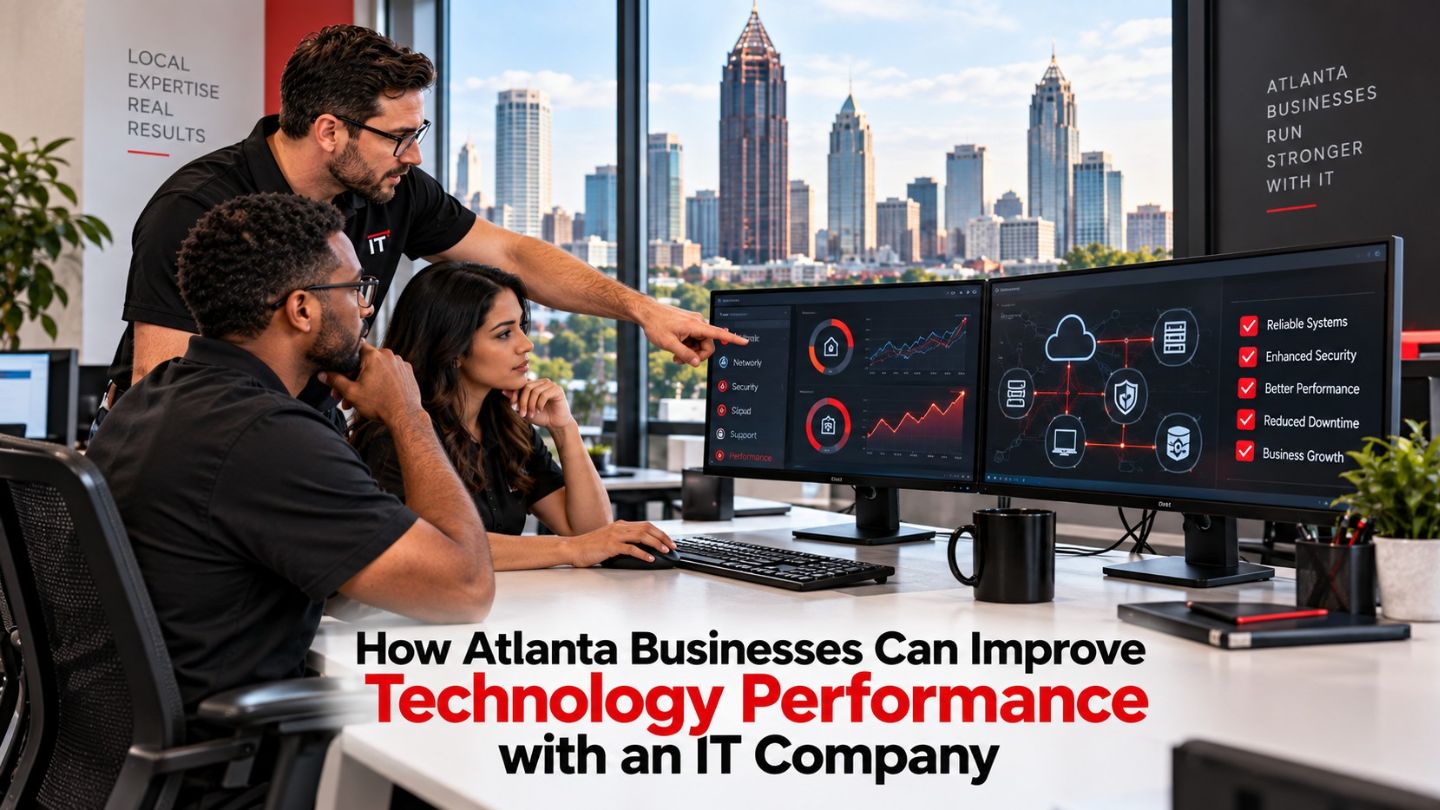
Atlanta businesses depend on reliable, fast technology to serve clients, meet compliance requirements, and keep employees productive. But slow networks, aging hardware, and reactive IT support create friction that compounds over time. Understanding how Atlanta businesses can improve technology performance with an IT company starts with identifying the root causes of poor performance and then applying targeted fixes through infrastructure optimization, proactive monitoring, cloud migration, and strategic planning.
This article breaks down the specific performance challenges companies in Atlanta face, what happens when internal teams reach capacity, the core services an IT provider delivers to resolve bottlenecks, and how strategic technology planning supports long-term growth.
Key Takeaways
- IT companies provide proactive monitoring and maintenance that catches performance issues before users experience downtime.
- Professional IT services optimize infrastructure (servers, networks, storage) for faster speeds and better reliability.
- Managed IT providers implement security measures like multi-factor authentication and endpoint protection without degrading system performance.
- Strategic technology planning through virtual CIO services ensures scalable performance aligned with business goals.
- Regular performance assessments identify bottlenecks before they disrupt operations or create compliance risk.
Common Technology Performance Challenges for Atlanta Businesses
Metro Atlanta’s growing business community includes organizations in healthcare, finance, legal services, real estate, and other data-intensive industries. As these companies add employees, locations, applications, and compliance obligations, they often need to improve the performance of existing systems without replacing their entire technology environment at once.
Three performance problems recur across organizations of all sizes.
- Slow networks can result from aging switches or routers, poorly configured wireless access points, interference, coverage gaps, or outdated and damaged cabling. Properly installed Cat 5e can support Gigabit Ethernet, but older Cat 5 runs, poor terminations, and equipment limitations can restrict throughput. Latency may also rise during peak usage or when remote employees access centralized applications and file servers.
- Outdated hardware creates compounding slowdowns. Servers and workstations running past their expected lifespan, with mechanical hard drives, insufficient RAM, and missing security patches, waste employee time. Outdated devices can waste time and reduce productivity across every department.
- System downtime caused by power disruptions, server crashes, or software failures costs more than repair time. For healthcare organizations subject to HIPAA and financial firms operating under PCI DSS or SOX-related controls, outages can threaten service availability, business continuity, and compliance obligations if safeguards and recovery procedures are inadequate. Severe storms and resulting power outages across Metro Atlanta make backup power, tested recovery plans, and redundant connectivity important parts of local risk planning.
These problems reduce operational efficiency, degrade customer service, inflate IT costs, and expose businesses to cyber threats.
When Internal IT Resources Hit Performance Limits
Internal teams often spend their days responding to urgent tickets rather than planning improvements. When the help desk queue grows faster than staff can work through it, and when the same issues recur week after week, the team has shifted into permanent reactive mode.
Signs that internal IT resources have reached capacity:
- Tickets pile up with no resolution timeline
- Staff lack specialized skills in cloud architecture, cybersecurity, or compliance
- No performance baselines or SLA dashboards exist
- Hardware replacements happen only after failure, not before
- Technical debt accumulates as legacy systems stay in place because nobody has time to migrate them
The difference between reactive fixes and proactive performance management is concrete. Reactive support replaces a failed hard drive after it disrupts operations. Proactive IT management monitors drive-health metrics, flags degradation trends, verifies that backups are usable, and schedules replacement before the device fails. Proactive IT support reduces technology-related downtime and keeps employees focused on core business functions.
Core Ways IT Companies Boost Technology Performance

An IT company approaches performance improvement through three connected layers: infrastructure optimization, continuous monitoring, and bottleneck elimination.
Infrastructure optimization begins with an audit. A technology company examines servers, storage, network cabling, wireless coverage, switches, and routers. Recommendations flow from findings: replacing mechanical drives with SSDs, upgrading network switches, reconfiguring wireless access points for coverage gaps, virtualizing workloads to consolidate underused hardware, or adding redundancy (backup power, failover connections) to reduce single points of failure.
Bottleneck elimination requires diagnostic tools, not guesswork. Application performance monitoring, network tracing, and resource profiling identify where latency, congestion, or software inefficiencies actually reside. A misconfigured firewall, an overloaded database server, or a poorly balanced load across application servers each require different interventions. Companies can improve productivity by addressing recurring friction points rather than applying generic fixes.
Proactive System Monitoring and Maintenance
Continuous monitoring is the operational core of managed IT services. This model combines ongoing monitoring and maintenance rather than relying solely on reactive support, so it helps clarify what managed IT services are and what they typically include. Remote monitoring and management tools detect and resolve network latency issues, track CPU and memory utilization, measure disk I/O, and alert engineers when thresholds are crossed.
Automated maintenance runs alongside monitoring. A risk-based patch-management process prioritizes actively exploited and high-severity vulnerabilities, tests updates when appropriate, and deploys them on a schedule that balances security with operational stability. Planned maintenance windows keep operating systems, firmware, and applications current while limiting disruption during business hours. Automated backups support business continuity, while documented recovery procedures and regular restore tests confirm that systems and data can be recovered when needed.
This support model replaces the break-fix cycle with a process of continuous improvement: monitor, detect, resolve, optimize, repeat.
Specific Performance Improvements Atlanta Businesses Experience
When Atlanta businesses partner with an IT provider, three categories of improvement show up consistently.
- Faster network speeds and better application response times: Infrastructure upgrades, whether replacing aging switches, optimizing LAN/WAN configurations, or migrating workloads to properly sized cloud instances, reduce the lag employees experience when accessing core applications. Remote workers connecting to centralized resources see fewer disconnections and faster file transfers. Productivity improves with better systems and workflows because employees spend less time waiting and restarting.
- Improved system reliability: Continuous monitoring can identify hardware degradation, resource exhaustion, and configuration drift before they cause outages. Documented and tested disaster recovery plans help restore critical services within defined recovery-time and recovery-point objectives, reducing the duration and impact of an incident.
- Security that does not slow operations: A strong cybersecurity plan includes multi-factor authentication standards, endpoint detection and response agents, intrusion detection systems, and email filtering. Properly architected, these controls add minimal latency. Multi-layered security frameworks balance protection with performance by selecting lightweight agents, offloading inspection to dedicated appliances, and tuning rulesets to avoid false positives that interrupt workflows.
Cybersecurity should be a top priority for Atlanta businesses. Verizon’s 2025 Data Breach Investigations Report found that third parties were involved in 30% of the breaches analyzed, up from 15% in the prior report. That finding reinforces the need for vendor-risk management, access-control reviews, and regular reviews of user and third-party permissions that reduce exposure without creating unnecessary friction for employees.
Cloud Migration for Enhanced Performance
Cloud services allow businesses to scale resources up or down based on actual demand rather than purchasing hardware for peak capacity that sits idle most of the year. Transitioning legacy systems to cloud environments improves operational flexibility, and cloud environments can be optimized for performance through instance rightsizing, load balancing, storage tiering, and auto-scaling.
Cloud migration can improve resilience when workloads are deliberately designed across availability zones or regions and paired with tested backup and failover procedures. Because redundancy is not automatic for every cloud service, an IT provider should select and configure the appropriate architecture for each workload. For growing businesses in the Atlanta area, a well-designed cloud environment can add capacity without requiring a major hardware purchase every time demand increases.
Local IT consultants assist organizations in cloud migration and optimization, handling the technical complexity of moving workloads while maintaining compliance requirements during the transition. Compliance includes secure data storage and access controls, which must remain intact throughout any migration process.
Strategic Technology Planning for Long-Term Performance

Performance optimization without a plan produces short-term fixes that degrade over time. Strategic planning ties technology investments to business objectives. A well-developed roadmap helps businesses prioritize those investments, and understanding why businesses choose an IT company for long-term technology planning provides useful context when evaluating this approach.
A virtual CIO can create a multi-year technology roadmap that outlines infrastructure refresh cycles, cloud adoption phases, cybersecurity milestones, and application modernization projects. Because compensation for a full-time CIO in Atlanta can reach well into six figures and varies by company size and role scope, many small and mid-sized businesses use virtual CIO services to obtain executive-level guidance without adding a full-time position. This approach helps align technology priorities and spending with business growth.
Capacity planning analyzes usage trends across CPU, storage, and network to project when current resources will reach limits. This prevents both over-provisioning (wasted spending) and under-provisioning (bottlenecks during peak periods). Creating a prioritized technology roadmap can guide IT investments over time and support long-term business objectives such as revenue growth.
Vendor management can reduce costs and improve technology procurement by consolidating service agreements, negotiating better terms, and ensuring that the tools and platforms a business uses are still the right fit as requirements evolve.
Performance Metrics and Continuous Improvement
IT companies track specific indicators to measure whether improvements hold. Key performance indicators include system uptime percentage, mean time to repair, mean time between failures, network latency, application response times, and resource utilization rates.
Risk assessments help identify gaps in technology, processes, and controls before they create audit findings or operational exposure. The appropriate review schedule depends on the organization’s risk profile, regulatory requirements, and the pace of change in its systems and vendors. Compliance goals, control ownership, and remediation deadlines should be documented and reviewed regularly rather than addressed only when an auditor or regulator asks.
Regular reviews, whether quarterly or monthly, compare current metrics against baselines and SLA targets. When a metric trends in the wrong direction, the IT provider investigates the root cause and applies corrective action before users notice degradation. Data analytics from monitoring tools feed into decision-making, helping the leadership team make informed decisions about where to invest next.
Why Choose IntegriCom for Technology Performance Improvement
IntegriCom works with Atlanta businesses across industries where performance failures carry operational and regulatory consequences: healthcare practices, law firms, professional services firms, and financial organizations. The company focuses on delivering managed IT solutions that combine daily infrastructure management with strategic guidance from virtual CIO consulting services.
IntegriCom’s approach covers the full scope of performance improvement. Network services for servers and workstations address hardware and connectivity. Proactive monitoring identifies problems before they cause downtime. Outsourced help desk support maximizes employee productivity by giving employees fast access to technical assistance. Automating repetitive tasks through automation tools enhances operational efficiency across the organization.
For healthcare organizations, IntegriCom supports HIPAA-aligned safeguards while optimizing system performance. For law firms handling sensitive data, IntegriCom implements security controls designed to strengthen cybersecurity without unnecessarily slowing case management systems. Across industries, proactive IT management helps reduce technology-related downtime and improve operational resilience.
Outsourcing daily IT tasks allows internal staff to focus on core business functions. For organizations weighing this approach, understanding why companies outsource IT services can help clarify the potential operational benefits of working with an external IT provider. Rather than pulling an in-house generalist away from strategic projects to troubleshoot a printer, businesses get dedicated support from engineers who handle infrastructure management full-time.
Real Performance Improvements Atlanta Businesses Achieve
Growing companies that partner with an IT provider see measurable changes in how technology supports daily operations.
Employees report faster system response times after infrastructure upgrades and cloud optimization. Collaboration tools like Microsoft Teams and SharePoint perform better on properly configured networks with adequate bandwidth. Employee engagement improves when technology stops being a source of frustration and becomes a tool that works as expected.
IT-related support tickets decrease as proactive maintenance catches issues upstream. System reliability goes up. Unplanned downtime goes down. Businesses operating across multiple locations or supporting remote teams gain consistent performance regardless of where employees connect from.
For growing businesses planning expansion into new markets, scalable infrastructure means the technology supports future growth without requiring a complete rebuild. A multi-year technology roadmap supports long-term business growth by sequencing upgrades to match revenue milestones and headcount projections. Partnering with IT providers can optimize daily infrastructure oversight so the leadership team stays focused on business strategy rather than troubleshooting.
The benefits of managed IT services compound over time: each optimization cycle builds on the last, and performance baselines shift upward quarter over quarter.
Strengthening Your Business Through Smarter IT Solutions

Improving technology performance is essential for Atlanta businesses looking to increase efficiency, protect valuable data, and support long-term growth. Partnering with the right IT experts helps companies overcome technical challenges, enhance productivity, and build a reliable technology foundation that adapts to evolving business needs.
IntegriCom helps organizations improve technology performance through practical, security-focused guidance from an experienced Atlanta IT company. Our co-managed IT services, managed IT solutions for businesses, and cybersecurity consulting help strengthen daily operations, reduce technology risk, and support long-term growth. Contact us to schedule a technology performance assessment and identify the highest-priority improvements for your business.
Frequently Asked Questions
How quickly can an IT company improve our technology performance?
Initial improvements like patch deployment, network configuration changes, and monitoring setup often happen within the first few weeks. Larger projects such as cloud migration or hardware replacement follow a phased timeline based on the complexity of your environment. Continuous monitoring begins identifying and resolving issues from day one.
What performance improvements should we expect when working with an IT company?
Expect faster application response times, fewer unplanned outages, reduced support ticket volume, and better network speeds. Proactive IT management reduces technology-related downtime by catching problems before they affect operations. Over time, strategic planning and infrastructure refreshes continue to raise performance baselines.
How do IT companies measure and track technology performance improvements?
IT providers track metrics including system uptime, mean time to repair, network latency, application response times, and resource utilization. These indicators are reviewed against SLA targets during regular assessment meetings. Performance dashboards give your leadership team visibility into trends and improvement areas.
Will improving technology performance require replacing all our current systems?
No. An IT company audits your existing infrastructure and recommends targeted upgrades where they will have the greatest impact. Some systems run well and need only monitoring and maintenance. Others need replacement or migration to cloud services. A prioritized roadmap spreads investments across a timeline that fits your budget.
How do Atlanta businesses see ROI from technology performance improvements?
ROI comes through reduced downtime, fewer emergency repair costs, improved employee productivity, and lower compliance risk. Outsourcing daily IT tasks allows internal staff to focus on core business functions that generate revenue. Proactive maintenance also extends the usable life of existing hardware, deferring capital expenditures.
What makes technology performance optimization different from regular IT support?
Regular IT support responds to problems after they occur. Performance optimization is an ongoing process: monitoring system health, analyzing usage patterns, planning capacity, tuning configurations, and aligning technology investments with business objectives. The goal is continuous improvement, not incident response.