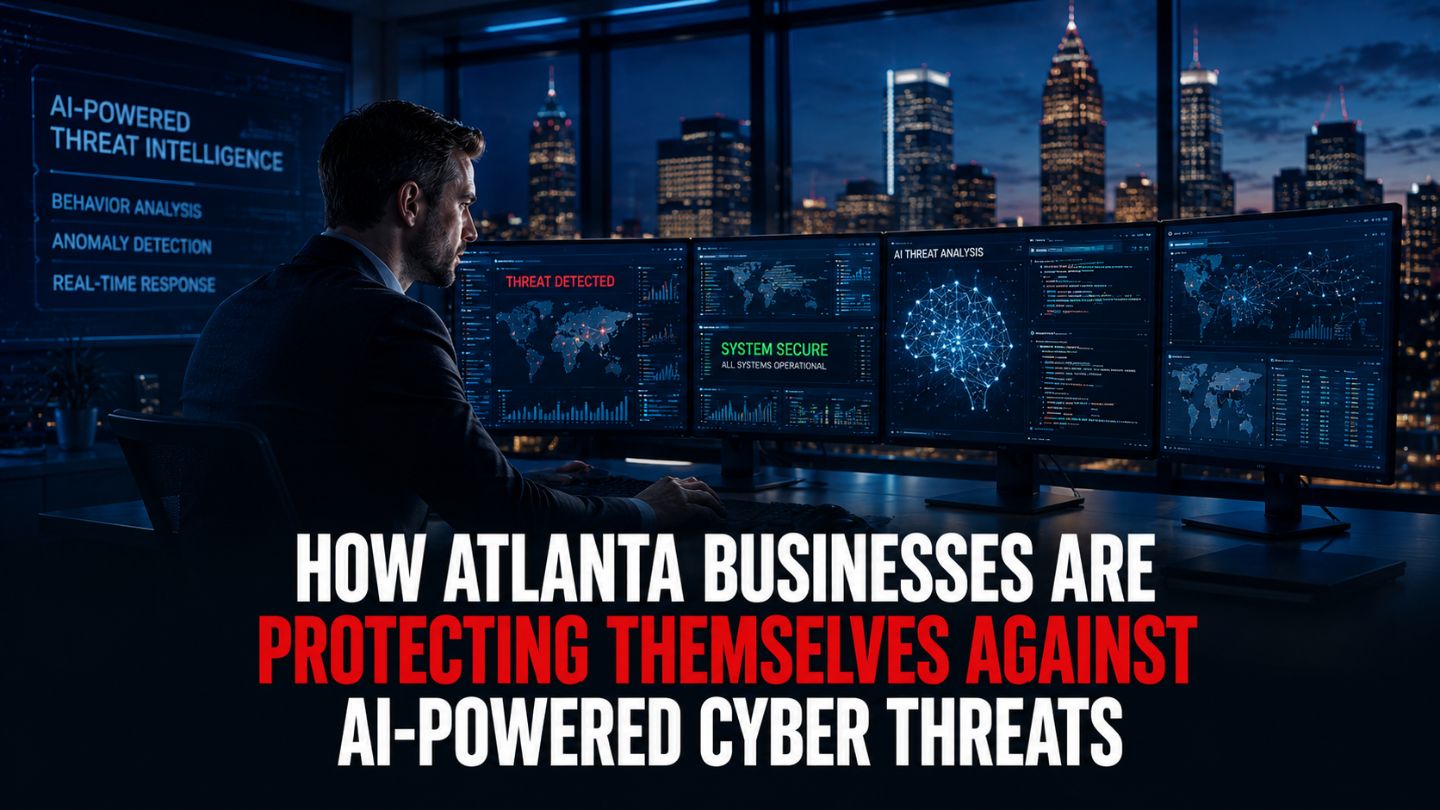
Atlanta businesses are facing a new generation of cyber threats powered by artificial intelligence — and they are responding with smarter defenses, stronger policies, and deeper partnerships with managed security service providers. AI-powered cyber threats such as deepfake fraud, adaptive malware, and hyper-personalized phishing emails are making attacks faster, more convincing, and harder to detect. Here’s how companies across Metro Atlanta are protecting sensitive data, strengthening defenses, and staying ahead of evolving threats.
Key Takeaways
- Atlanta businesses are investing in AI-powered defense tools, including behavioral analytics, EDR, and machine learning-based email filtering, to combat AI threats head-on.
- Multi-layered security approaches combining technical controls, employee training, and governance policies are becoming standard across Metro Atlanta organizations.
- Employee training programs are being enhanced to help staff recognize AI-generated phishing emails, deepfakes, and voice cloning attacks.
- Incident response plans are being updated to specifically address AI-specific scenarios like deepfake impersonation and AI-powered ransomware.
- Collaboration with managed IT providers is increasing as SMBs seek expert guidance to maintain compliance and close security gaps without building costly in-house teams.
Industries Most at Risk in Metro Atlanta
Atlanta’s most regulated and data-rich industries face the greatest exposure to AI-powered cyberattacks.
- Healthcare: Hospitals, medical practices, and dental offices across Atlanta are heavily targeted by AI-powered ransomware and credential-stealing phishing campaigns. Security breaches in healthcare trigger massive HIPAA fines, operational shutdowns, and reputational damage. AI-driven attacks exploit vulnerabilities in EHR systems and patient portals.
- Financial services: Banks, credit unions, and insurance firms face AI-driven social engineering, including deepfake CEO fraud where voice or video impersonation is used to authorize wire transfers. Business email compromise (BEC) scams powered by AI are increasingly difficult to detect.
- Manufacturing and utilities: Companies in these sectors often operate OT networks and edge devices that expand the attack surface. Adaptive malware targeting industrial control systems is a growing concern, particularly as remote access and private 5G networks become more common.
- Legal firms: Law practices hold enormous volumes of sensitive data, client PII, proprietary business information, and litigation strategies. They’re experiencing AI-generated phishing campaigns tailored specifically to exploit the trust-based nature of attorney-client relationships. Managed IT services for law firms have become a critical line of defense, reinforcing what businesses should expect from professional cybersecurity services when protecting sensitive client data.
Defense Strategies Atlanta Companies Are Implementing
Businesses across Metro Atlanta are adopting multi-layered defense strategies against AI cyber threats, combining technical infrastructure, policy changes, and human awareness into a cohesive security strategy that aligns with the ultimate cybersecurity checklist for protecting your business in Atlanta.
Multi-factor authentication significantly reduces unauthorized access risks, and adoption rates among Atlanta businesses have climbed steadily. MFA requires users to verify their identity through multiple methods, and using MFA can block attackers even if passwords are compromised. MFA solutions are increasingly affordable for businesses of all sizes. One important caveat: businesses should avoid SMS-based MFA, as it can be intercepted by attackers. App-based or hardware token solutions are strongly preferred.
Advanced email security solutions are being deployed throughout the region. Machine learning tools establish behavioral baselines to flag anomalous network activity, and AI-driven tools detect anomalies and threats in real-time. These ML-enhanced filters analyze not just signatures but language style, domain anomalies, and internal-versus-external signals, critical when AI-generated phishing emails can perfectly mimic the writing patterns of known contacts.
Dynamic Zero-Trust architectures enforce continuous verification for all interactions. Currently, 41% of organizations have implemented Zero Trust strategies, and that number is growing fast in Atlanta’s business community. Zero-trust architecture segments networks granularly, enforces least-privilege access, and eliminates the assumption that anyone inside the perimeter can be trusted. This approach is particularly valuable for healthcare and financial services clients managing sensitive data across cloud services and on-premise systems.
Ongoing workforce training helps recognize advanced AI-enabled social engineering threats. Proactive employee education helps staff identify sophisticated social engineering attempts, and simulated phishing campaigns improve employee recognition skills. Human error is the primary entry point for cyber attacks, and training programs should address AI-generated phishing attempts specifically, including deepfakes and voice cloning scenarios. Regular training helps employees report suspicious messages effectively and reduces human error across the organization.
Common Mistakes Atlanta Businesses Should Avoid

- Relying solely on traditional antivirus software against AI-powered malware. AI-powered malware can adapt to evade detection by traditional software, rendering signature-based antivirus software largely ineffective on its own. Businesses need EDR and behavioral analytics layered on top of legacy tools.
- Underestimating the sophistication of AI-generated phishing emails. These aren’t the poorly written scam emails of years past. AI produces grammatically perfect, contextually aware messages that exploit specific business relationships and workflows.
- Failing to update incident response plans for AI-specific scenarios is one of the hidden risks of neglecting professional cybersecurity for businesses in Atlanta. A plan that doesn’t account for deepfake impersonation or AI-powered data exfiltration leaves dangerous security gaps.
- Not training employees to verify suspicious requests through alternate channels. Establishing communication channels is critical during a cyber incident. Employees should always verify unusual financial requests or sensitive data transfers through a separate, pre-established communication method.
AI-Powered Security Solutions Being Adopted
Atlanta organizations are fighting AI with AI. Companies adopt automated defense mechanisms to counter AI-driven cyber threats across multiple fronts.
Behavioral analytics platforms are monitoring for unusual patterns in user activity, helping organizations move beyond common cybersecurity myths that Atlanta business owners need to know when evaluating modern security tools. AI systems create a baseline of normal behavior to detect deviations-whether that’s an employee logging in from an unusual location, accessing files they’ve never touched, or exhibiting network traffic patterns that suggest lateral movement. Behavioral biometrics help monitor user interaction patterns against deepfake attempts, adding another layer of verification.
AI-enhanced endpoint detection and response (EDR) tools have largely replaced basic antivirus as the standard for endpoint protection. Organizations use AI-based platforms for endpoint protection that can identify and isolate affected systems before threats spread across the network. These tools provide continuous monitoring and rapid response capabilities that minimize downtime and preserve business continuity.
Machine learning-based email filtering systems go far beyond spam detection. They analyze writing patterns, sender behavior, embedded link characteristics, and contextual signals to flag potential threats-even when those phishing emails are generated by sophisticated AI models.
Automated threat intelligence platforms provide real-time updates on emerging threats. Advanced threat intelligence sharing enhances collective defense against AI threats, allowing businesses to benefit from data gathered across thousands of endpoints and organizations. These platforms help companies stay protected against the latest attack vectors without requiring constant manual oversight.
AI-powered network monitoring solutions detect lateral movement, data exfiltration attempts, and anomalous network traffic in real time. Companies use red teaming to simulate AI-driven attacks and identify vulnerabilities before cyber criminals can exploit them, an increasingly popular approach through penetration testing exercises.
Regular software updates reduce vulnerabilities exploited by AI-driven malware, and keeping systems up to date remains one of the most effective yet often overlooked components of a defense-in-depth strategy.
Building AI-Specific Incident Response Plans
An incident response plan outlines procedures for cyber incidents, but traditional plans weren’t designed for the speed and sophistication of AI-powered attacks. Atlanta businesses are rewriting their playbooks.
Deepfake response procedures are being added to address scenarios where voice or video impersonation is used to authorize financial transactions, access sensitive data, or manipulate employees. These protocols include mandatory secondary verification steps and pre-established code words for high-risk communications.
Communication protocols are being defined for situations when AI compromises primary systems. Establishing communication channels is critical during a cyber incident, especially when email or messaging platforms themselves may be compromised. Businesses are setting up out-of-band communication methods-separate phone lines, encrypted apps, physical rally points-to coordinate their response.
Forensic preservation techniques are evolving to handle AI-generated attack evidence. Teams must preserve evidence of deepfake audio, AI-generated emails, and manipulated digital artifacts in ways that maintain chain-of-custody for potential legal proceedings. Incident response plans should include roles and responsibilities for team members, with specific assignments for forensic collection and analysis.
Recovery strategies specific to AI-powered ransomware and data breaches should focus on rapid response, isolation of affected systems, and verified backup restoration. This is where managed security services and cyber insurance how they work together becomes an important part of a comprehensive risk management strategy: managed security services help reduce the likelihood and impact of an incident, while cyber insurance can help address certain financial consequences after an event. The emphasis should be on minimizing downtime, because even short outages can disrupt operations, revenue, and customer trust.
Tabletop exercises simulating AI attack scenarios are becoming a quarterly practice for forward-thinking Atlanta businesses. Testing incident response plans through tabletop exercises is essential for identifying weaknesses before a real incident occurs. These exercises simulate deepfake CEO fraud attempts, AI-powered ransomware attacks, and coordinated AI phishing campaigns to ensure every team member understands their role. Employee training reduces human error in cyber attacks, and these realistic drills reinforce that training under pressure.
Read More: The Costs of Delaying Incident Response Planning
Staying Ahead of Evolving Cyber Risks
As AI-powered cyber threats become more sophisticated, businesses must take a proactive approach to security. Advanced threat detection, employee awareness training, continuous monitoring, and strong cybersecurity strategies help reduce risk and strengthen resilience. Investing in the right protection today can help organizations safeguard sensitive data, maintain compliance, and support long-term business success.
Read More: Cybersecurity vs Cyber Resilience: What’s the Difference?
As a trusted provider of cybersecurity services in Atlanta, IntegriCom helps businesses strengthen their defenses against emerging threats with proactive support and strategic guidance. Supporting organizations with business phone systems, cybersecurity consulting, managed IT services, and cloud services, our team delivers integrated technology solutions designed to improve security and operational efficiency. Contact us today to learn how we can help protect your organization in an increasingly complex digital landscape.
Frequently Asked Questions
What AI-powered threats are most common in Atlanta?
Key AI-powered cyber risks for Atlanta-area businesses include deepfake CEO fraud, adaptive malware that changes behavior to evade detection, and AI-generated phishing campaigns that produce highly convincing emails at scale. These threats are especially concerning for healthcare, finance, legal, and professional services firms that handle sensitive client or patient data. AI tools can help attackers personalize messages quickly, mimic familiar communication styles, and target entire organizations faster than traditional phishing campaigns.
Can small Atlanta businesses afford enterprise-level AI security tools?
Yes. By partnering with managed security service providers, small businesses gain access to enterprise-grade tools, including AI-enhanced EDR, SIEM, managed detection and response, and virtual CISO services, without the expense of building an in-house security team. Managed IT solutions scale to fit business size and budget, making robust AI threat protection accessible to organizations of all sizes.
How often should Atlanta companies update their AI defense strategies?
Given the pace of evolving threats, Atlanta businesses should conduct formal quarterly reviews of their security strategy, with monthly monitoring adjustments as new potential threats emerge. Regular software updates reduce vulnerabilities exploited by AI-driven malware, and incident response plans should be revised whenever a significant new threat vector is identified or after any security incident.
What role do employees play in defending against AI attacks?
Employees are both the most vulnerable target and the strongest line of defense. Human error is the primary entry point for cyber attacks, but employee training reduces that risk significantly. Training programs should include simulated phishing campaigns, deepfake recognition exercises, and clear procedures for verifying suspicious requests through alternate channels. Regular training helps employees report suspicious messages effectively and stay vigilant against increasingly sophisticated social engineering.
Should Atlanta businesses build internal AI security teams or outsource?
For most Atlanta SMBs, outsourcing to a managed security service provider offers stronger, more consistent protection than trying to build a full internal security team from scratch. Building an internal program requires recruiting scarce cybersecurity talent, purchasing and maintaining enterprise-grade tools, and providing ongoing monitoring coverage, which can quickly become expensive for small and mid-sized organizations. Managed services provide continuous monitoring, expert incident response, compliance support, and access to modern AI-powered defense tools, making them a practical choice for businesses focused on closing technical resource gaps while maintaining strong cybersecurity efforts.