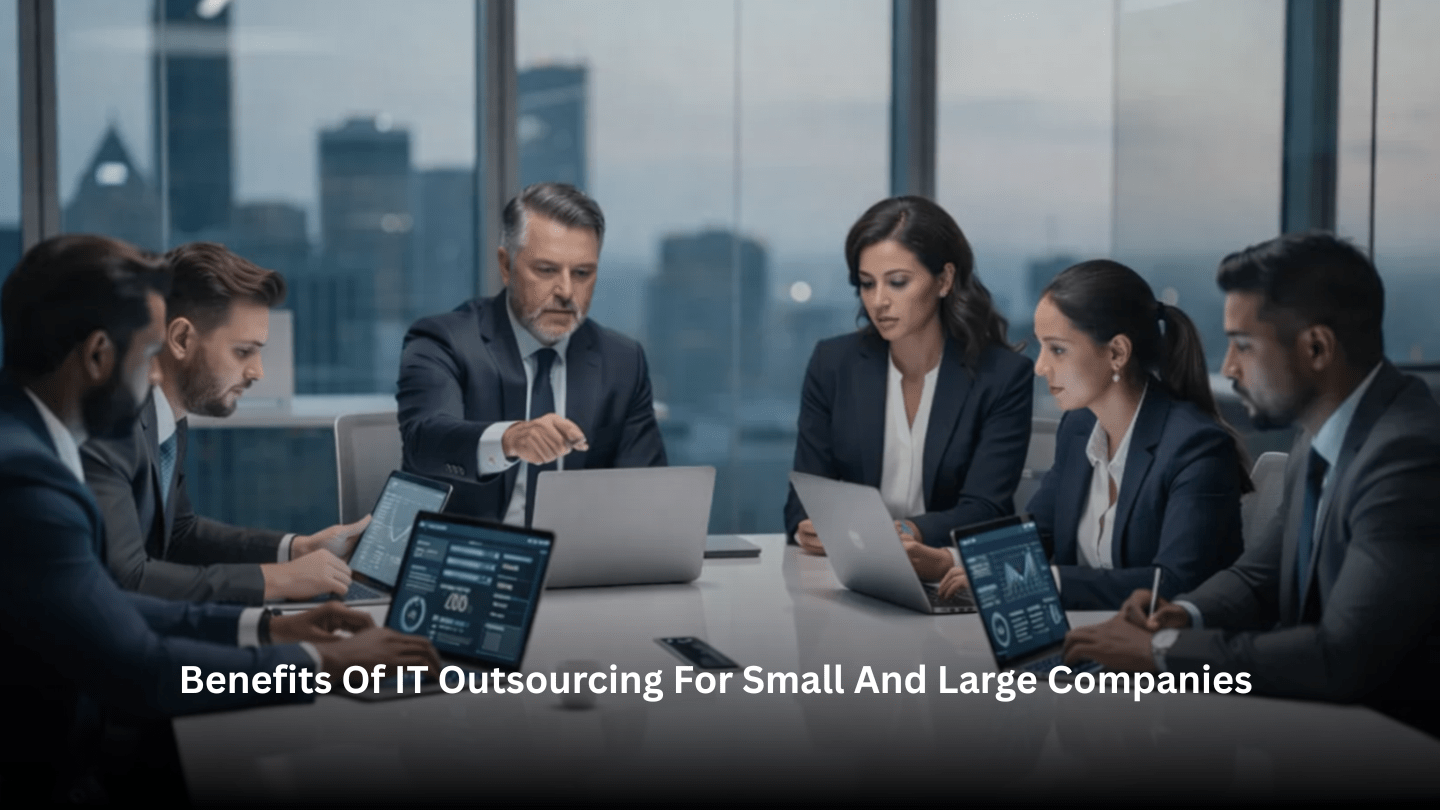
Technology demands continue to evolve rapidly, pushing businesses of all sizes to rethink how they manage IT operations. From rising cybersecurity threats to cloud adoption and remote workforce support, maintaining internal resources alone can strain budgets and limit growth. IT outsourcing has emerged as a strategic solution that balances cost control with access to specialized expertise. In this blog, we’ll examine the key benefits of IT outsourcing for both small and large companies, exploring how it improves efficiency, scalability, security, and long-term business performance.
Key Takeaways
- Around 70% of companies now use some form of IT outsourcing, making it a mainstream strategy for organizations of all sizes seeking cost control, enhanced security, and access to specialized skills.
- Small businesses gain fractional access to enterprise-grade tools and expertise without the overhead of full-time hires, while large enterprises use outsourcing to fill niche skill gaps and accelerate major initiatives.
- The core benefits span five themes: predictable costs, deep technical expertise, stronger security and compliance, on-demand scalability, and freedom to focus on core business functions.
Why IT Outsourcing Matters in 2026 for Small and Large Companies
Over the past five years, rapid changes in remote work, cybersecurity threats, and cloud adoption have transformed how businesses manage technology. Today, about 70% of companies outsource at least one IT function, primarily to reduce costs and improve efficiency. IT outsourcing can include helpdesk support, infrastructure management, cloud services, cybersecurity, and strategic consulting, often delivered through predictable monthly agreements.
Both small firms and large enterprises benefit, though their needs differ in scale and complexity. This article explores the key advantages of IT outsourcing, examines potential risks, and explains how to choose the right partner for your organization. Many leaders evaluating the reason why companies outsource IT services often discover that cost predictability, access to expertise, scalability, and stronger security consistently rank among the most compelling drivers.
Core Cost Benefits: Turning IT from a Cost Center into a Strategic Investment
Cost is still the number one reason companies outsource IT. But the real value goes beyond just spending less—it comes from making costs predictable and aligned with business outcomes rather than reactive emergencies.
According to industry research, roughly 59% of organizations report cost savings as the primary outcome of IT outsourcing. For many businesses, this translates to converting unpredictable capital expenditures—server purchases, licensing fees, emergency repairs—into stable monthly operating costs that CFOs can actually budget around.
Here’s how it works in practice. Outsourcing eliminates or reduces fixed costs like full-time salaries, benefits, training, and on-premises infrastructure. Instead, you shift to subscription or per-user models where you pay for what you use. This is particularly impactful for small businesses that can’t justify a full-time IT hire but still need professional support.
Access to Deep Expertise You Can’t Easily Hire
If you’ve tried to hire a senior cybersecurity analyst or cloud architect recently, you know the market is brutal. Salaries are high, candidates are scarce, and even if you land someone, they might leave for a better offer within a year.
Outsourcing partners bring teams of certified professionals—Microsoft 365, Azure, AWS, security certifications—that would be difficult or prohibitively expensive for most organizations to assemble in-house. You gain access to a bench of specialized skills without carrying the overhead of full-time experts in every domain.
For small businesses, this means fractional access to capabilities you’d never afford otherwise. Need someone who understands network management and can also handle compliance requirements for your industry? That’s probably two or three different skill sets. An outsourcing company staffs for exactly these combinations, spreading the cost across dozens of clients.
For large companies, outsourcing fills gaps in niche domains while internal teams focus on strategic planning and business-specific initiatives. Think 24/7 SOC monitoring, legacy system support, or large-scale migrations where internal resources are stretched thin. This approach lets your IT department concentrate on projects that move business forward rather than keeping infrastructure running.
Scalability and Flexibility for Changing Business Demands

Scalability, in plain language, means the ability to ramp IT capacity up or down when your business grows, opens new sites, or goes through seasonal peaks and slowdowns. It’s one of the biggest benefits of IT outsourcing for companies that don’t want to be locked into fixed infrastructure.
For small businesses, scalability might look like expanding from 10 to 50 users without redesigning your entire IT environment. Your outsourcing partner adds licenses, configures new devices, and extends your cloud-based solutions—all without you hiring additional staff or buying new servers. Organizations considering complex transitions often find that why cloud migration is smoother with outsourced IT services becomes evident during these growth phases, as experienced providers reduce disruption and accelerate deployment.
For larger companies, the scenarios are more complex but equally valuable. Consider an acquisition where you need to onboard 300 new employees across four locations in 60 days. An outsourcing provider can rapidly deploy standardized tools, extend network management to new sites, and maintain consistent security policies across the expanded footprint. Trying to do this with internal resources alone would strain even well-staffed IT departments.
Modern outsourcing models offer flexibility built into the pricing structure:
| Model | Description | Best For |
| Per-user pricing | Fixed monthly fee per employee | Predictable headcount growth |
| Tiered support packages | Bronze/Silver/Gold service levels | Matching support to the budget |
| Project-based engagements | One-time fee for specific initiatives | Migrations, upgrades, assessments |
| 24/7 coverage options | Around-the-clock monitoring and response | Critical systems, global operations |
Stronger Focus on Core Business and Strategic Initiatives
Let’s be honest: most business leaders are tired of their teams firefighting tech issues instead of working on sales, product development, or customer service. Every hour spent troubleshooting email problems or resetting passwords is an hour not spent on what actually generates revenue.
Offloading day-to-day tasks—password resets, patching, monitoring systems, user provisioning, backup checks—returns hours every week to internal staff and leadership. This isn’t just about convenience; it’s about operational efficiency and protecting your most valuable resource: time.
For small businesses, the impact is immediate. Owners and office managers stop acting as “accidental IT people” and can refocus on revenue-generating work and customer relationships. When something breaks, you call your support provider instead of spending your Saturday watching YouTube tutorials on server troubleshooting.
For large organizations, the benefit scales differently. Internal IT can shift from tactical support to strategic work like digital transformation, analytics, and process automation. When routine operations are handled externally, your IT department becomes a business enablement function rather than a cost center.
Security, Compliance, and Business Continuity Advantages
Cyber threats have escalated dramatically since 2020. Ransomware attacks, sophisticated phishing campaigns, and vulnerabilities introduced by remote work have made security a board-level concern for companies of all sizes. Most organizations simply can’t keep up with the constantly evolving threat landscape on their own.
Outsourcing to a security-savvy provider brings enterprise-grade tools and practices that would otherwise require massive internal investment. These typically include:
- Managed detection and response for fast incident response
- Advanced email filtering to block phishing attempts
- Multi-factor authentication rollouts
- Regular patching and vulnerability scanning
- Endpoint protection across all devices
- Security awareness training for staff
For small businesses, this means getting protection that rivals what large corporations have—without hiring a dedicated security team. Your outsourcing partner implements advanced tools, manages sensitive data with appropriate safeguards, and keeps your systems current with the latest patches. The result is enhanced security that builds customer trust and meets industry standards.
For larger organizations, outsourcing strengthens governance, risk, and compliance posture. If you’re in a regulated industry—healthcare, finance, manufacturing—you’re dealing with standards like HIPAA, PCI-DSS, or SOC 2. An experienced IT provider has implemented these controls many times and can improve security without the learning curve.
Disaster recovery and business continuity deserve special attention. A good partner designs and tests backup strategies so that when a server fails or a site goes down, systems and data storage can be restored quickly. This isn’t theoretical—it’s the difference between a minor disruption and a company-ending event.
Innovation and Operational Efficiency Through Modern Tools

IT outsourcing isn’t just about keeping the lights on. It’s also about enabling innovation: cloud services, automation, collaboration tools, and data analytics that help you stay competitive in a fast-moving market.
For small businesses, this might mean adopting Microsoft 365, implementing a cloud-based phone system, or deploying industry-specific SaaS platforms without the internal learning curve and project risk. Your outsourcing partner has rolled out these new technologies dozens of times—they know the pitfalls and how to avoid them.
For larger companies, providers bring proven playbooks for cloud migrations, containerization, and workflow automation. These aren’t theoretical frameworks; they’re battle-tested approaches that improve speed and reduce manual work. The goal is to move your business forward with technology, not just maintain the status quo.
Choosing the Right IT Outsourcing Partner
The quality of your partner largely determines whether you actually realize all the benefits described above. A poor fit can turn potential advantages into frustrations; the right partner becomes a strategic asset.
Evaluation Criteria
When assessing potential providers, consider these factors:
- Industry experience: Do they understand your sector’s specific challenges and compliance requirements? A partner experienced in healthcare IT will navigate HIPAA differently than one focused on retail.
- Certifications and technical depth: Look for relevant certifications (Microsoft Gold Partner, SOC 2 compliance, etc.) that demonstrate verified capabilities.
- Security posture: How do they protect their own systems and client data? Request information about their security practices and any third-party audits.
- References and track record: Ask for references from organizations similar to yours in size and industry. Actually call them.
- Financial stability: Will this company be around in five years? You want a reliable partner for the long term.
- Geographic coverage: If you have multiple locations or need support outside regular business hours, verify they can actually deliver.
- Growth alignment: Can they support your business needs as you expand? A provider perfect for 50 users might struggle at 500.
The Onboarding Process
Pay attention to how prospective providers handle the transition:
- How do they assess your existing IT environment?
- What documentation do they create during onboarding?
- What does the first 60-90 days look like?
- Who is your primary point of contact?
A structured onboarding process signals a mature organization that won’t leave you scrambling after the contract is signed.
Questions to Ask
Before signing, get clarity on: response time guarantees for different issue severities, escalation paths when problems aren’t resolved, 24/7 support availability and how it works, major incident handling procedures, contract flexibility if your needs change, and exit terms if the relationship doesn’t work out.
Values Alignment
Beyond technical capabilities, look for a provider whose team acts as a genuine extension of your business. The best partnerships share principles like being Selfless for our clients and each other and Relentless at improving. These aren’t just slogans—they shape how problems get solved and how the relationship evolves over time.
Final Thoughts
IT outsourcing has evolved into a strategic advantage for both small and large organizations. As explored throughout this article, businesses gain predictable costs, access to specialized expertise, stronger cybersecurity, scalable infrastructure, and the freedom to focus on core operations. Whether supporting rapid growth, navigating compliance requirements, or accelerating digital transformation, outsourcing allows companies to align technology with business outcomes instead of reacting to constant technical challenges.
For organizations seeking reliable outsourced IT services in Atlanta, IntegriCom delivers tailored solutions designed to strengthen performance, security, and scalability. Through comprehensive managed IT services, businesses gain proactive support and strategic guidance that adapts to growth. Companies across the region benefit from localized expertise, including managed IT services in Peachtree Corners, GA, Lawrenceville, GA, and Duluth, GA, ensuring responsive, business-aligned technology support built for long-term success. Contact us now to discuss how our outsourced IT solutions can support your growth, strengthen security, and streamline operations.
Frequently Asked Questions
Is IT outsourcing only beneficial for small businesses?
No. Small businesses gain affordable access to enterprise-level tools and expertise, while large organizations use outsourcing to fill specialized skill gaps, support complex infrastructure, enhance security, and scale operations without overloading internal IT teams.
How does IT outsourcing improve cybersecurity?
Outsourcing providers implement advanced security tools, continuous monitoring, patch management, multi-factor authentication, and incident response processes. This proactive approach reduces vulnerabilities, strengthens compliance, and protects sensitive data against evolving cyber threats and ransomware attacks.
Can IT outsourcing scale as my company grows?
Yes. Most outsourcing models offer flexible, per-user, or tiered pricing structures. Providers can quickly add users, deploy new tools, support acquisitions, and expand infrastructure, ensuring your IT environment adapts efficiently to changing business demands.