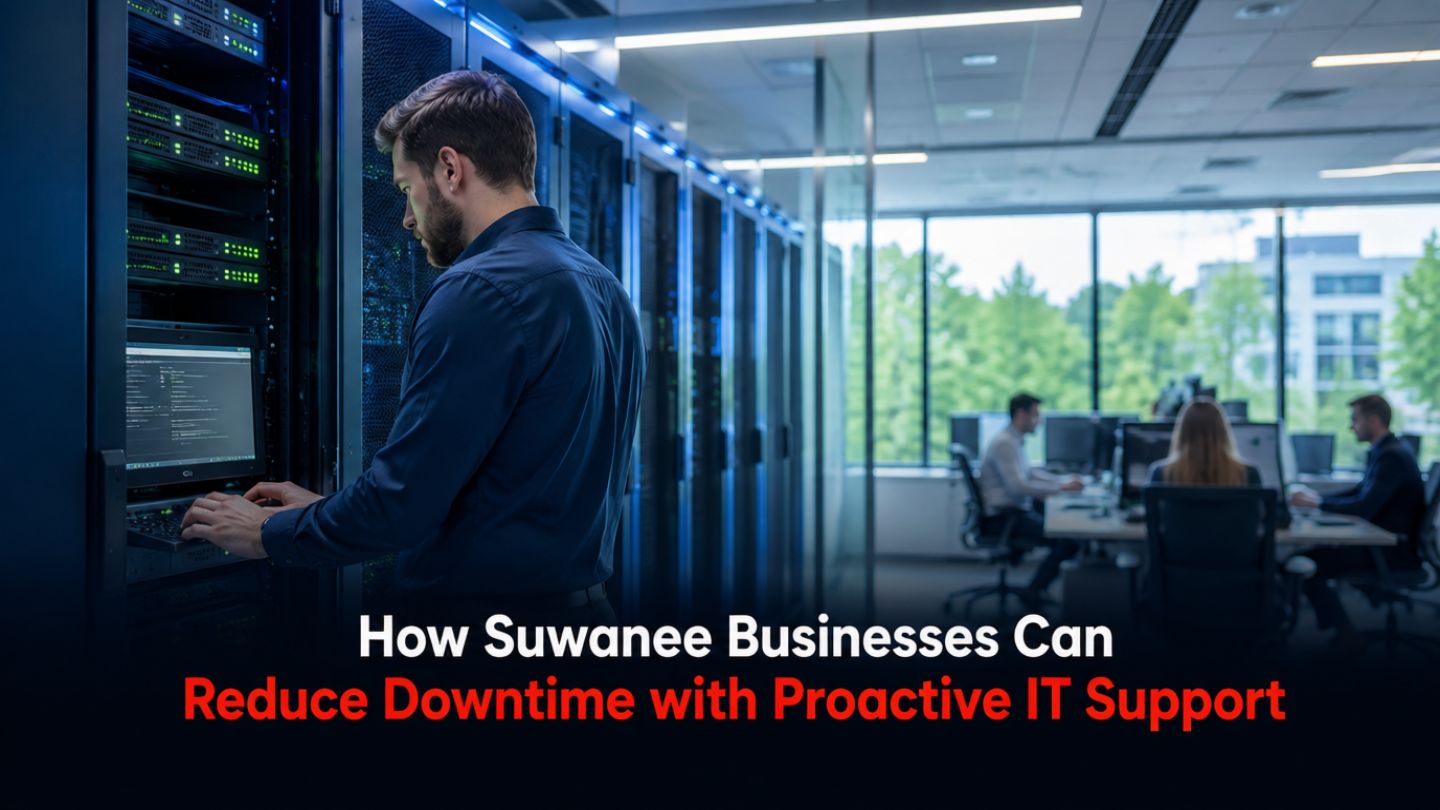
In Suwanee’s growing business community-where healthcare providers, financial firms, legal practices, and professional services compete for clients-those numbers add up fast. Understanding how Suwanee businesses can reduce downtime with proactive IT support is no longer optional; it’s a strategic necessity. Proactive IT support can reduce downtime by up to 80%, transforming unreliable systems into a foundation for business growth. This article covers the core strategies, technologies, and implementation steps that help local businesses shift from costly disruptions to operations running smoothly around the clock. In a market where reliability provides a genuine competitive edge, proactive IT management separates thriving businesses from those stuck in constant firefighting mode.
Key Takeaways
- Proactive IT monitoring can reduce system downtime by up to 75–80% compared to reactive approaches, saving Suwanee SMBs tens of thousands of dollars annually.
- Continuous monitoring and preventive maintenance catch critical issues before they disrupt business operations or cause data loss.
- Automated patch management and security updates close security vulnerabilities without interrupting daily workflows.
- Strategic IT planning aligns technology investments with business goals, preventing capacity shortfalls and obsolescence.
- Managed IT services provide 24/7 expertise and system monitoring without the overhead of full-time internal IT teams.
Understanding Proactive IT Support and Its Impact on Downtime
Proactive IT support is a fundamentally different philosophy from the traditional reactive “break-fix” model. Where reactive support waits for system failures to occur and then scrambles to repair them, proactive support focuses on continuous monitoring, scheduled maintenance, automated patching, and strategic planning to identify and resolve issues before they ever impact operations. Proactive support aims to eliminate the root causes of downtime rather than simply treating symptoms after the damage is done.
This proactive approach transforms IT management from a cost center into a business enabler. Organizations adopting proactive support report 72% fewer unplanned outages within six months compared to reactive models. In practical terms, that means uptime improves from around 94.2% under reactive management to 99.5% or higher-reducing annual downtime from roughly 500 hours to approximately 44 hours. For a Suwanee business that depends on its IT systems to serve clients, process transactions, or manage patient records, that difference is transformational.
Early detection is the mechanism that makes this work. Remote monitoring and management tools installed across endpoints, servers, and network devices continuously track system performance metrics like CPU utilization, disk health, memory usage, and network latency. When a hard drive begins showing degraded sectors or a server’s CPU usage trends steadily upward, alerts fire before the system crashes. Proactive IT support minimizes downtime by addressing issues early, often before any employee even notices a problem. The shift from firefighting IT problems to preventing them entirely is what makes proactive solutions so valuable for growing businesses.
Core Components of Proactive IT Support That Prevent Downtime
Effective proactive IT support isn’t a single tool or service-it’s an integrated system of technologies and processes that work together to keep IT infrastructure healthy and resilient. Here are the essential components that directly reduce downtime:
- Remote Monitoring and Management (RMM): Real-time system monitoring agents deployed across all endpoints, servers, and network devices report health metrics to a centralized dashboard. Modern RMM platforms provide automated alerting when thresholds are approached, enabling technicians to intervene before failures occur. Continuous network monitoring tracks server health and bandwidth usage, ensuring nothing slips through the cracks.
- Automated Patch Management: Automated patching closes security vulnerabilities without workflow interruptions. Security patches and operating system updates are deployed on controlled schedules-typically during maintenance windows-so that known vulnerabilities don’t become entry points for attacks or causes of system instability. Regular security updates help prevent cyberattacks and unauthorized access.
- Backup and Disaster Recovery (BDR): The 3-2-1 backup rule requires 3 copies of data on 2 different media types with 1 copy offsite. Proactive managed IT service providers implement automated backups with regular verification, ensuring that data backup and recovery processes actually work when needed. Disaster recovery plans should include regular testing of backup capabilities-not just assuming backups are functioning.
- Security Monitoring and Threat Detection: Endpoint detection and response (EDR), intrusion detection systems, vulnerability scanning, and dark web monitoring form a layered defense against potential cybersecurity threats. This approach protects sensitive data and prevents security-related downtime from data breaches or malware infections.
- Strategic Planning and vCIO Services: Regular technology roadmap planning ensures IT assets are replaced before end-of-life, cloud services scale with demand, and compliance requirements are met proactively. Business impact analysis guides smart technology decisions, aligning IT investments with business objectives.
- Employee Training: Many downtime events begin with human error-phishing clicks, misconfigured credentials, accidental deletions. Proactive cybersecurity training reduces risks from phishing attacks, while access controls and multi-factor authentication limit the blast radius of mistakes.
Read More: The Role of Multi-Factor Authentication in Preventing Cyberattacks
Implementing Proactive Monitoring and Maintenance Strategies

Moving from reactive to proactive IT support follows a structured path. Here’s how Suwanee businesses can deploy proactive monitoring and reduce unexpected downtime systematically:
- Start with an IT health assessment: Inventory all endpoints, servers, network devices, and cloud services. Map dependencies between systems. Assess current patch levels, backup status, and security gaps. Regular system audits ensure network bandwidth and processing power meet business demands. This baseline reveals where the greatest risks lie and where proactive solutions will deliver the fastest impact.
- Deploy comprehensive monitoring tools: Implement an RMM system covering all critical IT assets—servers, workstations, network equipment, and supported cloud resources. A unified dashboard gives technicians centralized visibility into device health, capacity, performance, and alert conditions. When escalation thresholds and response procedures are configured correctly, continuous monitoring can identify developing issues earlier and shorten diagnosis and resolution times compared with waiting for users to report a failure.
- Standardize preventive maintenance schedules: Establish regular cadences for server OS updates, firmware patches, storage health checks, and hardware refresh cycles. Proactive hardware lifecycle management tracks performance and schedules replacements before failure. Predictive maintenance helps replace failing parts before unexpected downtime, using advanced analytics and AI-assisted anomaly detection to identify trends that precede failures-like rising disk I/O error rates or memory leaks.
- Automate routine tasks: Automation of IT processes reduces manual errors and increases efficiency. From patch deployment to backup verification to alert routing, automating routine tasks frees IT resources to focus on strategic work while reducing human error across the board.
- Measure and report results: Measuring downtime provides metrics to improve IT service effectiveness. Track KPIs including uptime percentage, MTTR, patch compliance rate, number of incidents prevented, and the ratio of planned versus unplanned work. Many proactive IT programs show visible improvement in downtime, ticket volumes, and patch compliance within 3 to 6 months, with ROI over three years commonly falling between 150% and 400%.
Strengthening Cybersecurity to Prevent Security-Related Downtime
Cyberattacks are among the most devastating causes of unplanned downtime, and proactive security measures are essential to any strategy aimed at reducing downtime. With data breaches reaching 3,158 compromises in 2024 and ransomware outages averaging 24 days, businesses that treat cybersecurity reactively are accepting enormous risk.
A proactive strategy for protecting against cyber threats includes deploying endpoint detection and response tools, conducting monthly vulnerability scans, and implementing intrusion detection systems that flag suspicious activity in real time. Dark web monitoring watches for compromised credentials, while regular phishing simulations test and improve employee awareness, reducing risks from the human error that initiates many security incidents.
Proactive IT support includes continuous monitoring for early threat detection, but technology alone isn’t enough. Employee training is a key aspect of any security program, because the most sophisticated security tools can be bypassed by a single careless click. Combining technical controls with ongoing education creates the security culture that keeps systems running smoothly.
Every business also needs a documented incident response plan that defines roles, communication protocols, and recovery procedures. When combined with tested disaster recovery capabilities and business continuity planning, these preparations ensure that when something does get through, the response is rapid and the disruption minimal. Proactive IT support includes strategic planning for long-term stability, not just immediate threat prevention.
Read More: Why Reliable IT Support Is Critical for Business Continuity
Benefits of Partnering with Managed IT Services for Proactive Support

For many Suwanee businesses, staffing an internal IT department for continuous monitoring, cybersecurity, help desk support, and strategic planning is not practical or cost-effective. The choice between co-managed IT vs. managed IT services depends on whether the business already has internal IT staff and where additional coverage or expertise is needed. A managed service provider can supply enterprise-grade monitoring tools, security expertise, and strategic guidance at a predictable monthly cost, while managed IT services for technical resource gaps can supplement limited internal resources without requiring several full-time hires.
The key benefits are substantial and measurable:
- More predictable costs: Proactive IT support can reduce financial risk by replacing unpredictable emergency work with planned maintenance, lifecycle management, and a more consistent monthly service model. The actual savings depend on the business’s size, technology environment, outage history, labor costs, and operational dependencies. A useful cost comparison should include service fees, internal labor, lost productivity, missed revenue, recovery expenses, and the business impact of delayed customer service.
- Enhanced employee productivity: Proactive IT support reduces interruptions that keep employees from accessing email, files, business applications, and communications tools. Fewer disruptions can protect billable time for professional-services firms, support appointment schedules for healthcare practices, and reduce frustration throughout the organization. Law firms considering managed IT services for law firms can also use proactive monitoring, security, and support to protect access to case files and client communications.
- Scalability for growth: Proactive IT strategies enhance efficiency and scalability. As Suwanee businesses grow, proactive support ensures that IT infrastructure scales alongside them-through capacity planning, cloud services optimization, and network performance management. This prevents the growing pains that often cause costly downtime during expansion.
- Compliance and security support: Businesses in regulated industries can use managed IT services to help maintain technical safeguards and documentation relevant to frameworks and regulations such as HIPAA, PCI DSS, and SOX. Industry regulations assign different responsibilities to each organization, so automated monitoring, periodic assessments, documented controls, and remediation support should be coordinated with legal, compliance, and business leadership. These services can improve audit readiness, but they do not guarantee compliance by themselves.
- 24/7 expertise without full-time overhead: Managed service providers can offer around-the-clock monitoring, help desk support, remote troubleshooting, and on-site service options that would otherwise require multiple internal hires. Coverage varies by provider and service agreement, so businesses should confirm monitoring hours, response targets, escalation procedures, after-hours support, and on-site availability before signing a contract. Well-defined coverage helps ensure that critical issues are detected and routed appropriately outside normal business hours.
Why Choose IntegriCom for Proactive IT Support in Suwanee
IntegriCom, Inc. provides managed IT services and proactive support for businesses in Suwanee and across the Atlanta area. Founded in 2000, our team combines technical expertise with a relationship-focused approach built on integrity and long-term client partnerships. Our core values guide how we work: be selfless in serving clients and one another, remain relentless about improving, operate with professional and unassuming confidence, and joyfully do the right thing regardless of the circumstances.
We understand that every minute of downtime can impact your bottom line. That’s why IntegriCom offers comprehensive support services designed to minimize disruptions and avoid costly downtime. Our approach includes regularly monitoring your entire IT environment, optimizing system performance, and implementing robust data backup and disaster recovery plans that follow industry best practices like the 3-2-1 backup rule.
Our team helps clients address security risks through continuous threat monitoring, automated patch management, and employee cybersecurity awareness training. We also support the technical safeguards and documentation that may be relevant to requirements such as HIPAA, PCI DSS, and SOX. Because compliance depends on each organization’s policies, processes, data, vendors, and legal obligations, our role is to help clients strengthen controls, document their environment, and prepare more effectively for assessments and audits.
By partnering with IntegriCom, you bring business operations under expert care, leveraging scalable solutions that grow with your company. Our managed IT services provide predictable monthly costs and access to elite IT professionals without the overhead of a full-time internal team. Whether you need strategic IT planning, cloud services, or rapid on-site support, IntegriCom is your reliable ally in achieving seamless, secure, and efficient IT operations.
Experience the difference of proactive IT support that truly supports your business goals. Contact IntegriCom today to learn how we can help reduce downtime and empower your Suwanee business to thrive.
Keep Your Suwanee Business Running Without Disruptions

Proactive IT support helps Suwanee businesses reduce downtime by identifying potential issues before they become costly disruptions. Regular monitoring, system maintenance, security measures, and responsive support create a more stable technology environment. With fewer unexpected problems, businesses can maintain productivity, protect operations, and focus on serving customers and growing their organizations.
IntegriCom helps businesses improve reliability with managed IT services in Suwanee tailored to their users, systems, and business priorities. Our network services, co-managed IT services, telephony, and cloud services help organizations maintain dependable technology and reduce interruptions. Contact us to schedule a free IT consultation to identify risks in your current environment and discuss a practical plan for improving uptime, security, and support.
Frequently Asked Questions
What is the difference between proactive and reactive IT support for reducing downtime?
Proactive IT support focuses on continuous monitoring, preventive maintenance, and early detection so potential problems can be addressed before they disrupt operations. Reactive support begins after something breaks, often after employees have already lost access to the systems they need. Over time, a preventive approach can reduce recurring incidents, shorten recovery time, and make IT costs more predictable, while a reactive model tends to produce repeated downtime and emergency repair expenses.
How quickly can proactive IT monitoring detect and resolve issues before they cause downtime?
Modern monitoring tools can detect many warning signs as soon as configured thresholds or unusual activity are identified, often before users report a problem. Automated remediation may resolve certain routine conditions, while more complex issues require technician review and escalation. Detection and resolution times depend on the system involved, the quality of the monitoring configuration, the severity of the issue, and the support agreement in place.
How does proactive IT support help Suwanee businesses maintain compliance and security?
Proactive IT support can help Suwanee businesses maintain security and support compliance efforts through vulnerability scanning, patch management, access controls, backup testing, logging, and documented incident response procedures. For organizations subject to HIPAA, PCI DSS, SOX, or other requirements, these technical measures should be mapped to the organization’s specific obligations and reviewed alongside administrative, physical, contractual, and legal responsibilities. Regular evidence collection and testing can improve audit readiness, but no monitoring platform can guarantee compliance without broader organizational oversight.
Can small businesses in Suwanee afford comprehensive proactive IT monitoring services?
Yes. Managed IT services are designed to scale with business size, so small businesses access the same enterprise-grade monitoring tools and expertise as larger organizations without the cost of building internal IT teams. Because proactive support prevents costly disruptions rather than reacting to them, the investment typically pays for itself through avoided downtime, reduced emergency costs, and improved employee productivity. Businesses can save costs by preventing major IT issues with proactive support rather than absorbing repeated outage losses.
How long does it take to implement proactive IT monitoring and see downtime reduction results?
Initial setup-including the IT health assessment, monitoring tool deployment, and baseline configuration-typically takes a few weeks. Most businesses see meaningful improvements in patch compliance, ticket volumes, and uptime within 3 to 6 months. Strategic ROI, including cost savings from avoided outages and improved system performance, generally becomes fully apparent over 12 to 18 months as the proactive strategy matures and optimization continues.